





ADL Arizona’s Annual Essay Contest

1st place prize: $2,500
2nd place prize: $1,500
3rd place prize: $1,000
Submission Deadline: March 25th, 2022 by 12:00PM
Submit Your Essay
Background:
In 2020, the Arizona legislature passed House Bill 2241. The bill requires that all Arizona students receive education on the Holocaust and other genocides during their K-12 education at least twice between seventh and twelfth grade.
“This bill works to educate our youth on the atrocities of the Holocaust and other genocides. Tragedies like this must never be allowed to happen again,” said Gov. Doug Ducey on signing the landmark legislation.
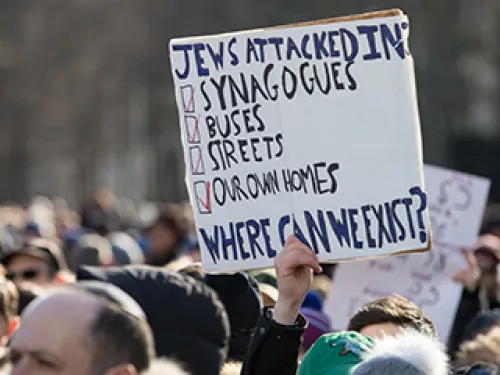
The legislation is in response to a troubling increase in antisemitism locally and globally. According to the ADL, more than 2,000 incidents of antisemitism have been reported across the country in the last two years, and in Arizona specifically – 22 incidents in 2020 (up 16% from 2019) and 26 incidents in 2021 (up 18% from 2020), some of the recent include Tucson at the Chabad Center, ASU campus in Tempe, Queen Creek and Chandler.
Write an essay on how Holocaust education can help to develop the moral courage to respond when incidents of hate and antisemitism occur in our communities.
Before You Start Writing:
Step One:
Read the speech by Miep Gies, honored as “Righteous Among the Nations” at Yad Vashem in Israel, for helping to hide Anne Frank and her family during the Holocaust. Miep exemplifies the moral courage of those who stand up to hate and injustice.
Step 2:
Listen to at least two of the following interviews from Holocaust survivors living in Arizona. Learn from their experiences during the Holocaust of how they survived through their own moral courage, strength, determination and that of others who helped them. Please read their short bios for context before watching their testimonies.
-
Survivor Testimony #1 – Oskar Knoblauch, Holocaust Survivor
- My name is Oskar Knoblauch. I was born in Leipzig Germany in 1925. In 2010 I self-published my book, A Boy’s Story A Man’s Memory-Surviving the Holocaust 1933-1945.
I am currently an active speaker and a member of the Phoenix Holocaust Survivors Association. My campaign urges students, teachers and adults of all ages to proactively teach and promote Holocaust education. I also stress the importance of respect, tolerance and to be an upstander… to stand up and speak out for what is right!
Together, I believe we can work in harmony to be the voice of tolerance in our hearts, our communities, our country and the world!
- My name is Oskar Knoblauch. I was born in Leipzig Germany in 1925. In 2010 I self-published my book, A Boy’s Story A Man’s Memory-Surviving the Holocaust 1933-1945.
-
Survivor Testimony #2 – Oskar Knoblauch, Holocaust Survivor
- My name is Oskar Knoblauch. I was born in Leipzig Germany in 1925. In 2010 I self-published my book, A Boy’s Story A Man’s Memory-Surviving the Holocaust 1933-1945.
I am currently an active speaker and a member of the Phoenix Holocaust Survivors Association. My campaign urges students, teachers and adults of all ages to proactively teach and promote Holocaust education. I also stress the importance of respect, tolerance and to be an upstander… to stand up and speak out for what is right!
- My name is Oskar Knoblauch. I was born in Leipzig Germany in 1925. In 2010 I self-published my book, A Boy’s Story A Man’s Memory-Surviving the Holocaust 1933-1945.
-
Survivor Testimony #3 – Marge Rich, Holocaust Survivor
- Marge Rich is a Holocaust survivor, and was born, Margit Zsupnyik, on December 13, 1937 in Vienna, Austria. Suddenly and abruptly, life changed under Nazi occupation. Marge’s childhood and adolescence was stripped as she and her family fell victim to Nazi persecution and sent, by cattle car to Theresienstadt Concentration Camp, where she can recall horrible memories of the atrocities committed by the Nazis. Today, Marge is retired and lives in Sun City, Arizona, after a lengthy career as a local small business owner and entrepreneur.
-
Survivor Testimony #4 – Charlotte Adelman, Holocaust Survivor
- Charlotte Adelman was 9 years old and living in Paris when the Nazis invaded in 1940. She and her brother were given away to an orphanage by her parents, who were told by the Nazis that they had to go work at a “camp.” Instead, they were put on a truck that was headed to Auschwitz, where her mother, the motivation for Charlotte’s own survival, was killed. Adelman’s father escaped but her mother stayed on the truck, fearing she’d be killed and never see her children again if she ran away. Adelman’s brother was sent to the hospital due to scarlet fever, and she was adopted by a woman who was later known to be selling children to the Nazis. Her father successfully located her and made arrangements to bring her to the Quatreville family in Beaumont du Argonne. The Quartreville family, recognized by Yad Vashem as Righteous among the Nations, agreed to take her in and hid her in a cellar, with a mattress and a lamp. Charlotte spent 9 months in the dark basement. After the war, Charlotte stayed with the Quatrevilles for another six months, as her father fought to find her brother and piece their lives back together.
- Survivor Testimony #5 – Alexander Bialywlos, Holocaust Survivor
- Born Alexander Bialywlos (Polish for White) in 1923, Dr. White grew up in the town of Krosno, Poland. He was 14 years old, on September 1, 1939, when the Nazis invaded Poland and began their reign of terror. His father’s last words as they were taking him to the gas chambers at Auschwitz Concentration Camp, were to be a Mensch, which is Yiddish for “a special, ideal human being: a person endowed with the finest attributes by Our Creator, including charity, kindness, tolerance, honesty and love of mankind.” Dr. White spent more than a year in several camps, including Krakow-Plaszow and Gross-Rosen, before moving to one of the camps where Oskar Schindler saved thousands of Jews by employing them in his factories. Following the war, Alex was aided by several Jewish organizations, studied medicine in Munich, and came to America in 1950. He immigrated to Chicago after the War ended and became a successful doctor and medical school professor. In Chicago, Alex met his wife, Inez, and joined the US Army, having served in the Korean War. To date, Dr. White continues to promote Holocaust education by teaching students not to be indifferent, to get an education, and to be a Mensch.
Essay Prompt:
Drawing on the sources above, write an essay on why learning about the Holocaust – in the words of those who suffered the atrocities of the Nazis campaign to destroy the Jews and others, and the words of those who put their own lives at risk to help them – helps you to respond to antisemitism and hate in your school and your community with moral courage, and what skills or attributes are needed to do that.
Consider one or more of the following questions to guide your writing:
- How does learning about the Holocaust help make you an upstander rather than a bystander, or as Gies shares, someone who does the right thing?
- How do we relate Moral Courage and the atrocities of the Holocaust to today’s world? Make connections rather than comparisons when answering this question. We always want to avoid comparing horrific events from history to today, since it can belittle and devalue the pain, harm and experience of those who survive.
- Examine Moral Courage and relate it to the idea that “Nothing changes for the better, if we don’t change it.”
- Defend the value of Holocaust Education as being essential for building a more just and inclusive society through Moral Courage. How does Moral Courage help in responding to hate and antisemitism in our communities?
Essay Guidelines:
- Students must be in grades 9-12 and attend an Arizona high school
- Essays should be a minimum of 350 words and a maximum of 750 words
- Each contestant may submit one essay
- All work must be 100% original – no plagiarism
- If using quotes or citations, please include a Works Cited page
- Please DO NOT include your name or school name on your essay. Each essay will be assigned a number that corresponds to your entry. This allows essay readers to not know the identity of each writer, which allows us to read essays without implicit bias.
- Please submit your essay by 12pm on March 25th. Essays submitted after the deadline will not be considered.
- Essays will be read by a panel of judges and scored based on a rubric:
- 30% connection to essay prompt
- 30% demonstrates strong understanding of moral courage
- 10% demonstrates understanding of high-school level writing and grammar
- 10% references provided sources
- 20% demonstrates creativity
- Essay winners will be announced on Monday, April 25th
Please email [email protected] with any questions.
Submit Your Essay
Thank you to our community partners:


