







Getty Images
Antisemitism in K-12 schools has become a pressing national concern, with 1,162 antisemitic incidents recorded in 2023 and 860 antisemitic incidents recorded in 2024 in K-12 schools alone, according to recent data from ADL’s annual Audit of Antisemitic Incidents. Since 2020, incidents at K-12 schools have spiked by an alarming 434%. In light of the persistently high rates of antisemitic incidents in K-12 schools, ADL’s Ratings and Assessments Institute (RAI) and Ronald Birnbaum Center to Combat Antisemitism in Education (CCAE) launched a new initiative to examine antisemitism within non-Jewish independent/private K-12 schools, henceforth referred to as independent K-12 schools. Independent K-12 schools were selected as the subject of the research as they operate outside of the direct oversight of public education systems, meaning they typically have greater autonomy in shaping their curricula, policies, and disciplinary procedures, which can lead to inconsistent responses to antisemitism. By examining this specific sector, we aim to highlight unique challenges and identify gaps in accountability, reporting and education that may not be as visible in public schools.
To kick off this initiative, RAI and CCAE conducted focus groups and a survey of parents of Jewish children who attend independent K-12 schools. We recruited participants through ADL’s established networks, including its 25 regional offices, which maintain connections with Jewish stakeholders and community leaders throughout the country. This study aimed to assess the independent school climate for Jewish students amidst heightened tensions due to the Israel-Hamas conflict and identify methods to better support Jewish students and their families in these settings. The findings, detailed in this report, highlight the urgent need to protect Jewish students in independent K-12 schools and foster an inclusive and safe educational environment for all.
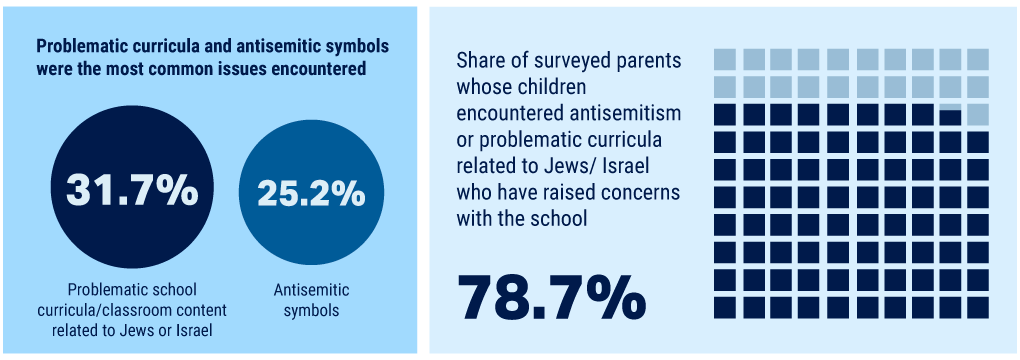
1. Swastikas and biased curricula are prominent issues in independent K-12 schools. Focus group participants recounted their children’s experiences with swastikas and problematic classroom content related to Zionism, Israel, and Jews in school. Survey data further highlighted the extent of these issues: among surveyed independent school parents, 25.2% said their child(ren) had experienced or witnessed antisemitic symbols in school since October 7, 2023. Beyond just this type of antisemitism, 45.3% of surveyed parents reported that their children had experienced or witnessed some form of antisemitism since October 7, 2023. In addition, 31.7% said their child(ren) had experienced or witnessed problematic school curricula or classroom content related to Jews or Israel.
The alarming frequency and nature of these experiences point to a pressing need for schools to take urgent action. Schools must thoroughly vet educational materials; clearly prohibit all forms of antisemitic harassment and intimidation; raise awareness of the varying manifestations of antisemitism, including the use of antisemitic symbols; and implement critical reforms to ensure that Jewish identity and Israel-related topics, including the definition and history of Zionism, are approached with accuracy, balance and respect. Without such safeguards, classrooms risk becoming sources of harm rather than learning.
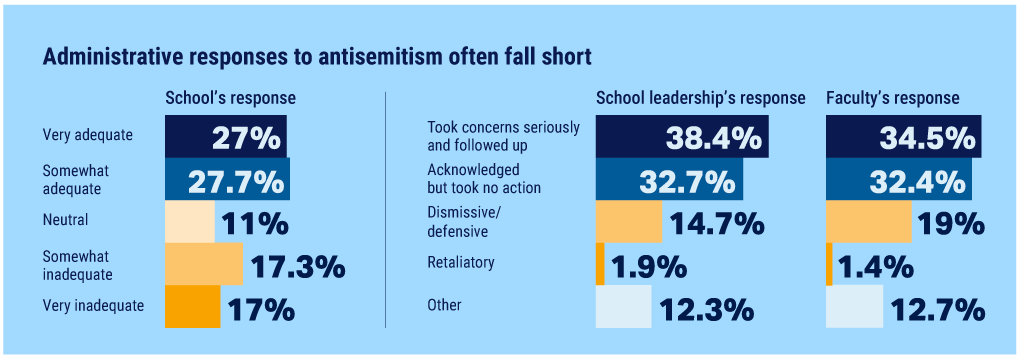
2. Parents believe independent school responses to antisemitism fall short. In focus groups, parents recounted many challenges with school administration when it came to addressing antisemitism, such as schools being unwilling to take a stance on antisemitism or school leadership trying to convince parents that their concerns of antisemitism were isolated cases when this was not in fact accurate. Our survey data also revealed concerns of insufficient school response to antisemitism. Of the parents surveyed who were aware of antisemitism in their children’s school, 34.3% said the school’s response was either somewhat or very inadequate.
3. Antisemitism is underreported to school leadership and faculty at independent schools. A substantial percentage (21.3%) of surveyed independent school parents who said their child(ren) had experienced or witnessed some form of antisemitism or encountered problematic school curricula or content related to Jews or Israel in school since October 7, 2023, had not raised concerns about antisemitism with school leadership or faculty. This finding suggests that while many parents do report antisemitism to the school, a noteworthy fraction of antisemitic experiences go unreported. Additionally, given that parents’ ability to report antisemitism to the school relies on their children both identifying and informing them of these issues, underreporting of antisemitic experiences in K-12 schools is of great concern. This issue of underreporting of antisemitism to independent school administration reflects a broader ADL concern that antisemitism may go unreported, suggesting an urgent need to identify the factors that discourage and inhibit people from reporting antisemitism at large.
4. Current non-discrimination programming & DEI frameworks are failing to include Jewish identity. In focus groups and open-ended survey responses, parents voiced widespread concern that current non-discrimination programming and DEI frameworks systematically ignore Jewish identity and antisemitism. This omission not only erases the experiences of Jewish students and families but also undermines the core mission of non-discrimination programming and DEI. Far from being a minor oversight, parents see this as a fundamental flaw – one that allows bias to go unchallenged and signals to their children that their identity does not matter.
5. Jewish families are feeling pushed to the margins in independent schools. During the focus groups, parents described a growing fear that, while legally permitted to enroll in independent schools, Jewish families are being excluded in practice – made to feel like outsiders within institutions they are paying to attend. Without meaningful change, independent schools risk becoming spaces where Jewish students are technically included but culturally and socially marginalized, eventually leading to their quiet disappearance from these communities. This is a trend already beginning to show in enrollment patterns.
In light of the persistently high rates of antisemitic incidents witnessed in K-12 schools across the U.S., ADL – through its Ratings & Assessments Institute (RAI) and Center to Combat Antisemitism in Education (CCAE) – conducted an in-depth study of antisemitism within non-Jewish independent/private schools during the spring of 2025. While antisemitic incidents in non-Jewish public and independent/private K-12 schools decreased in 2024, Jewish students in these settings continue to face troubling levels of antisemitism, with 860 incidents logged by ADL in 2024, representing 9% of all antisemitic incidents recorded that year nationwide. Given the insidious nature of bullying, along with the fact that many children may not feel empowered or aware of how or where to report their experiences, the actual number of K-12-based antisemitic incidents was likely higher than the figures recorded by ADL.
The historical exclusion of Jews from educational spaces – including elite independent schools – is a well-documented phenomenon, rooted in centuries of systemic discrimination and prejudice. Despite significant strides towards inclusivity, Jewish students continue to face antisemitism and marginalization within independent schools today. This persistent issue not only undermines the educational experience of Jewish students but also perpetuates a cycle of marginalization and exclusion that has long been a part of their history.
This report sheds light on the experiences of Jewish families[1] who have been sidelined and subjected to discrimination within the independent school sector. Despite the prevalence of antisemitism, there is a notable lack of public data or research specifically addressing this issue in independent schools. This gap in knowledge hinders the ability of educators, policymakers, and community leaders to effectively address and combat antisemitism in these environments. By understanding the perspectives of Jewish families, this report takes a preliminary step toward filling that gap.
In addition to increasing understanding of the challenges Jewish families face in independent schools, this study aims to equip parents, caregivers, school leaders, educators, and policymakers with data to inform actionable steps and encourage greater accountability and safeguards within the sector. By providing detailed accounts and analyses, the report seeks to empower stakeholders with the information needed to implement meaningful changes, promoting inclusivity, equity, and respect for all students. Independent schools have a duty to ensure safe, inclusive environments for all students and staff by actively preventing and confronting antisemitism – and by holding both individuals and themselves fully accountable for any form of discrimination.
Through increased awareness, informed action, and an unwavering commitment to accountability, we can build educational systems where antisemitism is no longer a barrier to personal growth and professional success. However, continued failures to address exclusionary practices risk driving Jewish families out of independent schools altogether. When Jewish students and their families are made to feel unwelcome or unsupported, they are left with little choice but to seek education elsewhere – a phenomenon we are beginning to witness more and more.
This pattern of exclusion not only undermines the integrity of these institutions – it also sends a clear and damaging message: that Jewish families do not belong.
We used a mixed-methods approach, combining focus group and survey data to generate insights into the experiences of Jewish families within independent schools. We conducted focus groups with parents of Jewish independent school children in New York City, Chicago, California (Los Angeles and San Francisco areas/regions), and Washington D.C./Maryland suburbs, during which participants were asked a series of open-ended questions about the types of antisemitism their children have experienced in school, the school’s response to antisemitism, and what resources could help them feel better equipped to advocate for their children, among others. Three focus groups were conducted in person and one was conducted virtually. Rather than impose specific language for parents to use by requiring them to respond to closed-ended prompts, the open-ended and semi-structured format of the focus groups gave parents the ability to respond organically and in their own words to provide insight into the nature of antisemitism in independent schools.
To supplement the focus group data, we conducted a survey of parents of Jewish independent/private school children. The survey eligibility criteria described eligible participants as, “at least 18 years-old and are the parent or guardian of one or more Jewish children in any grade from kindergarten to 12th grade who is enrolled in an independent/private school in the U.S. that is NOT formally designated as a Jewish day school or yeshiva.” For simplicity and because guardians serve parental roles, we refer to survey respondents as “parents.”
The survey asked a combination of closed-ended and open-ended questions on the same core topics as the focus groups. To recruit respondents, the survey was distributed through ADL’s established networks, including its 25 regional offices, which maintain connections with Jewish stakeholders and community leaders throughout the country. We also used connections from other ADL leadership groups and the connections of parents recruited to focus groups to reach additional survey respondents. As a result, we were able to achieve an analytical sample size of 369 parents of Jewish children who attend non-Jewish independent/private schools in the U.S. who completed the survey. Our extensive efforts to reach eligible respondents throughout the U.S. are reflected in the composition of our survey sample – respondents had children in independent/private schools that spanned 21 different states and the District of Columbia.
The demographic breakdown of the survey sample is as follows: 81% of respondents were women, 18.7% were men, and 0.27% identified as some other way in terms of gender; 56.1% identified as a Democrat, 28.5% as Independent, 10.6% as a Republican, and 4.9% as other/something else in terms of political partisanship; and while 91.1% of respondents did not receive scholarship funding for their children to attend their independent school, the remaining 8.9% of respondents did receive scholarship funding.
In addition to recruiting survey respondents through ADL networks and trusted partners, we took several other approaches to maximize data quality and integrity in our survey. First, at the start of the survey, we clearly stated the eligibility criteria for participation in the survey and asked respondents to confirm that they met the eligibility criteria. Second, we included an attention check question in the survey to help weed out bots and ensure attentiveness of actual respondents during survey completion. Furthermore, we implemented several of Qualtrics’ security features to further scan for bots and duplicate responses. In accordance with Qualtrics’ established thresholds for determining whether a response is likely that of a bot or the duplicate submission of an existing respondent, we removed responses from the survey, leaving us with an analytical sample of 369 valid survey submissions.
Because we used snowball sampling to recruit participants for both the survey and the focus groups, our results cannot represent the full population of parents of Jewish children in independent/private schools. Additionally, parents with children who attended different independent/private schools may have focused their survey responses on only one of the schools or on their generalized experience across the different schools, as they were instructed in the survey, “If you have children at more than one independent/private school, please respond based on your overall experience across the different schools.” Furthermore, since the unit of analysis is parents, it is possible that more than one parent of a given child(ren) responded to the survey and so the school experience of the same child(ren) may be accounted for more than once in the survey. Finally, due to sample size limitations, we were not able to test for meaningful differences in results by child grade level and region, but we hope to examine these differences in future research.
Despite these limitations, our results still shed light on key ways that antisemitism presents itself in these school contexts and illuminate how advocates can better support Jewish families in independent schools. We view this report as preliminary, exploratory, and a launching point for future research and advocacy.
Figure 2 shows the percentage of survey respondents who responded that their child(ren) had experienced or witnessed a given type of antisemitism at their school since October 7, 2023. 45.3% of surveyed parents indicated that their child(ren) had experienced or witnessed at least one of these forms of antisemitism since October 7, 2023.
Since the forms of antisemitism that respondents could select from were pre-specified in the survey, and since we limited the time frame to “since October 7, 2023,” it is likely that 45.3% is a conservative estimate of the percentage of surveyed parents whose children have experienced or witnessed antisemitism at school. Responses to a different survey question suggest that our limiting of the time frame and of the forms of antisemitism may indeed make this a conservative estimate of the prevalence of antisemitism within independent schools. On a survey question where we asked respondents to indicate how they would characterize the school’s overall response to antisemitism, one of the response options was to say “Not applicable (no incidents).” Of the full sample of 369 survey respondents, only 13.8% selected the “Not applicable (no incidents)” response option, suggesting that the vast majority of respondents had some level of concern with antisemitism at their children’s school.
The most common form of antisemitism that respondents’ children had experienced or witnessed at school was antisemitic symbols (25.2%). The prevalence of this type of antisemitism aligned with findings from ADL’s 2024 Audit of Antisemitic Incidents, which found over half (52%) of the incidents recorded in all K-12 schools included one of the most recognizable and hateful antisemitic symbols – the swastika.
Beyond manifestations of antisemitism, encounters with problematic school curricula/classroom content related to Jews or Israel were also common, with 31.7% of surveyed parents reporting such experiences.
Concerns regarding antisemitic symbols and problematic school curricula/classroom content related to Jews or Israel were also commonly described in the focus groups with independent school parents. A New York-based parent described a situation where the school curriculum itself included the use of antisemitic symbols: “On Holocaust Remembrance Day, the seventh-grade history department decided to do a lesson about how the swastika isn't only a hateful symbol...That was a Holocaust Remembrance lesson.” The swastika has served as one of the most prominent hate symbols since 1945. Its depiction by the school as a not fully hateful symbol on Holocaust Remembrance Day demonstrates a clear failure on the part of the department to understand the symbol’s significance and the deep trauma it represents for Jewish people.
A number of parents also described cases where swastikas or other antisemitic symbols/slogans were drawn or posted on school property. For instance, a California-based parent explained, “Some desks were carved with swastikas in a history classroom.” As one New York-based parent described, “There was writing on the school saying, ‘Free Palestine from the river to the sea.’” Participants in the D.C./Maryland suburb focus group also mentioned the presence of swastikas in their children’s schools. As one parent recounted, “At our school, we’ve had multiple inciden[ts]. We’ve had swastikas on the desks, swastikas on the walls.”
In addition to describing the case of a school teaching about the alternate meanings of the swastika on Holocaust Remembrance Day, focus group participants revealed other cases in which school curricula or classroom activities involved troubling content related to Jews, Zionism, and Israel. For example, a California-based parent reflected in their focus group that: “On October 8, both faculty and students celebrated publicly the massacres, both in emails and in classrooms.”
Parents also reported antisemitic rhetoric being expressed by students, as well as teachers. As a Chicago-based parent recounted, “In [my daughter’s] classroom, a child said that...Israel deserved what happened to them. They asked for it.” Focus group participants expressed that antisemitic rhetoric has been present in school even before October 7, 2023. As one New York-based parent described, “I think this was pre-October 7th, but my son's friend was speaking with another boy. They were joking around a little bit, but the other boy said something to my son's friend, something like, ‘They're going to put you back in the oven.’”
Beyond problematic school curricula and antisemitic symbols, survey respondents and focus group participants indicated that their children had experienced other issues related to their Jewish identity in school. For instance, a focus group participant described a case of a child being blamed for Israel’s actions and receiving antisemitic verbal harassment: “We've had kids called Kike on the playground, numerous kids. We've had--my child and another child followed around after October 7th with a phone in their face saying, you're genocidal, your people are genocidal.”
The presence of antisemitism in independent schools translates into a culture in which not all Jewish students feel fully comfortable expressing their Jewish identity in school. Figure 3 shows that while 64% of surveyed parents reported that their children feel very comfortable showing their Jewish identity in school, the remaining 36% of surveyed parents feel otherwise.
Several focus group participants described that their children do not feel fully comfortable showing their Jewish identity at school. A New York-based parent explained, “[My child] has a Jewish star necklace. He doesn’t wear it at school. He’s like, ‘I’ll wear it at camp.’” Although student experiences vary, the fact is that many Jewish students do not feel fully comfortable expressing their Jewish identity at independent schools.
Survey respondents and focus group participants described a range of experiences dealing with the school administration to respond to antisemitism. Figure 4 shows that, excluding the parents who were not aware of antisemitism at their children’s school, a sizeable number (34.3%) of parents viewed the school’s response to antisemitism as somewhat or very inadequate.
Relatedly, survey respondents who said they had raised concerns of antisemitism with school leadership or faculty faced mixed reactions from these parties. Regarding the school leadership response, 38.4% of parents said the school took concerns seriously and followed up, while others faced less supportive reactions. 32.7% said the school leadership acknowledged their concerns but took no action and 14.7% faced dismissive or defensive responses. Similarly, regarding the school faculty response, while 34.5% of parents who had raised concerns of antisemitism to school faculty said the faculty took concerns seriously and followed up, 32.4% said the school faculty acknowledged their concerns but took no action and 19% said the faculty were dismissive or defensive.
The accounts of focus group participants support this range of experiences with the school administration when it comes to addressing issues of antisemitism in school. On the one hand, some participants described positive experiences with the school administration. For instance, a Chicago-based parent explained,
A kid in middle school in the music class on their own decided to research and looked up the Nazi March music sheets and played that. This was not something that was distributed by the teacher, this was not something that was condoned by the teacher, asked by the teacher. [The school] handled it perfectly, it was addressed.
A California-based parent also described a reasonable school response to antisemitic content in the classroom, though highlighted that it required them pointing out the issue to the school. This parent expressed,
[There was] the assignment of readings from Al Jazeera. When we pointed it out, and we pointed out what it was, the teacher took action, and the administration, you know, said...that that's not an appropriate source, but it required us pointing it out.
Whereas several focus group participants recounted cases where schools responded adequately to antisemitism, others had much more negative experiences. A number of parents described feeling as though the school was unwilling to address antisemitism or take a public stance condemning antisemitism. As a Chicago-based parent described, “[My child’s school] seems unwilling to have a position about antisemitism per se.” This sense that the school does not want to call out or respond to antisemitism can leave parents feeling alone in their fight to combat antisemitism in the school. As a Chicago-based parent described:
I'm the only person fighting. I'm very alone in the school fighting. There are not a lot of Jews. When people hear of antisemitic or anti-Israel things, they come tell me instead of reporting it themselves.
In some cases, parents realized over time that their concerns were being deliberately minimized, and schools sometimes gave the impression that each parent raising concerns was an isolated case. As one California-based parent detailed,
It took probably till January of 2024 to figure out that the administration at [my child’s school] wasn't going to respond to any of the antisemitic incidents on campus...I had continually asked the head of school... “Has anyone else voiced these concerns?" and he said "No," but we later found out many people had raised the same issues.
This suggests not just a lack of transparency or action to address antisemitism, but a troubling effort to prevent Jewish parents from both realizing they are not alone in their concerns and from potentially organizing or advocating more effectively as a group. By presenting each complaint as an isolated case, administrators effectively discouraged collective reporting and solidarity among Jewish families, weakening their ability to push for meaningful change. A parent in a focus group recounted a similar experience where the school belittled concerns about antisemitism related to a teacher attending an anti-Israel march:
We've tried to explain how it feels as Jewish people to have [a class] be taught by someone like that...the school just, they refused to move or hear us, and when I brought it up to [an official at the school, they] said, "I just don't know how to make you people happy.”
Parents’ negative experiences with the school administration and sense of isolation in the fight against antisemitism in school may have created a culture where parents do not always report antisemitism to the school. As portrayed in Figure 5, among parents who indicated that their child(ren) had experienced or witnessed some form of antisemitism or had encountered problematic school curricula/classroom content related to Jews or Israel since October 7, 2023, 21.3% said that they have not raised concerns about antisemitism to school faculty or leadership. Although the survey data suggest that there is some level of under-reporting of antisemitism or other concerns related to Jewish identity and Israel in independent schools, the survey results cannot speak to the cause of this under-reporting. However, the focus groups revealed some insights into a few factors that may contribute to this under-reporting.
The focus group data detailed above suggest that negative experiences with school administration when it comes to handling antisemitism may be one plausible explanation of this under-reporting. Another possible cause of under-reporting that arose in the California focus group was fear of retaliation. One parent described,
As part of the work that we did in advocating at [my child’s school], we interviewed...about 20...Jewish students, and every single one of them shared multiple examples of antisemitism that they had faced, and every single one of them wanted to make sure that we wouldn't identify them by name, because they feared retaliation from faculty.
This not only highlights the climate of fear that has taken root in some schools but also reveals a troubling failure of institutional responsibility. In these cases, the burden of documenting and responding to antisemitism – work that should fall squarely on school administration – has instead been taken up by Jewish families themselves.
While the scope of these results on under-reporting of antisemitism is limited to the context of independent schools, the issue of under-reporting of antisemitism is a broader ADL concern. ADL’s 2024 Audit of Antisemitic Incidents revealed a 26% decrease in incidents from 2023 in K-12 schools. One possible explanation for this decrease is simply a decrease in reporting of antisemitism. Understanding the factors that lead people to abstain from reporting antisemitism is critical to improving measures of antisemitism prevalence and efforts to better combat antisemitism.
Another prominent theme that emerged across all four focus groups – with participants based in New York City, Chicago, California (Los Angeles and San Francisco regions), and Washington D.C. – was the exclusion of Jewish identity and antisemitism from school-based Diversity, Equity, and Inclusion (DEI) and non-discrimination programming. While concerns related to DEI and non-discrimination programming are only applicable to schools that have such programs in place, the schools that do implement these programs must recognize and address this gap.
Although focus groups are exploratory and reflect the experiences of a limited number of parents, the fact that this issue surfaced in every group suggests it is not confined to isolated experiences of antisemitism or specific regions. Notably, this concern also appeared repeatedly in the open-ended responses from the broader survey, underscoring its relevance beyond the focus group discussions. Moreover, one of the advantages of combining focus groups with survey data is the ability to surface nuanced, emotional, and often underrepresented experiences that may be missed or insufficiently captured through quantitative methods alone.
Throughout the focus groups and within the survey open-ended responses, parents repeatedly shared concerns that, while DEI efforts and non-discrimination programming in their children’s independent K-12 schools aimed to promote inclusivity and represent a broad range of minority experiences, they often failed to meaningfully include Jewish perspectives. During a focus group, one Chicago-based parent remarked, "They've gone so deep on so many topics, like race...They won't even go there on antisemitism. I've repeatedly said this at both schools when I've been asked, education is the key to change. That is how things are going to change." Another parent from the D.C./Maryland suburb focus group echoed this sentiment, noting: “The school, the same way that they recognize anti-Asian hate, anti-Black hate, and all the other hates that have been going around that we've been learning about...it's time to start learning about Jewish hate.” This gap left Jewish students and their families feeling unseen, misunderstood or actively misrepresented within the DEI framework.
Parents described a pattern in which Jewish identity was either omitted from DEI conversations altogether or mischaracterized in ways that reinforced harmful assumptions and perpetuated bias. Many felt that DEI and non-discrimination programs in their schools treated Jewish students as white or white-passing – or did not recognize the breadth of Jewish identity beyond Judaism as a religion – and therefore did not view Jews as a group that could experience bias and discrimination. During the New York focus group, one parent shared their experience when meeting with the administration of the school: “We opened...saying ‘we both feel Jewish is our identity, we feel it's our race and we feel it's our faith.’ The head of DEI then had the gall to say, ‘when you enter a room and when your son enters a room you are white identified and you are white...’ We've been now moved into the binary of we are white and our Jewish identity doesn't matter." In the same focus group, another parent from New York City echoed this sentiment, stating, "The schools try to reduce Judaism to a religion."
This framing often erases the ethnic, minority and historical dimensions of Jewish identity, leaving students feeling excluded from DEI efforts and unsupported and vulnerable when facing antisemitism. In addition, labeling all Jews as white also negates the broader racial/ethnic and cultural diversity within the Jewish population and the fact that students can hold multiple intersecting identities simultaneously.
The erasure of the Jewish identity in specific DEI and non-discrimination programming has also infiltrated broader curricula in some schools, with one of the parents from the New York City focus group recounting a story where a health teacher was discussing members of minority groups experiencing worse mental health issues than members of non-minority groups and the teacher listed a number of minority groups, but failed to list Jewish individuals. The parent’s child said, "Oh, how come Jews aren't on this list?" and one of his classmates responded, "Obviously, because Jews don't suffer from that." Such instances of exclusion of Jews from identity-related discussions may leave other students with the impression that Jews are not a minority group.
Concerningly, some parents emphasized that the responsibility of initiating and sustaining educational efforts around antisemitism often falls on Jewish families themselves. As one New York–based survey respondent noted, “I wish diversity programming included more Jewish programming. Antisemitism programming wouldn’t exist if not for vigilance by Jewish families and faculty.” When the burden of inclusion rests on parents – rather than being institutionally supported – it not only places an unfair strain on families but also reveals a troubling inconsistency between schools' stated commitments to inclusivity and their actual practices.
Most worryingly, however, some parents who do advocate for the inclusion of antisemitism education face significant resistance from school leadership. One New Mexico–based survey respondent shared, “I have had conversations with administration officials and they view Judaism as a religion, not as a culture, and they view it through a homogenous lens, not recognizing how many different ways there are to be Jewish. They also don't understand that Zionism and support for Israel and its right to exist is not a political viewpoint but part of Jewish identity.” These experiences point to a deeper institutional misunderstanding of Jewish identity - one that not only hinders meaningful inclusion in programming but risks perpetuating the very marginalization these efforts are meant to address.
As one Chicago-based parent put it during their focus group,
[H]ow am I going to make sure that my kids are ultimately good kids?…I think there are so many amazing things that independent schools are able to do…They really do spend almost as much time on social, emotional, whether it's DEI or sports. Many other aspects besides academic, which I love…That being said, with all the topics that are covered …they will refuse, in my experience, at least, to ho[n]e in on some of these things that have emerged in antisemitism and name them and discuss them.
As another parent from the Chicago focus group observed, current DEI models are “ill-prepared…to say…Jews are part of the DEI community.” This was further underscored by a New York-based survey respondent, who noted that existing DEI frameworks are undermined by the “real gaps in understanding how to deal with teaching about antisemitism that is NOT the Holocaust” and a Pennsylvania-based survey respondent who declared them to be “completely incompatible with allowing Jewish children to feel included.”
Parents who choose to send their children to independent schools often do so thoughtfully and at significant personal expense. These schools are seen as offering not only academic excellence but also a community that supports shared values. As one Chicago-based parent explained during their focus group, "My feeling was this was a school that matched my values of critical thinking, social justice, empathy. These were really leading things that were part of my value system that I knew I was going to be raising my child that way as well, and I wanted an institution to match that." For many families, enrolling in an independent school represents an investment in both education and community, with the expectation that these environments will nurture and reflect the principles they teach at home.
However, when antisemitism is left unaddressed – or worse, when it is embedded quietly within the school culture - parents are forced to reconsider those choices. During the focus groups, some parents shared that they are now actively looking at other schools for their children, feeling disillusioned and unwelcome in communities they once trusted. One parent from the Chicago focus group put it simply: "We are looking at other high schools starting next year. We will look at other high schools besides [our current school] because of our experience as Jews." A parent from the California focus group echoed a similar struggle: "It's painful to hear these stories. And like truthfully, we were thinking of switching schools. And I'm like, damn it, they're all having the same problem." Alarmingly, another Californian parent – a respondent to our survey – stated:
“We’re leaving the school because they terrorize our children.”
Similarly, a parent of children in a Missouri-based school explained, “We recently pulled both our kids from [school] after several anti-Semitic incidents went unaddressed.”
These sentiments reveal a sense of fear that Jewish families, while legally permitted to enroll, are being excluded in practice - made to feel like outsiders within institutions they are paying to be part of.
The long-term risk for independent schools is significant. If these issues are not addressed meaningfully, Jewish families may feel they have no choice but to leave, leading to a quiet but damaging form of exclusion. Schools may pride themselves on being open and inclusive in theory, but if Jewish students and parents face bias, harassment, marginalization or fear of retaliation, then the reality does not match the rhetoric. As one parent from the Chicago focus group poignantly noted, "I would be lying if I said I didn't want to be like, 'Hey, can I sit in on your class every single day to protect my child against something you might say that I might not know you said?' I am nervous about that. I also know as Jews, that's like our lot in life in every space that we go into and every space our children will enter into."
Failing to confront antisemitism not only damages the trust and safety of Jewish families but also compromises the very values of critical thinking, debate, and community that these schools claim to uphold. Without meaningful change, independent schools risk becoming spaces where Jewish students may be technically included but culturally and socially marginalized, eventually leading to their quiet disappearance from these communities. This concern is already evident in recent enrollment figures.
Since October 7, 2023, there has been a sizeable increase in the enrollment of Jewish students in Jewish day schools – this Prizmah study identified that a substantial subset of new enrollees came from independent schools. In the Prizmah study, one of the key reasons that families chose to enroll their children in Jewish day school was concerns about antisemitism. While Jewish day schools offer the many benefits of an independent school experience within a Jewish context, it is problematic if one of the driving reasons for increased enrollment in Jewish day schools is due to Jewish exclusion from other educational settings. If we fail to address antisemitism in non-Jewish K-12 schools, including independent schools, Jews may decreasingly enroll in these schools creating a de facto system of Jewish exclusion from non-Jewish K-12 private educational settings.
One important insight that emerged from the focus groups was that in many cases, the frustrations around challenges in addressing antisemitism were not directed primarily at teachers or even the schools themselves. Instead, parents often pointed to a broader lack of education about antisemitism within the school communities, suggesting a real need for more proactive, accessible training for both students, parents and educators. Instead of presuming a shared understanding of contemporary antisemitism, schools should implement workshops or provide targeted resources to foster informed awareness among all members of the school community – from students all the way up to leadership, whom one parent from the New York City focus group noted were the “the tip of the spear as far as how independent schools fall in the line.”
During the focus groups, another parent from New York City observed, "you often have the school administrators who are really not that knowledgeable on either side. They do...things like excising all of the Zionism language from the definition [of antisemitism], without even really understanding why either side cares so much about it." This gap in knowledge isn't just about content; it's about recognizing why these issues matter to students and families, and how mishandling them can alienate entire communities, both Jewish and non-Jewish. As the same parent reflected, "I think a part of it is figuring out how to educate the administrators...so they really understand what's at stake for both sides."
The same insight emerged repeatedly in the open-ended survey responses, where countless parents underscored the importance of mandating antisemitism education for administrators, staff, and faculty. Parents highlighted that without a foundational understanding of Jewish identity, history, and the contemporary forms antisemitism can take, even well-meaning educators may overlook or mishandle manifestations of antisemitism. As one survey respondent whose child attends an independent K-12 school in D.C. noted: “There needs to be faculty training about what antisemitism looks like so that the adults are able to recognize and intervene when it happens.” This was echoed by a California-based survey respondent, who stressed that “the teachers try to do the right thing, but haven't had the background education specifically on antisemitism to recognize tropes...When our Jewish Parent Advocacy group has approached the school to ask for specific antisemitism training, they have been disinterested.”
Across the survey responses and focus groups, embedding antisemitism education system-wide was seen as essential to creating a truly inclusive environment – one where Jewish students and families are not only protected but fully understood and represented within the school’s broader commitment to inclusivity.
In addition to education, parents emphasized the need for stronger, swifter responsiveness from schools when members of the school community experience antisemitism. Parents should not be expected to carry the burden of documenting and addressing antisemitism. Schools must take ownership of these issues and create systems where 1) concerns are formally reported, investigated, taken seriously, acted upon and where 2) “proactive prevention and firm and decisive reaction” is core to the school’s approach, as one survey respondent whose child attends an independent K-12 school in Missouri stressed.
Crucially, parents also expressed frustration that, when schools do respond, they often do so through broad, vague condemnations of hate that fail to explicitly acknowledge antisemitism. As one New York–based survey respondent put it, what families need is an “understanding that the school had a clear zero tolerance policy for antisemitism specifically, given its disproportionate number of incidents – not a general universal declaration against hate.” Without clear naming and targeted action, schools risk minimizing the lived and unique experiences of Jewish students and families.
Beyond immediate responses to antisemitism, several parents also raised concerns about a slower, more subtle shift: the seepage of antisemitic bias into school curricula. Unlike overt slurs or antisemitic symbols, covert issues are harder to detect - and therefore harder to correct. One parent from the New York City focus group noted,
There was a lot of stuff that happened, and that was the first phase where it was very blatant, shocking antisemitism. The school semi-addressed this. What I think is more important and much more difficult to eradicate is what I see going on now, which is how the antisemitism has leaked into the curriculum in a way that's not immediately obvious.
Parents emphasized that addressing this challenge demands more than a reactive response; it requires proactive, systematic curricular reviews to identify and eliminate misinformation and bias - particularly around topics like Israel, Zionism, and Jewish identity. They stressed that even well-meaning educators can unintentionally introduce harmful material when vetting processes are absent or inadequate. A parent from the California focus group explained:
A very, you know, a well-trained…history teacher, who's been a friend to the Jewish community, was attempting to teach the kids about Zionism quickly as part of a comparative religions course. And the source that he chose was a video put out by the Turkish Government about what Zionism is, which obviously cast it in a really negative light. I don't believe this person intended to be antisemitic. What it brought up for me is…where is the content coming from?
Without careful oversight, biased or inaccurate material can leave Jewish students feeling isolated, targeted, or ashamed of their identity, while spreading dangerous misconceptions among their peers. During the California focus group, one parent noted that "immediately following October 7, antisemitism started showing up in the classes, mostly brought in by the faculty, less so by the students. Teachers would all of a sudden start to discuss it, even though it had nothing related to the curriculum of what they were teaching." In the same focus group, another Californian parent recalled a moment when "one child who is Israeli... her teacher...came in a classroom one day in English class and declared... ‘all Israelis are killing Gazan children and women.’"
Such experiences not only foster a hostile environment for Jewish students but risk entrenching anti-Jewish bias more broadly into the classroom by presenting complex geopolitical issues in an overly simplistic or one-sided manner. Several actions are necessary to address these issues. Specifically, many parents flagged that schools need to conduct rigorous, independent audits of curricula, syllabi, and educational materials to ensure they are free from antisemitic and anti-Zionist bias. In addition, they called for greater inclusion of Jewish voices, perspectives, and protagonists across literature, history, and social studies – not just in the context of antisemitism, but in everyday, humanizing narratives. As one California parent stressed during their focus group, the lack of positive Jewish representation in required reading materials is also part of the problem: "In terms of like the core curriculum, and specifically the books they read, having books with, like Jewish protagonists and having them build sympathy for Jewish humans through Jewish characters is a thing I've been fighting for." Moreover, when biased materials are identified, parents expect swift correction and clear communication about how the issues are being addressed.
Failing to address these deeper curricular issues risks normalizing antisemitism under the guise of education, leaving Jewish students feeling unsafe and misrepresented while misinforming an entire generation of students. As one parent in California succinctly put it during their focus group, "It was evident in the months since [10/7] that the faculty had a very anti-Zionist perspective, and were allowed to articulate that both in the classroom and in student programming." Without vigilance and structural change, what begins as subtle bias can become ingrained prejudice.
Finally, parents highlighted the potential for outside organizations like ADL to play a critical role in creating momentum for change. Several pointed to the idea of independent assessments and public transparency around which schools are doing well at creating inclusive environments for their Jewish and Israeli students - and which are not. Others highlighted the need for ADL to advocate with associations and organizations that aim to unify independent schools and seemingly drive meaningful change, but that currently marginalize Jewish students. Focus group participants voiced concerns that these bodies must do significantly more, not only to actively include Jewish students, but also to address and prevent the promotion of biased, anti-Israel agendas. Parents noted that faculty and staff regularly attend conferences hosted by these associations and are exposed to harmful and biased misinformation that later influences pedagogy and school environments.
A key example cited was the December 2024 National Association of Independent Schools (NAIS) Conference, during which extreme anti-Israel rhetoric was reportedly widespread. This event served as a flashpoint for growing frustration among parents. One parent from the California focus group expressed a belief that organizations like NAIS "do not really have the Jewish interest at heart" and that they "shelter a lot of antisemitism.” One California-based parent described this experience at conferences led by other associations as "gaslighting," noting that the persistent denial of bias further deepened feelings of exclusion and mistrust.
These concerns were also reflected in survey responses, including from two New York–based parents, one who criticized his school’s administration for not issuing an apology “for our school's presence at the NAIS conference last year” and another who urged his school’s administration to embrace “frank communication about what if anything the school intends to do about the NAIS's history of allowing these sorts of occur[r]ences [sic].”
Parents also emphasized that participation in some NAIS programs is mandatory for member schools, raising alarms about the scope of potential harm if such organizations are not reformed. Without significant changes, the harm to Jewish students and to the broader values of inclusivity and respect within independent schools could be profound and lasting. Recent developments, such as NAIS’s decision to pause the People of Color Conference (PoCC) – pending a re-assessment of the inclusivity of the conference after complaints of antisemitic content at the December 2024 conference – underscore the growing visibility of these concerns and may reflect the impact of sustained communal advocacy and public pressure to ensure that these valuable educational missions are balanced, informed and free from harmful bias or misinformation.
The findings of this report underscore the urgent need for independent K-12 school administrators to take the issue of antisemitism seriously. Our survey and focus groups revealed that:
The alarming increase in antisemitic incidents within K-12 schools over the past five years – and particularly post-10/7 – highlights the widespread normalization of anti-Jewish attitudes and behaviors and the damaging impact it has on Jewish students. Failure to address antisemitism can have profound consequences on the educational journey and personal, intellectual, and social development of Jewish students during their formative years. To ensure that antisemitism is not tolerated within the classroom and throughout independent school communities, administrators must take the following six steps:
Read these six steps in full detail.
In addition to the responsibilities of school administrators, policymakers also play a crucial role in combating antisemitism in public and private educational settings. They must ensure that schools are equipped with the necessary resources and frameworks to fight against antisemitism effectively. Where feasible, this includes supporting legislation that promotes comprehensive anti-bias education that specifically references antisemitism, providing funding for training programs, and enforcing policies that protect Jewish students from discrimination and harassment. Only through decisive collaboration between school administrators and policymakers can we ensure that every student learns in an environment free from antisemitism – one that is truly safe, inclusive and conducive to their full potential.
ADL will continue to closely monitor how independent K-12 schools are responding to this crisis and will persist in urging the adoption of our six core recommendations. We remain committed to working alongside schools and parents to ensure that antisemitism is addressed head-on, not ignored or minimized. Through our advocacy, we will continue to hold schools accountable and push for transparency and action.
[1] We use “Jewish families” to describe families with any members who are Jewish and thus may be subject to antisemitism. We recognize that the family arrangements of Jewish people, religiously, ethnically, and structurally, come in many different forms.
The work of the ADL Ratings & Assessments Institute is made possible by the generous support of:
The work of the ADL Ronald Birnbaum Center to Combat Antisemitism in Education is made possible by the generous support of: