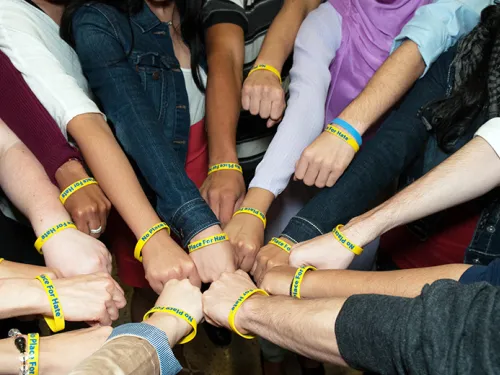









The handsign of the Hammerskins, a racist skinhead group, consists of two crossed forearms emulating the "crossed hammers" of the Hammerskins logo.
All the symbols depicted here must be evaluated in the context in which they appear. Few symbols represent just one idea or are used exclusively by one group. For example, 100% is often used as an amount or an expression and it is also used by some by some white supremacists as shorthand for "100% white." Similarly, other symbols in this database may be significant to people who are not extreme or racist. The descriptions here point out significant multiple meanings but may not be able to relay every possible meaning of a particular symbol.
233 Results
Back


Alternate Names: Nazi Salute, Sieg Heil Salute, Fascist Salute, Roman Salute
The Nazi or Hitler salute debuted in Nazi Germany in the 1920s to pay homage to Nazi leader Adolf Hitler. It consists of raising an outstretched right arm with the palm down. In Nazi Germany, it was often accompanied by chanting or shouting "Heil Hitler" or "Sieg Heil." Since World War II, neo-Nazis and other white supremacists have continued to use the salute, making it the most common white supremacist hand sign in the world.
The Nazi salute was one of a number of similar salutes adopted by fascist parties and movements across Europe in the interwar period. These salutes were often claimed to be based on an ancient Roman salute, but this does not appear to have been the case. However, people making such salutes today sometimes assert, typically insincerely, they are “Roman” salutes rather than “Nazi” ones. White supremacists have also adopted the term “roman,” as in “throwing a roman,” for the Nazi salute. In recent years, they have also created a typographical or emoticon version of the salute (see O-Slash Hitler Salute and Double Romans).




ALTERNATE NAMES: Jeran Rune
The Jera rune is an ancient European runic symbol, part of the runic alphabet. It also symbolizes concepts such as the harvest or the passage of time.
German ultranationalists of the pre-Nazi period began appropriating various runic symbols to help them create a link to a mythic “Aryan” past; from the 1920s through the 1940s, the Nazi party took such runic appropriation to a new level, incorporating many runic designs into Nazi iconography and symbology. Because the Nazis had done so, later neo-Nazi groups continued the tradition, adopting various runic symbols as logos, including symbols the Nazis themselves did not use.
The Jera rune is one of the less common runic symbols appropriated by modern white supremacists, perhaps because the Nazis do not appear to have used it. In the 2010s, however, white supremacists in Europe and the United States began to use the symbol. In Sweden, for example, the National Youth League (Förbundet Nationell Ungdom), a neo-Nazi group, adopted the Jera rune as its logo. In the United States, the rune began to appear on flyers and cards associated with the alt right segment of the white supremacist movement.
Some white supremacists may use the symbol because its design can conjure the image of a swastika without the symbol actually being a swastika.
Because the Jera rune is used by non-racists as well, including by adherents of modern pagan religions such as Asatru, one should not assume use of the symbol is racist but instead should only judge the symbol carefully in its specific context.
