




We have long expressed deep concern over UN Special Rapporteurs who abuse their mandates, utilize antisemitic tropes, trivialize the Holocaust, and support violence against the Jewish state, to drive political agendas. While we recognize the complexity of the removal process for Special Rapporteurs and the importance of maintaining their independence, the current system has allowed for individuals whose conduct conflicts with the UN’s core values to continue serving in these influential positions and acting under the UN’s emblem with all the imprimatur that it carries.
Two salient examples of Special Rapporteurs whose conduct violates guidelines are Francesca Albanese, Special Rapporteur on the Situation of Human Rights in the Palestinian Territories Occupied Since 1967, appointed to her position in March 2022, and Richard Falk, who held the same mandate from 2008 to 2014, both of whom have troubling histories of antisemitic and incendiary statements.
As the UN system considers reform in several sectors, we call for the UN Special Rapporteur system to be included to allow for a thorough vetting process that makes it possible for biases to be examined prior to appointment, enhanced accountability mechanisms when the Code of Conduct is breached, a review process before publishing reports, and a streamlined removal process for Rapporteurs who breach the Code of Conduct to ensure true adherence to the UN’s values.
Breaches of the Special Rapporteur Code of Conduct are often overlooked within the UNHRC, as removal requires a formal resolution by member states and therefore a consensus which is usually impossible to obtain. Nevertheless, we believe the UN system would benefit from reviewing its association with Rapporteurs whose conduct crosses the line into antisemitism or any kind of bias or bigotry, and support of violence, which are at odds with the organization’s values.
We respectfully urge the UN, the UNHCR, the High Commissioner for Human Rights, and member states to consider reform to address serious breaches of the Special Rapporteur Code of Conduct prior to and during appointment to a UN position. Such reforms would serve multiple important purposes: protecting the integrity of the Special Rapporteur system, ensuring that human rights work maintains the highest professional standards, and reinforcing public confidence in the UN's commitment to its founding principles.
Annex:
Some examples of Special Rapporteurs abusing their mandates as UN officials include:
Richard Falk
Prior to Richard Falk’s appointment into special procedures, he was a professor of law at Princeton University who espoused highly controversial theories. For instance, in 1973, he gave testimony about the legitimacy of violent resistance in a hearing for Karleton Armstrong, who killed a physics researcher when he bombed the University of Wisconsin Army Mathematics Research Center in August 1970 in protest of the Vietnam War. He used the Nuremberg Trials as a precedent for such resistance, demonstrating no discomfort with Holocaust inversion that continued. Later, in 2002, he authored an article discussing the legitimacy of suicide bombing in Palestinian resistance.
Despite the obvious misalignment of his statements and actions with global human rights, he was appointed as Special Rapporteur in 2008. His embrace of political violence and his practice of blaming the victims of the violence continued during his posting as a UN Special Rapporteur.
In 2011, Falk wrote a blog post claiming that 9/11 involved a cover-up by the US government. Rather than apologizing for his offensive and problematic statements, he claimed that the criticism and calls for his removal were conspiratorial. Secretary General Ban Ki-Moon condemned his statements as preposterous and offensive, but he asserted that he did not have the authority to remove Falk from his post. The UNHRC and member states did not take action in that direction, allowing an open conspiracy theorist and supporter of terrorism to remain employed by and associated with the UN.
Following the Boston Marathon Bombing in 2013, Falk published an article blaming Israel for the bombing, stating that: “As long as Tel Aviv has the compliant ear of the American political establishment, those who wish for peace and justice in the world should not rest easy.” In his statement, Falk utilized a classic antisemitic trope of global Jewish power and demonization, indicating that Israel somehow has been tricking the US into causing violence in the world. Canada and the US called for his removal, while the UK issued a condemnation of Falk for the third time. After initial resistance to condemning Falk, UN chief Ban Ki-Moon “rejected” Falk’s statements but stopped short of calling for his removal by the UNHRC.
Francesca Albanese
Prior to Francesca Albanese's appointment as UN Special Rapporteur in May 2022, she had already demonstrated a clear pattern of antisemitic statements and support for terrorism that should have disqualified her from any human rights role.
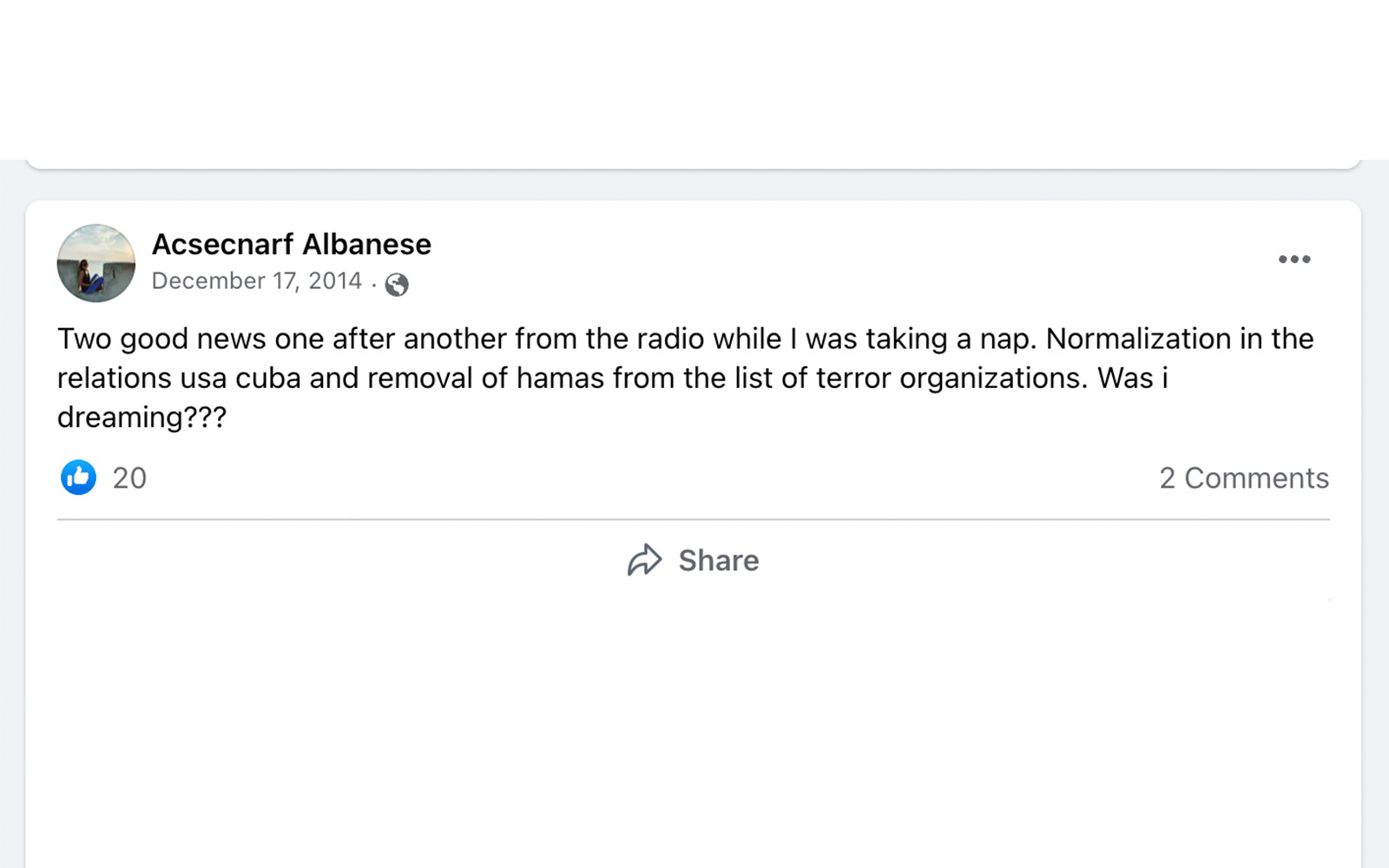
Most notably, in 2014, Albanese made explicitly antisemitic statements about "America and Europe, one of them subjugated by the Jewish lobby, and the other by the sense of guilt about the Holocaust." When these comments were uncovered in 2022, US Special Envoy Deborah Lipstadt condemned them as "blatantly antisemitic,” prompting Albanese to express regret for the statement. 2014 was the same year that Albanese celebrated Hamas being temporarily removed from the EU’s terror list.
Following her appointment, concerning patterns continued. Albanese began justifying terrorist violence, in June 2022 stating,"The Palestinians have no other room for dissent than violence" and telling Hamas’s Council on International Relations in November 2022 that Palestinians "have the right to resist this occupation." Notably, Richard Falk also spoke at the same Hamas-organized conference.
Albanese’s antisemitism continued in her official capacity, including Holocaust distortion by comparing Israel to the "Third Reich" and reposting images comparing Netanyahu to Hitler. Most egregiously, she minimized the October 7 massacre, claiming victims "were not killed because of their Judaism but in response to Israel's oppression" - making her the first UN Special Rapporteur condemned by both France and Germany for antisemitism.
Despite international condemnation from the US, France, Germany, and Jewish groups worldwide, the UN Human Rights Council renewed Albanese's term for three more years in April 2025 without addressing any of the allegations against her.
To appoint and then renew the mandate of someone with such documented expressions of antisemitism and sympathy for terrorism represents a breach of the principle that Special Rapporteurs' "personal political opinions are without prejudice to the execution of their mission," and a further example of how the system’s current design fosters the status quo and transactional entanglements rather than principled choices.