






(Official U.S. Navy Photograph in the Public Domain)
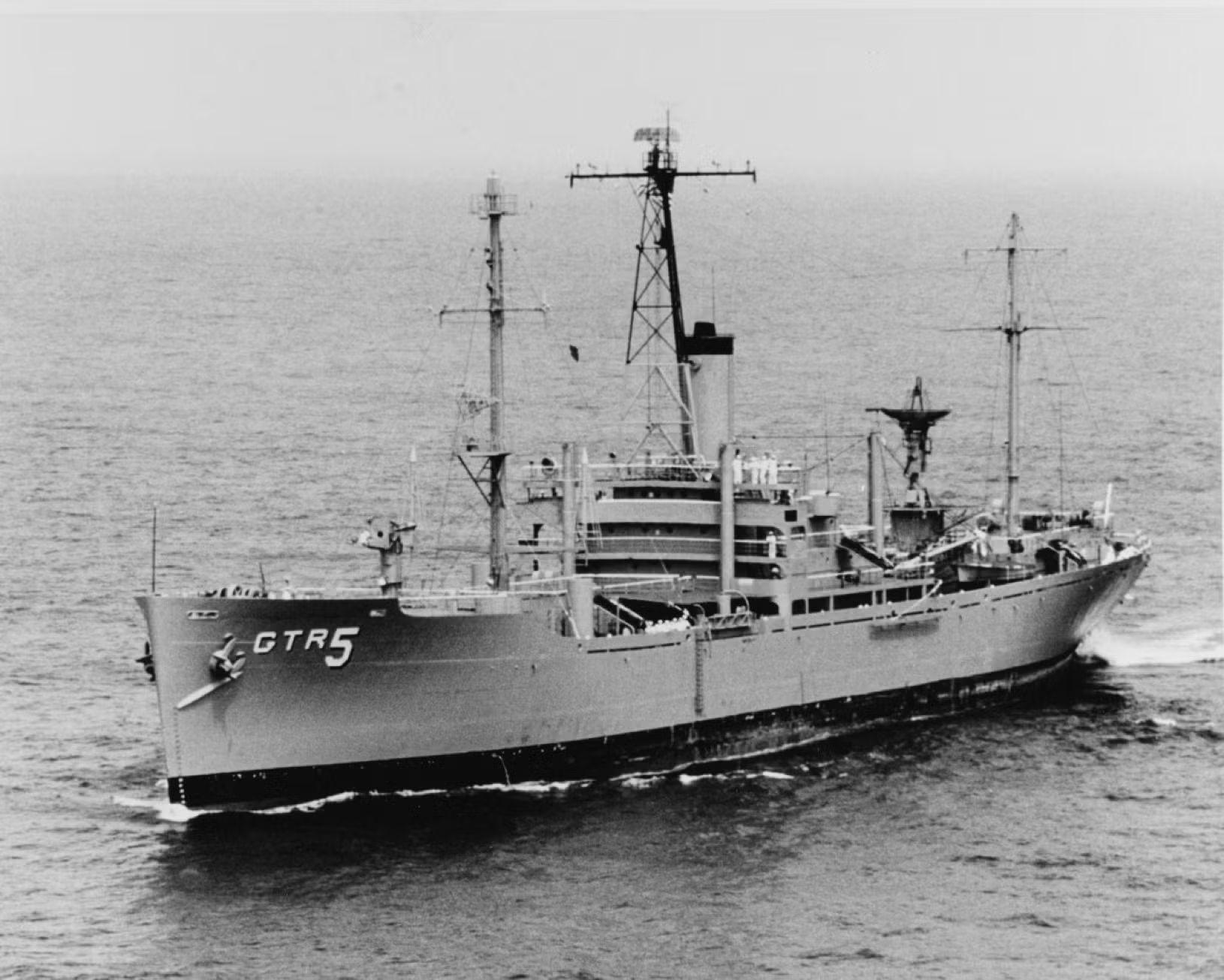
The U.S.S. Liberty in the Chesapeake Bay, July 29, 1967, upon its return from the Mediterranean.


In spring 1967, as tensions in the Middle East between Israel and its Arab neighbors threatened to burst into all-out war, the U.S. sent the U.S.S. Liberty, an electronics intelligence-gathering vessel, to the eastern Mediterranean to monitor the deteriorating situation. What would become known as the Six-Day War broke out before the Liberty arrived, leading the U.S. to order the ship to stay at least 100 miles from both Egypt and Israel. But the Liberty never received that message and continued to its original destination, arriving early on June 8.
Later that same day, Israeli planes and patrol boats attacked the Liberty, mistaking it in the chaos of the high-intensity war for an Egyptian vessel of somewhat similar design, causing grievous damage to the ship itself while killing 34 crew members and wounding 171 more—a shocking toll (the Liberty had a total crew of 358). The Israeli government quickly apologized to the U.S. for the mistaken attack and paid compensation to those wounded in the attack and to the families of those who perished (some years later, Israel also compensated the U.S. government for the damage to the Liberty itself). A CIA investigation conducted shortly after the incident concluded that there was “little doubt” that it was a case of mistaken identity on the part of the Israeli military. Subsequent inquiries over the years largely sustained this determination.
One of the most enduring consequences of the tragic attack on the Liberty was the construction of conspiracy theories that asserted the Israeli attack was deliberate and offered various conspiratorial rationalizations as to why Israel would want to attack a ship of a friendly nation. The connection of Israel to the attack quickly attracted antisemitic and anti-Israel actors of all types seeking to exploit it for propaganda purposes—a factor that also guaranteed such conspiracy theories would be repeated for many years.
The incident was useful to bad actors because it was an event that happened specifically to Americans and could be used to cast Israel as a danger to the U.S. Citing the Liberty, for example, one Texas woman wrote to a newspaper in 1975 to claim that “we can no longer sit by and let Zionism do to us what they have done to Russia, Germany, and Palestine.”
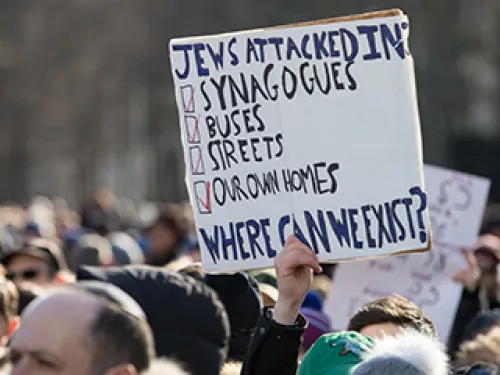
Over the years, antisemitic and anti-Israel activists rushed to invoke the Liberty whenever Israel engaged in any sort of high-profile or controversial action. After Israel attacked an Iraqi nuclear reactor in 1981, for instance, to prevent Saddam Hussein’s regime from obtaining a nuclear weapon, the head of the Aryan Unity Party of America cited that event and the Liberty incident as the reasons why “Aryan American patriots” should “rid America and the world of these anti-Christ, one-world forces.” Such tactics have continued to this day. After war began in Gaza in October 2023 following the Hamas terrorist attack on Israel, demonstrators showed up at a pro-Palestinian demonstration in Tampa, Florida, with a sign reading, in part, “Google USS Liberty.” In Alabama around the same time, White Lives Matter members staged a roadside demonstration that included a sign urging people to “Research Who Attacked the USS Liberty.” A couple of weeks later, protesters at an event on Staten Island similarly displayed a sign reading “America look up USS Liberty #WAKEUP.”
Antisemitic and anti-Israel actors on both the far right and the far left have long embraced the Liberty incident as a useful trope to further their causes. Cynthia McKinney, a former congresswoman and outspoken anti-Israel activist and conspiracy theorist, has repeatedly invoked the Liberty trope over the years; so has longstanding anti-Israel activist Alison Weir. Notorious white supremacist David Duke often referenced the Liberty incident. More recently, far-right activists like Candace Owens and Tucker Carlson have embraced the trope, making up for lost time with their own Liberty invocations. “There really were 34 Americans who really were killed—it really was a tragedy,” said conservative activist Richard Stern recently of such activity. “But every single time I’ve heard it brought up, it’s because people are looking for something to blame on the Jews.”
Many activists who have exploited the Liberty tragedy have taken advantage of several angry former Liberty crew members unwilling to accept that an attack of such destruction could possibly have been an accident. Oral interviews by the National Security Agency with surviving crew members in 1980 revealed that “time has not healed all the scars,” with many former crew members bitter at both the Israeli government for the attack and the U.S. government for not quickly coming to the assistance of the Liberty. Indeed, starting in the early 1980s, several people who had served on the Liberty began demanding new investigations while publicly accusing Israel of having launched a deliberate attack.
In recent decades, two former crew members have been most active in making such assertions about the Liberty attack: Phil Tourney and Joe Meadors, both now in their 70s. As they have sought any audience receptive to their claims, both have been exploited for years by conspiracy theorists as well as antisemitic and anti-Israel actors on the far right and the far left. Touney, for example, spoke at a Holocaust denial event in 2002, among other connections he’s had to far-right figures over many years. More recently, Candace Owens, the outspokenly antisemitic far-right influencer, interviewed Tourney on her show in December 2024. Popular antisemitic podcaster Stew Peters featured Tourney on his own podcast the same month. Such appearances have garnered Tourney a new audience of young supporters on the far right. Meadors, on the other hand, has had more connections to far-left anti-Israel actors, such as Cynthia McKinney, who, as she put it, “encouraged and supported” Meadors’ participation in “Freedom Flotilla” events in the 2010s to draw attention to Gaza.
The renewed popularity of U.S.S. Liberty conspiracy theories is a malicious phenomenon. The Liberty deserves to be remembered—not only for the tragedy that occurred but for the courage and steadfastness the ship’s officers and crew displayed during and after the attack, bravery reflected by the many commendations they received, including the Congressional Medal of Honor for the Liberty’s captain, William Loren McGonagle. The ship’s legacy does not deserve to be exploited by antisemitic and anti-Israel militants harnessing the tragedy for their own biased ends.