






All the symbols depicted in the hate symbols database must be evaluated in the context in which they appear. Few symbols represent just one idea or are used exclusively by one group. For example, 100% is often used as an amount or an expression and it is also used by some white supremacists as shorthand for "100% white." Similarly, other symbols in this database may be significant to people who are not extreme or racist. The descriptions here point out significant multiple meanings but may not be able to relay every possible meaning of a particular symbol.
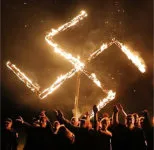
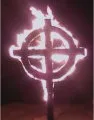
Since the early 1900s, Ku Klux Klan groups have burned crosses at many of their private and public events. They have also burned crosses on others’ property in acts of hateful intimidation. Today, the burning cross remains a very common white supremacist symbol.
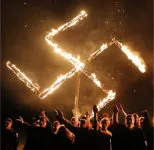
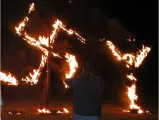
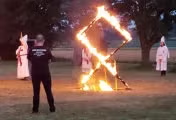
Since at least the 1970s, there have been also been occasional instances of burning swastikas placed on property to intimidate and threaten people or institutions. The targets of these tactics were often Jewish.
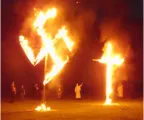
In the 1990s, some neo-Nazis began burning swastikas at their own events, directly emulating Ku Klux Klan cross burnings. This may have started with swastika burnings alongside cross-burnings at joint Nazi-Klan events.
In the 2000s, the National Socialist Movement became the neo-Nazi group most associated with burning symbols at its events. White supremacists also expanded the range of symbols that could be burned to include the Othala rune, the life rune, the triskele and the Celtic Cross, among others.
Additional Images
MORE TO EXPLORE

Burning Neo-Nazi Symbols
Sturmabteilung