




By Jonathan Greenblatt
To the Class of 2026, my dear graduates, Mazel Tov.
I know what you went through to get here.
You arrived on campus in the Fall of 2022. There was the usual mix of nerves and excitement. New friends. Late nights. The rhythms of college life in a post-pandemic world. There was one year of relative normalcy.
And then, in the first weeks of your sophomore year, on a Saturday morning in October 2023, Hamas launched the deadliest attack on the Jewish people since the Holocaust.
For Jews across the world, the grief was immediate and immense.
Many of you spent the days that followed seeing surreal videos of young Jews — people your own age — being kidnapped and murdered. And you reached out to your campus communities for comfort. For solidarity. For basic human decency.
What you found, in many cases, was something else entirely.
Days after the massacre, a Cornell history professor stood at a rally and told the crowd he was “exhilarated” by the attack.
Within weeks, at Cooper Union in Manhattan, Jewish students had to barricade themselves inside the library while protesters pounded on the doors, chanting “globalize the intifada.”
And then, in the Spring of 2024 — the end of your sophomore year — anti-Israel encampments began at Columbia and spread to campuses across the country. At UCLA, protesters built physical checkpoints and turned students away unless they first made a statement disavowing Israel’s right to exist.
I visited many of those campuses. What I saw and heard stayed with me.
I heard young people — your peers — tell me through tears that they were afraid to walk across the quad.
I heard stories of professors using class time to preach their hatred of Israel, regardless of what the course was actually about. I heard of students hiding their Star of David necklaces, and changing their names on their Uber profiles to sound less Jewish.
I felt this violence. It was not abstract.
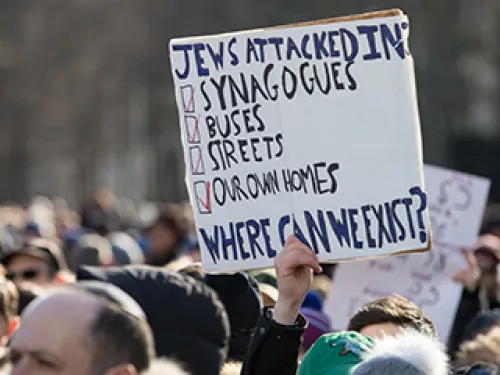
In the year after October 7, 2023, 83 percent of Jewish college students experienced or witnessed some form of antisemitism on their campuses.
You were trying to get an education — and you were being told, in ways large and small, that doing so would come at a cost. That was the world you, the Class of 2026, inherited in the middle of your college years.
Now here’s what I want you to know.
You could have gone quiet. And some of you did, for a time. You tucked away your Star of David necklaces. You rerouted around encampments. You held your breath and waited for things to calm down.
But that’s not the whole story.
You also organized. You filed complaints. You testified before Congress. You demanded that your universities be held to the same standard for how they treated Jewish students as for every other student on campus.
You came together and said: enough is enough.
And at ADL, we set out to help.
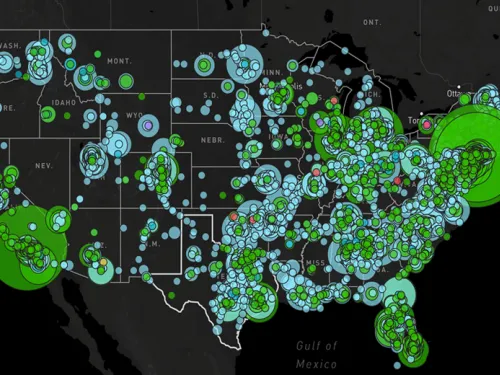
We worked to protect. We joined with Hillel, the Brandeis Center, and Gibson Dunn to launch the Campus Antisemitism Legal Line — CALL — connecting students facing discrimination with pro bono legal counsel. In its first year, CALL received nearly 1,000 reports from more than 230 campuses.
We worked to advocate. We established the Campus Antisemitism Report Card, built on a simple premise: institutions respond to pressure backed by evidence. Grades are a language everyone understands, especially colleges and universities. And since every school wants an A, we also educated them — working directly with administrators through guidance, webinars, and direct consultations.
The results tell the story. A’s and B’s now account for over 60 percent of grades. Two years ago, that number was barely 20. And ADL’s 2025 Audit of Antisemitic Incidents found incidents on college campuses are down significantly, with 583 antisemitic incidents on college campuses in 2025 — a 66-percent decline from the 1,694 incidents we recorded in 2024. While no number of incidents is acceptable, this is an encouraging trend.
And yet — I would be doing you a disservice if I told you the work is done.
Just in the past few weeks, as your class was preparing to graduate, encampments returned at Occidental College and Smith College (and were subsequently dismantled). At Swarthmore, administrators reported hundreds of incidents of antisemitic vandalism in a single week. At The New School in New York City, the student senate voted to defund the campus Hillel in an attempt to isolate Jewish students.
These incidents are a reminder that progress is real, but it is not permanent. The policies we fought for must be enforced. The standards we established must be upheld. Every year. Every campus. Every time.
This Fall, a new class will arrive. The Class of 2030 will walk onto campuses that look meaningfully different from the ones you encountered at their worst. These are institutions where policies have been strengthened, and where accountability systems exist that simply did not four years ago.
That happened because of you.
You didn’t create this crisis. But you refused to be broken by it. You stood up, raised your voices, and demanded better. And because you did — things actually got better.
So as you leave today, I want you to carry that with you. Carry the knowledge that you faced something hard and you didn’t turn away from it. When your community needed advocates, you showed up.
And now, Class of 2026, may you go from strength to strength.
The author is the ADL CEO and National Director.