









Study summary and takeaways for educators and administrators
Abstract
This paper reports findings from a randomized evaluation of a single-period (roughly 45-minute) classroom lesson on contemporary antisemitism, conducted with 372 students across nine public middle and high schools in a Southeastern U.S. metropolitan area between September and November 2025. Participating educators selected one class period to receive the lesson and another to serve as the within-school control. Pre- and post-assessments measured antisemitic attitudes, willingness to engage in allyship behaviors, and warmth toward Jews. Students who received the lesson were significantly less likely than controls to endorse conspiratorial tropes about Jewish power and influence, with reductions in agreement from 6.5 to 15.5 percentage points across the most affected items. Effects on willingness to engage in allyship behaviors were positive but smaller and less consistently statistically significant. A subsequent online experiment with 5,005 high school students from a national sample replicated the core finding: presenting antisemitism as a cyclical conspiracy that has persisted throughout history to the present day substantially reduced endorsement of antisemitic tropes, including among students with elevated baseline zero-sum thinking – one of the strongest predictors of antisemitic attitudes. We discuss implications for the design of school-based antisemitism education and outline priorities for replication and further research.
Keywords: antisemitism education, prejudice reduction, classroom RCT, conspiracy theories, secondary education, Holocaust education
What We Already Know
- Research from the Center for Antisemitism Research has consistently shown that certain attitudinal predispositions are strongly predictive of holding antisemitic attitudes.
- Elevated levels of three key variables – conspiratorial disposition, zero-sum and binary thinking, and situation within social networks that are openly prejudiced – are the factors most associated with the development of prejudicial attitudes against Jews.
- Preliminary research indicates that, more than any other factor, holding zero-sum attitudes and binary thinking are the most strongly associated with antisemitic attitudes among teens.
- Research from the Center for Antisemitism Research also suggests a correlation between knowledge about the Holocaust and lower levels of antisemitic beliefs.
Key Takeaways
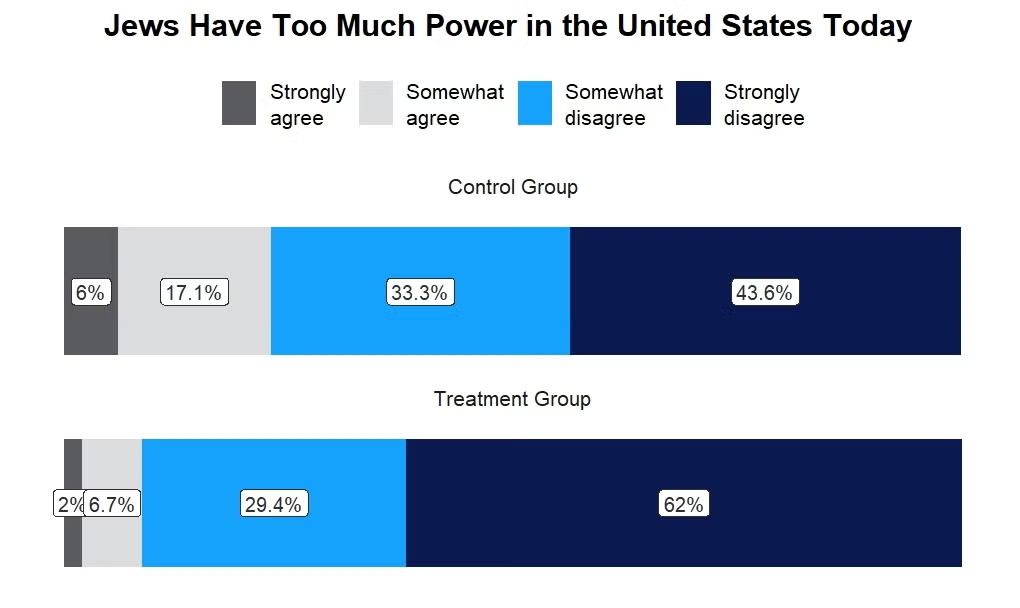
- A single 45-minute lesson moved teen attitudes on antisemitism. In a randomized evaluation across nine public secondary schools, students who received the lesson were 14.4 percentage points more likely than controls to disagree with the statement “Jews have too much power in the United States today” (91.4% vs. 76.9%).
- Effects were strongest on conspiratorial tropes — the most policy- and harm-relevant outcomes. Reductions in agreement appeared across multiple items related to Jewish power, dual loyalty, and media influence.
- Effects on allyship were positive but modest. Treated students endorsed 4.1 of 5 allyship statements on average, compared with 3.7 for controls. However, the lesson reduced minimization of antisemitism by 13.6 percentage points.
- A national online follow-up supported the core finding. Among 5,005 high school students, the most effective treatment framed antisemitism as a recurring conspiracy — the same central mechanism of the classroom lesson.
Implications. Brief, well-designed instruction on contemporary antisemitism appears to be a tractable lever for reducing antisemitic conspiratorial belief among teens. Replication in larger and more representative samples is the immediate next priority.
1. Introduction
Recent surveys document declining Holocaust knowledge and rising endorsement of antisemitic tropes among American youth, alongside broad public support for school-based education on antisemitism and the Holocaust (ADL 2024; Shapiro, Woo, and Kaufman 2025). Yet rigorous evidence on whether contemporary antisemitism education actually reduces antisemitic attitudes in authentic classroom settings remains scarce. The studies that do exist are concentrated in Holocaust education, often conducted as summative program evaluations rather than experiments, and rarely measure the antisemitic attitude outcomes most predictive of negative outcomes.
This paper reports results from a randomized classroom evaluation of a single-period lesson on contemporary antisemitism delivered in nine public secondary schools in a Southeastern U.S. metropolitan area in the fall 2025 academic term. The lesson was selected based on three criteria:
- The lesson could be delivered within a timeframe that is manageable for educators with limited time to teach the topic (i.e., one class period) without any standalone professional development on the topic;
- The lesson presents antisemitism as a cyclical conspiracy, drawing on prior synthesis work suggesting that providing information about prejudice rather than just focusing on prejudice reduction itself is more effective
- The lesson incorporates interactive design features that the same meta-analytic evidence associates with effective school-based prejudice-reduction programs (Zych and Gaffney 2025).
Three research questions guided the study. First, does a brief classroom lesson on contemporary antisemitism reduce student endorsement of antisemitic attitudes, particularly conspiratorial tropes? Second, does it shift students’ willingness to engage in allyship behaviors with Jewish peers? Third, does it increase warmth and reduce negative feelings toward Jews themselves?
About the Lesson: Echoes & Reflections, Unit 11 Lesson 2
The lesson evaluated in this study is Echoes & Reflections Unit 11, Lesson 2, "What Is Antisemitism and What Are Features of Antisemitism?" The lesson combines survivor testimony, group discussion, and reflection to introduce students to antisemitism as a recurring pattern of stereotypes and conspiracy beliefs, rather than a topic confined to the Holocaust. The lesson is free to access at echoesandreflections.org.
2. Background
2.1 The teacher-time problem
While a 2024 ADL survey found overwhelming public support for both Holocaust education (89%) and antisemitism education (84%) in local school districts, a 2025 RAND/One8 survey of secondary teachers found that more than a third of those who address the Holocaust spend less than two hours on the topic, and two-thirds spend less than five (Shapiro, Woo, and Kaufman 2025). Roughly half of teachers in the same survey reported that the curriculum guidance they receive is inadequate. These constraints make brief, single-period lessons that can be inserted into existing curricula a practical priority in their own right. Evaluating the efficacy of these lessons in real classroom settings then becomes a pressing empirical question.
2.2 What works in school-based prejudice reduction
Meta-analytic evidence on school-based prejudice-reduction programs identifies several features common to demonstrably effective interventions: substantive informational content (rather than moralization about the harms of prejudice), interactive pedagogy, integration of audiovisual or technology-mediated material, and linkage to broader historical context (Zych and Gaffney 2025). Less is known about how these features apply to antisemitism specifically, where the operative belief structures — conspiracy theories about Jewish power, control, loyalty, and influence — differ structurally from the affective prejudices that dominate the broader literature.
3. Methods
3.1 Intervention
The treatment was a single-period (≈45 minutes) lesson on the nature of antisemitism developed by Echoes & Reflections, an ADL educational partner (“Lesson 2: What Is Antisemitism and What Are Features of Antisemitism?”). The lesson covers the definition of antisemitism, its historical and contemporary manifestations, and its negative impact on Jewish and non-Jewish people and societies. Notably for this study, the lesson explicitly presents antisemitism as cyclical — a recurring set of stereotypes and conspiracy beliefs that resurface in periods of social fear and uncertainty. The lesson integrates factual instruction, audiovisual testimony, individual reflection, and small-group activity.[1]
3.2 Sample
The study was conducted with 372 students across nine public secondary schools in a Southeastern U.S. metropolitan area between September and November 2025. Five participating schools were high schools (188 students) and four were middle schools (184 students); participating students ranged from grade 7 to grade 12. The participating schools were socioeconomically and racially diverse: school-level free/reduced-price meals (FARMs) participation ranged from 20% to 100%, and the proportion of white students ranged from 2% to 36%. Per-school demographic breakdowns are reported in Appendix Table A1. Seven educators delivered the lesson across the participating schools; most taught humanities or social-science subjects. None had received professional development on the lesson, and none had taught it previously. Most participating students reported no prior classroom exposure to antisemitism education specifically.
3.3 Design and procedures
Within each participating school, the educator selected one class period to receive the treatment lesson and another comparable class period to serve as the control group. Pre- and post-assessments were administered in class to both groups, with each educator administering pre- and post-assessments to treatment and control on the same days to mitigate the risk of differential exposure across the two conditions. All student responses were anonymous; no personally identifiable information was collected. The study was approved by the Gratz College Institutional Review Board.
Because each school cluster used a single educator across both conditions, with treatment and control assessments administered on the same days, the risk of cross-contamination from extra-class events affecting one condition differentially was substantially mitigated.
3.4 Measures
Pre- and post-assessments measured four key sets of outcomes: (1) endorsement of conspiratorial antisemitic tropes (four items: Jewish control, dual loyalty, Jewish power in the United States, Jewish influence over the media); (2) endorsement of affective antisemitic items (four items: minimization of antisemitism, perceived overemphasis on the Holocaust, greed, in-group exclusivity); (3) feelings of warmth toward Jewish people, measured by a 0–100 feeling thermometer; and (4) willingness to engage in five allyship behaviors (interrupting anti-Jewish comments and jokes, standing up for Jewish classmates, reporting mistreatment of Jewish classmates to an adult, support for laws protecting Jewish people, and desire to fight antisemitism). All attitudinal items were measured on four-point agreement scales. Item wording, response categories, and baseline frequencies are reported in Appendix B.
3.5 Analytic approach
Treatment effects were estimated using bivariate ordinary least squares regression of post-assessment outcomes on treatment status, with cluster-robust standard errors at the educator level. Because there was only one educator administering the assessment per participating school, the assumption that treatment effects within one cluster do not affect outcomes in another (the SUTVA assumption) was substantially supported by the design. Treatment effects are reported as percentage-point changes in agreement (or, in the case of multi-item measures, as differences in mean number of items endorsed). Statistical significance is reported at p<0.05 unless otherwise noted. Some pre-/post-assessment matching at the individual level was not possible due to incorrect entry of anonymous IDs; the analyses reported here therefore rely primarily on between-condition comparisons rather than within-student change scores. This is discussed further in Section 6.
4. Results
The results demonstrated the lesson’s effectiveness in reducing antisemitic attitudes, with generally positive movement on key outcomes and no significant impact across others. Most notably, students who participated in the lesson were significantly less likely to endorse conspiratorial tropes about Jews. Though there was some improvement on measures of allyship and feelings toward Jews, these findings were less robust.
4.1 Conspiratorial antisemitic tropes
The largest and most consistent treatment effects appeared on items measuring endorsement of conspiratorial tropes. Students who received the lesson were significantly more likely than controls to disagree with the statement “Jews have too much power in the United States today” (91.4% disagree vs. 76.9%, a 14.4 percentage-point difference). Treated students were 6.5 percentage points less likely than controls to agree with the statement “Jews always like to be in control of things,” and 15.5 percentage points less likely to agree with the dual-loyalty trope “Jews are more loyal to Israel than to the United States.” Differences on the media-influence trope were similarly directional. Differences between treatment and control were statistically significant for the combined index of four conspiratorial tropes. Item-level results are summarized in Table 1, and agreement with the Jewish power trope is visualized in Figure 1.
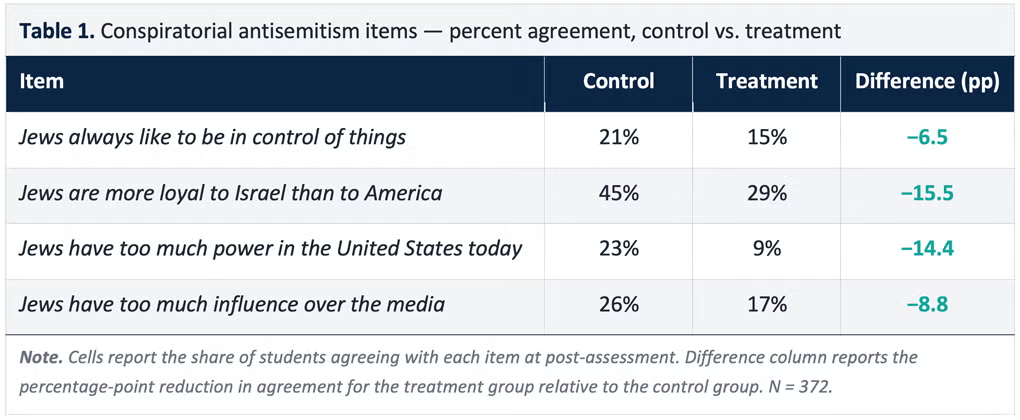
These reductions were observed across the participating schools and were not limited to students with high baseline knowledge of the Holocaust or low baseline antisemitism. The pattern is consistent with the lesson’s explicit framing of antisemitism as a recurring system of stereotypes and conspiracies.
Figure 1. Treatment vs. Control Differences in Endorsement of Jewish Power Trope
4.2 Affective antisemitism and minimization
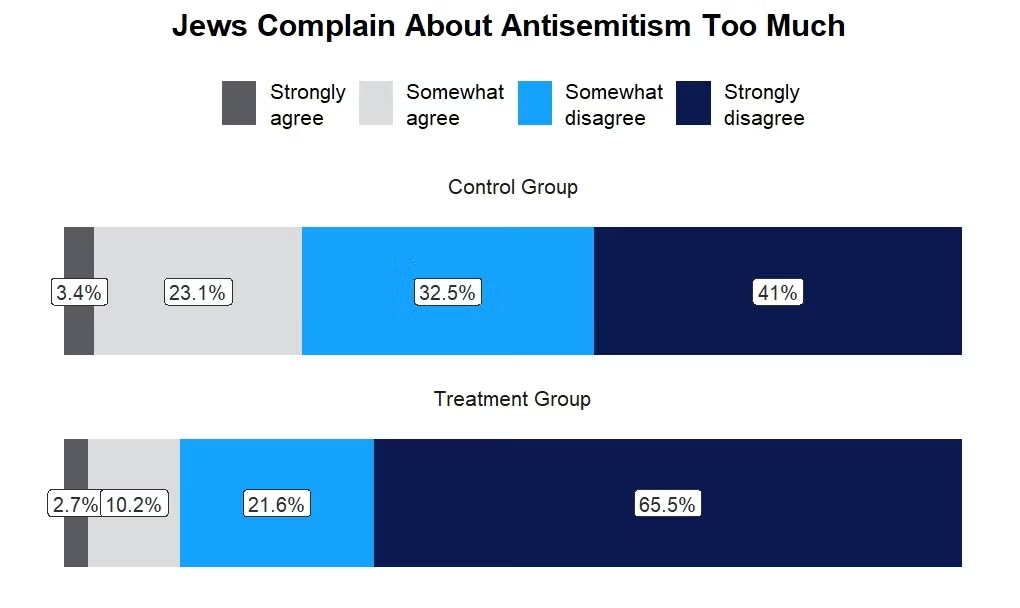
Effects on affective antisemitism items were mixed. The clearest result was on minimization: 87.1% of treated students disagreed with the statement “Jews complain about antisemitism too much,” compared with 73.5% of control students (a 13.6 percentage-point difference, significant at p<0.05). Figure 2 visualizes these treatment versus control differences.
Figure 2. Minimization of Antisemitism as an Issue
Effects on the remaining affective items — perceived overemphasis on the Holocaust, greed, in-group exclusivity — were directionally consistent with reductions but smaller in magnitude and inconsistently statistically significant. The lesson did not produce a statistically significant change in overall scores on the overall affective-attitude index. The pattern is consistent with the design of the lesson: it is built to teach about antisemitism as a phenomenon, not to teach about Jewish people or Jewish identity. Items measuring affect toward Jews themselves are correspondingly less directly targeted by the intervention.
4.3 Warmth toward Jews
In addition to the four affective antisemitism items, respondents indicated their feelings of warmth toward Jewish people via a feelings thermometer. Though treated students did report slightly warmer feelings toward Jewish people on the 0-100 feeling thermometer than controls when measured by a t-test, this difference was modest (9.4 out of 100 points difference). Statistical significance disappeared when the clustered structure of the data was accounted for.
4.4 Allyship
Across the five allyship items, treated students endorsed 4.1 of 5 statements on average, compared with 3.7 for controls (a difference of 0.4 statements). The largest item-level differences appeared on “In the future, I will interrupt anti-Jewish comments and jokes if I hear them from my friends or family” (80% treated vs. 70% control), “I want the U.S. to pass laws that protect Jewish people against anti-Jewish prejudice” (84% vs. 77%), and “I want to help fight anti-Jewish prejudice” (80% vs. 70%). Differences for telling an adult about mistreatment of a Jewish classmate and standing up for Jewish classmates were positive but smaller. Differences in this domain were less robust than those for conspiratorial tropes, both in effect size and in statistical significance.
4.5 Engagement and learning
In addition to the core attitudinal outcomes, respondents were asked to indicate engagement with the lesson and basic awareness of antisemitism as a term. Item-level results for these measures are reported in Appendix B. Students who received the lesson were substantially more likely to correctly identify antisemitism as prejudice against Jewish people (79% vs. 47% of controls), confirming that the lesson successfully transmitted its primary definitional content. Engagement items — “I learned something valuable from this lesson,” “This lesson was interesting,” “I understand why we learned this lesson” — showed broadly positive endorsement among treated students, ranging from 81 to 92% endorsement.
5. Corroborating Online Experiment
In a separate research project following the in-class evaluation, CAR researchers conducted a randomized online experiment.[2] One hypothesis tested as part of this study – that framing antisemitism as a cyclical set of conspiracy theories about Jews could reduce antisemitism – mirrored the core mechanism of the lesson tested in the classroom study. The online study reproduced its effects in a larger and more nationally distributed sample of high-school students, providing additional empirical evidence about the efficacy of the broader approach to teaching and talking about antisemitism.
5.1 Design and sample
Five thousand five students (N=5,005) recruited from a national high-school sample were randomly assigned to read one of ten short paragraphs, each touching on a common theme in Jewish identity and history (JIH) education, or to a no-treatment control. Outcome measures paralleled those used in the classroom evaluation: endorsement of conspiratorial antisemitic tropes, feelings of warmth toward Jewish people, and willingness to engage in allyship behaviors. As was the case with the lesson that was tested, this treatment presented antisemitism as a cyclical set of conspiracy theories that evolve over time and frequently engage in scapegoating Jews for societal problems. Critically, as was also the case with the Gringlas lesson, antisemitism was presented as an enduring problem that has manifested in similar ways throughout history and to the present day, rather than as a phenomenon that culminated in the Holocaust.
5.2 Findings
Students assigned to the cyclical antisemitism treatment showed significant reductions in endorsement of conspiratorial antisemitic tropes, including dual loyalty (39% vs. 51% in the control group), Jewish power in the United States (20% vs. 29%), and the trope that Jews are uniquely greedy (20% vs. 28%). Effects on warmth toward Jewish people on the feeling thermometer also trended positive, but did not reach statistical significance when the clustered structure of the data was accounted for.
Positive effects of the cyclical antisemitism treatment also held for students with elevated baseline zero-sum thinking, a set of attitudes that is generally thought of as an added barrier to effective intervention due to the strong empirical connection between such attitudes and antisemitism. Among control-group students who agreed that “when one group gets ahead, it usually means others are held back,” 36% also agreed that Jews are uniquely greedy. Among treatment-group students endorsing the same zero-sum item, only 19% agreed with the same antisemitism trope. The cyclical-antisemitism treatment thus appears able to break through among students whose baseline cognitive dispositions are typically associated with elevated antisemitism. (Conspiracy-theory belief at baseline was not associated with elevated antisemitism in this sample, complicating any parallel test on that dimension; the relationship between baseline conspiracy belief and antisemitism in teens warrants further study).
Figure 3. Antisemitic tropes were endorsed at lower rates for the cyclical antisemitism treatment group
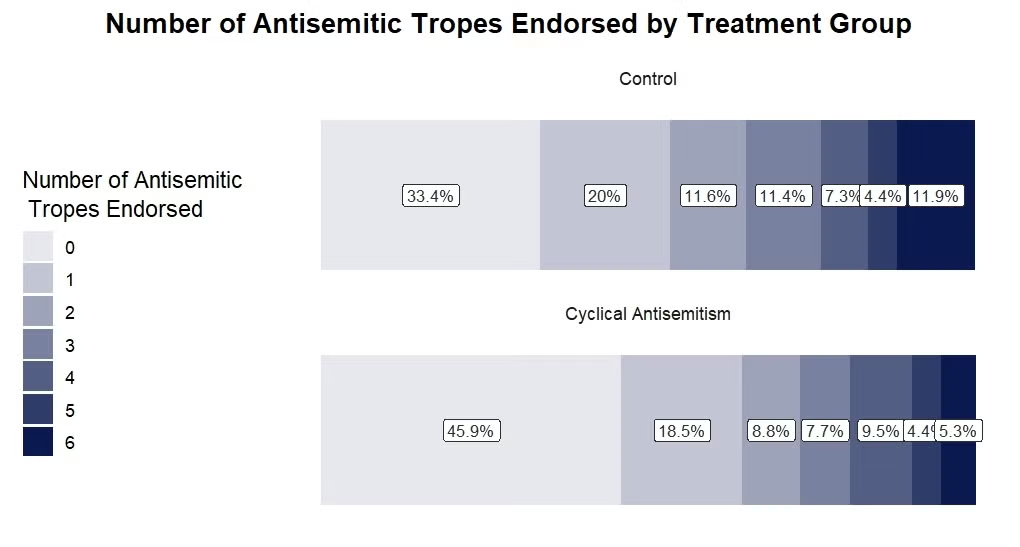
The convergence of findings across two methodologically distinct studies — a classroom RCT in a regionally bounded sample and an online experiment in a national sample — strengthens the case that the cyclical antisemitism framing is an effective approach to teaching about antisemitism. It also raises the possibility that effects observed when this content is delivered online — in seconds, via a short text sample — may be amplified and made more durable when delivered as a 45-minute interactive lesson by a trusted adult educator.
6. Discussion
6.1 What this study contributes
This study is, to our knowledge, the first randomized evaluation of a single-period contemporary-antisemitism lesson conducted in authentic public secondary classroom settings in the United States. Its findings are consistent across two independent samples and two distinct delivery modalities. They suggest that brief, well-designed instruction on contemporary antisemitism can produce meaningful reductions in conspiratorial antisemitic belief among teens — a population at a critical stage of attitude formation, and one in whom prior CAR research has documented rising rates of antisemitic trope endorsement.
The pattern of effects — large on conspiratorial tropes, smaller and inconsistent on affective items, modest on allyship — is consistent with a substantive interpretation. The lesson is designed to teach about antisemitism itself, not about Jewish people. Items asking about Jewish character, warmth, or in-group exclusivity are correspondingly less directly targeted. The design implication is that affecting affective dimensions of attitudes toward Jews may require complementary content about Jewish identity and peoplehood, paired with the antisemitism-as-conspiracy content rather than substituting for it.
6.2 Limitations
Despite these generally positive findings, several study limitations should be noted. First, the regional sample is not representative of the U.S. secondary school population, and findings should not be generalized beyond the sample tested without replication in other regions. Second, the sample size, while sufficient to detect moderate effect sizes for the largest items, was a binding constraint for items with smaller expected effects. Third, individual-level pre-/post-assessment matching was not possible in the majority of cases due to incorrect entry of anonymous student IDs; the analyses therefore rely primarily on between-condition comparisons rather than within-student change, further limiting ability to detect statistically significant differences between groups. Fourth, although educators within each school administered both pre- and post-assessments to treatment and control on the same days, the staggered scheduling across schools (early October to mid-November) means the broader information environment was not held constant across the full sample, a possible source of bias in the results. Fifth, the study evaluates one specific lesson; effects of other contemporary antisemitism lessons that take a similar approach may differ, and effects of lessons that take different approaches may differ substantially. Sixth, the post-assessment was administered immediately following the lesson; durability of effects beyond the same class period was not measured and is a question for future research.
6.3 Priorities for replication
Three replication priorities follow from the limitations above. The first is replication in larger and more nationally representative classroom samples, ideally including school-level demographic strata not well represented in the present study. The second is the addition of a delayed post-assessment to estimate durability and/or decay of effects beyond the day of delivery. The third is direct comparison of contemporary antisemitism content delivered alone, traditional Holocaust education delivered alone, and the two delivered in combination, to test whether pairing produces additive effects on the outcomes most resistant to either intervention alone.
Two additional questions for future research arise from this study. First, whether providing educators with professional development on the lesson amplifies effects, given that the present study deliberately tested a no-professional development condition. Second, whether the conspiracy-targeting framing is similarly effective when applied to other prejudices, or whether antisemitism’s structurally conspiratorial character makes it uniquely well-matched to this pedagogical and rhetorical approach.
6.4 Implications for practice
These data indicate that antisemitism education does not necessarily require a full Holocaust education unit to be effective—as demonstrated in this study, a single class period that presents antisemitism as a system of cyclical conspiracies that have evolved throughout history to the present day can move the needle on the attitudes most directly linked to harm. The data also suggest that extensive educator foreknowledge of or training on antisemitism as a subject area need not be a significant barrier to delivering effective antisemitism education to students, as many of the educators in this study had no prior training on the unit itself, and many had not taught about antisemitism previously.
These results, considered alongside the corroborating online experiment, support several preliminary conclusions for practice.
- Brief instruction can move attitudes when its content is well-designed;
- The conspiracy-targeting framing appears to be an active mechanism worth preserving in lesson design;
- The affective-antisemitism domain may require complementary content focused on Jewish identity and peoplehood. CAR’s ongoing research portfolio is structured to test these propositions directly.
References
ADL. 2024. Antisemitism in Schools and Support for Holocaust Education. Anti-Defamation League. https://www.adl.org/resources/report/antisemitism-schools-and-support-holocaust-education.
ADL. 2024. Antisemitic Attitudes in America 2024. Anti-Defamation League. https://www.adl.org/resources/report/antisemitic-attitudes-america-2024.
ADL. 2024. “A Closer Look at the Relationship Between Holocaust Knowledge, Education, and Antisemitism.” Anti-Defamation League. https://www.adl.org/resources/article/closer-look-relationship-between-holocaust-knowledge-education-and-antisemitism.
Center for Antisemitism Research (CAR). 2026. “Conspiracy-Targeting Approaches to Reducing Antisemitism: A Synthesis of Recent Evidence.” Internal synthesis memo, Anti-Defamation League.
Echoes & Reflections. n.d. “Lesson 2: What Is Antisemitism and What Are Features of Antisemitism?” Unit 11. https://echoesandreflections.org/unit-11/.
Shapiro, A., A. Woo, and J. H. Kaufman. 2025. Public School Instruction on the Holocaust and Topics Related to Jewish People: Understanding How Secondary English Language Arts and Social Studies Teachers Address These Complex Topics. Santa Monica, CA: RAND Corporation. https://www.rand.org/pubs/research_reports/RRA3615-1.html.
Zych, I., and H. Gaffney. 2025. “School-Based Prejudice Reduction Programs: A Meta-Analysis of Program Features and Effectiveness.” Manuscript under review.
Appendix A. Sample and Methodology Details
A.1 Participating schools
Nine public schools in a Southeastern U.S. metropolitan area participated. Per-school demographic data are reported in Table A1. Student-level demographic data were not collected in order to protect student anonymity. School-level data show substantial racial and socioeconomic diversity: school-level free and reduced-price meals (FARMs) participation ranged from 20% to 100%, and the proportion of white students ranged from 2% to 36%.
Table A1. School-level demographics for participating schools
| School | % AAPI | % Black | % Hispanic | % White | % FARMs |
|---|---|---|---|---|---|
| High School 1 | 6% | 31% | 41% | 20% | 100% |
| High School 2 | 3% | 69% | 15% | 7% | 100% |
| High School 3 | 13% | 35% | 28% | 20% | 32% |
| High School 4 | 2% | 54% | 39% | 2% | 100% |
| High School 5 | 6% | 50% | 38% | 4% | 100% |
| Middle School 1 | 4% | 54% | 36% | 3% | 100% |
| Middle School 2 | 36% | 12% | 12% | 36% | 20% |
| Middle School 3 | 4% | 67% | 18% | 6% | 100% |
| Middle School 4 | 1% | 44% | 15% | 33% | 38% |
Note. Schools de-identified at the school level. Demographic categories come from publicly available school-level reporting. Rows may not sum to 100% due to additional or unreported categories.
A.2 Sample composition
Of the 372 participating students, 188 were enrolled in middle school and 184 in high school (grades 7–12). Seven educators delivered the lesson and administered the assessments across the nine schools. None had received professional development on the lesson and none had taught it previously. Most participating students reported no prior classroom exposure to antisemitism education specifically.
A.3 Procedures and IRB
Pre- and post-assessments were administered in class on the same day, with treatment and control sections drawn from the educator’s teaching schedule. Each educator selected one section to receive the treatment and another comparable section to serve as the control. Educators introduced the assessments using a standardized script. All student responses were anonymous; no personally identifiable information was collected. The study was approved by the Gratz College Institutional Review Board.
A.4 Estimation
Treatment effects were estimated using bivariate OLS regression of post-assessment outcomes on treatment status, with cluster-robust standard errors at the educator level. Statistical significance is reported at p<0.05 unless otherwise noted. Where multi-item indices are reported, indices were constructed as the mean number of items endorsed by each respondent.
Appendix B. Outcome Measures
This appendix lists the items used to measure each set of outcomes, along with baseline (control group) and treatment group agreement at post-assessment.
B.1 Definition of antisemitism
Antisemitism refers to prejudice against which of the following groups?
| Item | Control | Treatment |
|---|---|---|
| % answering correctly | 47% | 79% |
B.2 Conspiratorial antisemitism (agreement)
| Item | Control | Treatment |
|---|---|---|
| Jews always like to be in control of things. | 21% | 15% |
| Jews are more loyal to Israel than to America. | 45% | 30% |
| Jews have too much power in the United States today. | 23% | 9% |
| Jews have too much influence over the media. | 26% | 17% |
B.3 Affective antisemitism (agreement)
| Item | Control | Treatment |
|---|---|---|
| Jews complain about antisemitism too much. | 27% | 13% |
| Jews talk about the Holocaust too much. | 20% | 13% |
| Jews are greedy. | 21% | 9% |
| Jews only care about their own kind. | 21% | 14% |
B.4 Allyship items (agreement)
| Item | Control | Treatment |
|---|---|---|
| In the future, I will interrupt anti-Jewish comments and jokes if I hear them from my friends or family. | 70% | 80% |
| In the future, I will stand up for Jewish classmates if they are treated badly. | 75% | 82% |
| In the future, I will tell an adult if I see a Jewish classmate being treated badly. | 79% | 85% |
| I want the U.S. to pass laws that protect Jewish people against anti-Jewish prejudice. | 77% | 84% |
| I want to help fight anti-Jewish prejudice. | 70% | 80% |
B.5 Engagement with the lesson (treatment group only, agreement)
| Item | Treatment |
| I learned something valuable from this lesson. | 92% |
| This lesson was interesting. | 81% |
| I understand why we learned this lesson. | 87% |
Item-level frequencies are reported in the supplementary materials available from the corresponding author.
SUGGESTED CITATION
Anti-Defamation League. 2026. “Classroom Instruction on Contemporary Antisemitism Reduces Endorsement of Conspiratorial Tropes Among Teens: Evidence from a Randomized Evaluation in Nine Public Secondary Schools.” CAR Working Paper 2026-01. New York: Center for Antisemitism Research, Anti-Defamation League.
The Stan Greenspon Holocaust Education Center supported ADL in conducting the field research.