








Related Resources:

The Impact of Israel Divestment on the New York City Pension Funds: Estimating BDS’s Financial Toll on New York City Employees, Retirees and Beneficiaries (JLens Report)
JLens - The Impact of Israel Divestment on the NYC Pension Funds - Summer 2026
I. Executive Summary
This report indicates that adopting investment restrictions aligned with the Boycott, Divestment and Sanctions (BDS) movement[1] may result in substantial financial costs on the New York City Pension Funds ("Systems" or "NYC Pension Funds"), and as a result, could create material fiscal pressure on the City's operating budget. Based on a decade of historical performance data, JLens' extrapolation estimates that BDS-aligned exclusions applied to the NYC Pension Funds' large-cap U.S. public equity portfolios could reduce total pension assets by approximately $37.55 billion between 2025 and 2035.
By way of background, the New York City Pension Funds have more than $300 billion in assets under management and constitutes the fourth-largest public pension system in the United States.[2] Collectively, the NYC Pension Funds are comprised of five distinct funds: the Teachers' Retirement System of the City of New York (TRS), New York City Employees' Retirement System (NYCERS), the New York City Police Pension Fund (POLICE), the New York City Fire Pension Fund (FIRE) and the New York City Board of Education Retirement System (BERS).[3] Each of which is financially independent and is responsible for providing its members with the pension and related benefits to which they are legally entitled.[4]
Importantly, all five NYC Pension Funds operate as defined-benefit pension systems, meaning they are legally obligated to provide specified retirement benefits regardless of investment performance. Because promised benefits are legally guaranteed, sustained investment underperformance does not reduce liabilities; instead, it lowers funded status and must ultimately be addressed through increased employer contributions from the City of New York.[5] The assets used to finance these benefits are accumulated through a combination of employee contributions, employer contributions and investment earnings.[6]
With the election of Mayor Zohran Mamdani, who has publicly embraced the BDS movement—including defending his support for BDS at a UJA-Federation forum[7] and voicing support for ending the City's investments in Israel Bonds[8]—the likelihood of a BDS-aligned divestment is thought to have increased.[9]
To evaluate the impact of BDS-aligned divestment, JLens compared the historical performance of two hypothetical U.S. large-cap public equity indices over a ten-year period: 1) a broadly diversified index without constraints and 2) a broadly diversified index that excludes BDS-targeted companies. Both hypothetical indices were used as a proxy for each of the five NYC Pension Funds' U.S. large-cap public equity portfolios. Over the past ten years, the exclusionary BDS-aligned index underperformed the benchmark by an average of 2.0% annually (11.7% return of the broad equity index with BDS-aligned exclusions vs. 13.7% return of the broad equity index).[10] Importantly, as discussed in Section III, Exhibit Six, while the broad equity index with BDS-aligned exclusions exhibited modestly lower beta and volatility, its lower Sharpe ratio indicates that the reduction in returns was not proportionate to any reduction in systematic risk.
When compounded over time, such differences produced significant divergences in portfolio value. For example, a $1 billion allocation to the exclusionary BDS index would have generated nearly $600 million less in cumulative returns over the past decade. Estimated forward over the next ten years, JLens found that each of the five NYC Pension Funds would underperform, in magnitudes ranging from $1.4 billion to nearly $15.1 billion. Importantly, as demonstrated in the sensitivity analysis presented in Appendix B, this finding is not dependent on strong market assumptions; even under more conservative and actuarial-aligned return scenarios, the adoption of BDS-aligned exclusionary strategies could result in materially significant forgone value.
This potential underperformance could have implications beyond the pension balance sheet. Under New York State law, any shortfall in investment returns must be offset through higher employer contributions from the City of New York.[11] Lower returns therefore translate directly into increased budgetary obligations, requiring the City to redirect financial resources away from essential municipal services, reduce spending in areas such as education, public safety or social services, or raise revenues through higher taxes or fees. In effect, BDS-aligned divestment could impose meaningful costs on the City's taxpayers and the beneficiaries of public services.
While this report does not attempt to predict the future decisions of individual pension boards, it does examine the different governance structures of each board. Our analysis shows that the pension boards vary in their composition and decision-making dynamics: some are subject to greater mayoral control, and some have a demonstrated record of adopting exclusionary screens, such as fossil-fuel divestment, to reflect their values. In addition, several boards have active member-led campaigns urging divestment from Israel or Israeli-related securities, which could increase pressure on pension boards to adopt BDS-aligned proposals. As a result, the five NYC Pension Funds face different levels of Israel-related divestment risk, with some boards more vulnerable than others.
Given these variations in governance and susceptibility, this report confines itself to the financial implications of divestment rather than the political or moral debates surrounding BDS. Its purpose is strictly financial: to quantify the potential economic impact of BDS-aligned exclusions on the NYC Pension Funds and, by extension, on the City's fiscal position. To our knowledge, no prior analysis has examined the potential impact of BDS-aligned exclusions on the NYC Pension Funds through a comparable long-term financial framework.
As trustees are asked to consider adopting values-based exclusions, it is essential that fiduciary decision-making remain grounded in a clear understanding of the potential economic consequences. The analysis presented in this report suggests that BDS-aligned divestment could reduce long-term investment returns, increase required City contributions, strain the municipal budget and by extension weaken the retirement security of hundreds of thousands of New Yorkers who rely on the NYC Pension Funds. Policymakers and trustees must therefore weigh these material financial risks with great care when evaluating any proposal to adopt BDS-aligned investment strategies.
II. Governance and Divestment Risk Across the Five NYC Pension Funds
The New York City Pension Funds operate through five independent systems[12] – Teachers' Retirement System of the City of New York (TRS), New York City Employees' Retirement System (NYCERS), New York City Police Pension Fund (POLICE), New York City Fire Pension Fund (FIRE) and New York City Board of Education Retirement System (BERS) – each with its own board composition, voting rules mayoral influence, and fiduciary culture. These structural differences create meaningful variation in how susceptible each system may be to politically-driven divestment initiatives, including those aligned with the Boycott, Divestment and Sanctions (BDS) movement. While this report does not attempt to predict specific board decisions, an understanding of the governance landscape provides important context for interpreting the financial analysis that follows.
With the election of Mayor Zohran Mamdani, who has publicly embraced the BDS movement[13] and expressed support for ending the City's Israel Bond investments,[14] many believe that the potential for BDS-aligned divestment proposals has increased.[15] The Mayor appoints at least one trustee to each of the City's five pension boards and exercises varying degrees of additional influence, an important consideration given that the NYC Pension Funds collectively manage more than $300 billion in assets.[16] At TRS and BERS, mayoral appointees constitute a larger portion of the board or hold structurally important seats.
Union dynamics also contribute to the potential for a BDS-aligned divestment. Although the leadership of both the United Federation of Teachers (UFT) and District Council 37 (DC 37) has not endorsed BDS or Israel divestment, rank-and-file factions within both unions have publicly advocated for divestment, creating pockets of internal pressure.[17] These member-level campaigns do not dictate official union policy, but they may influence trustee perspectives in certain NYC Pension Funds—particularly TRS and NYCERS, where union-represented employees serve as elected trustees. In addition, three of the NYC Pension Funds—TRS, NYCERS and BERS—previously adopted fossil-fuel divestment,[18] demonstrating a willingness to consider exclusionary investment policies under certain conditions.
Taken together, these factors suggest that TRS, NYCERS and BERS could face higher relative exposure to BDS-aligned divestment proposals, while POLICE and FIRE exhibit lower exposure, owing to strong uniformed-services union representation, long-standing resistance to divestment screens, and limited mayoral influence. This report does not attempt to quantify the probability of divestment; rather, it aims to identify the Systems that appear more susceptible to such proposals based on governance structures and observable institutional dynamics.
The following pages provide detailed background on the governance structure of each system. This context should be viewed as complementary to the ten-step financial analysis that follows, which outlines the methodology and assumptions made to estimate potential losses for the NYC Pension Funds from a BDS-aligned divestment. While the economic findings quantify the potential costs of BDS-aligned divestment, governance dynamics determine where such proposals are most likely to emerge and where they might realistically advance.
III. Methodology: 10-Step Financial Analysis Framework
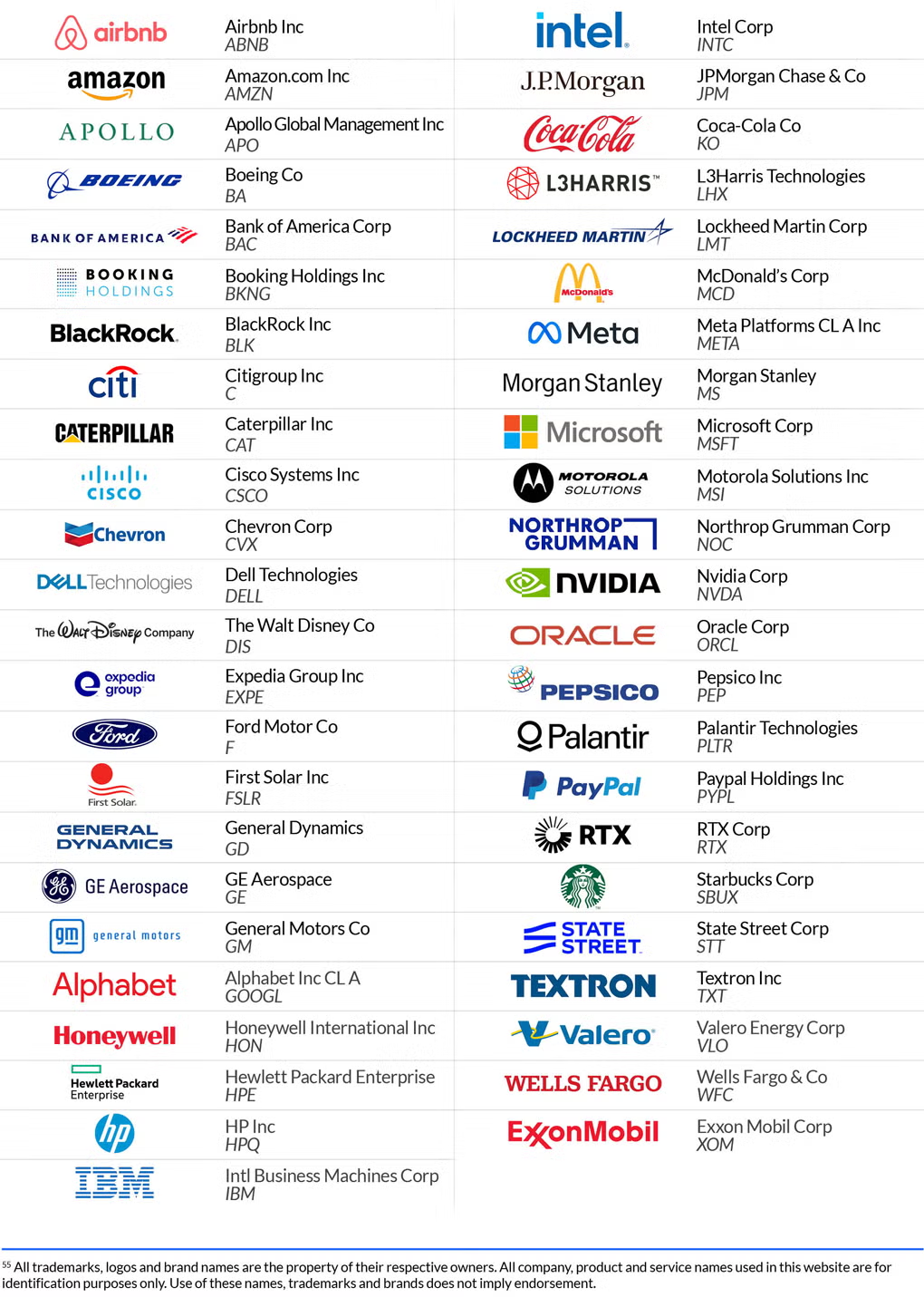
Step 1: Creation of "BDS Top Targets" List
JLens conducted a comprehensive review of companies targeted by the Boycott, Divestment and Sanctions (BDS) movement. This process involved analyzing research from six organizations which promote or facilitate BDS, collectively referred to as "BDS Proponents": American Friends Service Committee, Boycott-Israel.org, the Palestinian BDS National Committee, the Office of the United Nations High Commissioner for Human Rights (OHCHR), Who Profits and Don't Buy Into Occupation Coalition. Detailed information on each BDS Proponent can be found in Appendix A.
JLens notes that there are many other organizations that support BDS, but do not publish divestment targets. Additionally, in similar BDS divestment campaigns targeting city and state funds, activists have compiled their own divestment lists. For example, CALSTRS Divest, a campaign targeting the California teachers' pension fund, created a list of 22 companies targeted for divestment,[53] and a campaign titled "WA: Cut Ties With Genocide" states that Washington State invests in "more than 50 companies directly profiting from Israel's genocide."[54] However, JLens chose to focus on prominent pro-BDS organizations that have published online lists of divestment targets, presumably aiming to encourage widespread adoption of their campaigns.
A key finding of this review was the lack of unified methodology or central coordination among BDS Proponents. This inconsistency led to significant variations in their targeting criteria and calls to action. Some organizations focused on companies allegedly involved in the post-October 7 war in Gaza, while others identified companies based on alleged activities such as operations in the West Bank or Gaza, sales of goods or provision of services to the Israeli government and military, or broader business operations within Israel. Similarly, the BDS Proponents' advocacy ranged from merely providing information on a company's alleged involvement in Israel to directly calling for divestment and/or boycotts of specific companies.
Additionally, the landscape of companies doing business in Israel is vast and ever-changing, making it challenging to compile a definitive list of BDS targets that does not quickly become outdated. Many large U.S. public companies have significant ties to Israel, and the list of potential BDS targets can expand at any time due to geopolitical events, corporate actions and evolving activist strategies. For example, in a fall 2024 review of BDS targets, JLens identified 38 targeted companies. When this review was updated in the fall of 2025, applying the same methodology to the creation of the "BDS Top Targets" list, JLens identified 47 companies targeted by the BDS Proponents. Compared to the fall of 2024 research, the same 38 companies remained a target and an additional 9 companies had been added to BDS Proponents' lists.
Acknowledging this dynamic environment, JLens developed a focused and conservative "BDS Top Targets" list. This list includes companies that are:
- targeted by at least one BDS Proponent during the research and quantitative analysis phases of this report, typically within a BDS Proponent's online database or list of companies with alleged activities, and
- constituents of the VettaFi 500 index, which is an index comprised of the largest U.S. public companies.
Many companies were present on multiple BDS Proponents' lists. Additionally, JLens used publicly available information on Israel-related boycott campaigns to supplement information published by the BDS Proponents. By using the BDS Proponents as a source, JLens took a conservative approach selecting the number of BDS-target companies included in the analysis. More specifically, JLens conducted its own research into companies that have significant activities in Israel, such as companies that have offices in Israel or partnerships with Israeli companies, and identified 218 companies in the VettaFi 500 index, comprising 74% of the total market capitalization of the VettaFi 500 index. In comparison, the BDS Top Targets List contained 47 targeted companies, which comprised 36.8% of the market capitalization of the VettaFi 500 index, as of June 30, 2025.
The companies in the BDS Top Targets List receive the most attention from BDS Proponents and are thus at heightened risk for divestment. However, the BDS Top Targets List is not an exhaustive list of companies that may be targeted by BDS Proponents, particularly given the dynamic nature of current events and activist campaigns, as well as the numerous large U.S. public companies with significant activities in Israel.
BDS Top Targets List[55]
Step 2: Selection of Benchmark Index
JLens conducted its analysis using the VettaFi US Equity Large-Cap 500 Index ("VettaFi 500 index"). The VettaFi 500 index represents the 500 largest U.S. stocks by market capitalization. VettaFi provides an index methodology and fact sheet on the VettaFi 500 index. The VettaFi 500 index has historically shown high correlation in returns with the S&P 500,[56] and both the VettaFi 500 and S&P 500 represent the largest U.S. stocks. However, it's important to note some key differences:
- The VettaFi 500 index is fully passive and strictly rules-based, including the top 500 U.S. companies by market capitalization without any profitability requirement.
- In contrast, the S&P 500 is managed by a committee, allowing some discretion in stock selection, and requires companies to have four consecutive quarters of positive earnings.
These methodological differences can lead to slight variations in composition and performance between the two indexes. Nevertheless, the VettaFi US Equity Large-Cap 500 Index provides a robust and representative basis for comparing the potential financial impacts of BDS-aligned investment strategies.
Step 3: Application of the Negative Screen
JLens used the VettaFi 500 index as the starting universe to form the VettaFi Excl. BDS Top Targets index. JLens applied the BDS Top Targets List as a negative screen[57] to the VettaFi 500 index to create the VettaFi Excl. BDS Top Targets index, meaning that the 47 companies in the BDS Top Targets List were excluded in the VettaFi Excl. BDS Top Targets index and no other adjustments were made to the index.
Upon removal of the BDS Top Targets, the remaining constituents were re-weighted proportionally based on their market capitalization, consistent with standard index construction practice. No additional securities were introduced, and no active factor tilts were applied. The resulting portfolio reflects a constrained market-cap-weighted benchmark rather than an optimized substitute allocation. This approach reflects a passive implementation framework consistent with how many large public pension systems obtain a substantial portion of their U.S. large-cap equity exposure.
Step 4: Backtest Analysis
Backtest
JLens conducted a backtest of the VettaFi Excl. BDS Top Targets index and the VettaFi 500 index from the historical period of July 1, 2015 to June 30, 2025.[58] The backtest involved calculating daily returns based on market performance over the ten-year historical period. For each index, JLens received the index's daily return for each day over the ten-year period.
JLens analyzed performance summary data to determine the performance differences between the indices. JLens analyzed metrics such as number of equity holdings, annual performance, top ten holdings and sector allocations.
The ten-year backtest itself represents a historical counterfactual analysis, illustrating what the performance of a BDS-aligned exclusion strategy would have been had it been implemented beginning in 2015.
Step 5: Historical Performance Comparison
Performance Analysis
The VettaFi Excl. BDS Top Targets index consistently underperformed on an annualized basis compared to the VettaFi 500 index, measured over the historical period of July 1, 2015 to June 30, 2025 (see Exhibit One).
Exhibit One
Over this ten-year historical period, the VettaFi Excl. BDS Top Targets index lagged behind the VettaFi 500 index by 200 basis points (2%) on an annualized basis, translating into $600 million of underperformance on a portfolio with a $1 billion initial value (see Exhibit Two).
Exhibit Two
Additionally, in nine out of the ten years, the VettaFi Excl. BDS Top Targets index had a lower annual performance compared to the VettaFi 500 index (see Exhibit Three). The largest difference occurred in 2023, in which there was a 7.32% gap in annual performance.
Exhibit Three
Despite comprising slightly less than 10% of the number of companies in the VettaFi 500 index, the BDS Top Targets List represents a substantial proportion of the total market capitalization of the broader index: The cumulative market capitalization of the 47 companies excluded amounts to 36.8% of the total market capitalization in the VettaFi 500 index, as of June 30, 2025 (see Exhibit Four). This high concentration of market capitalization underscores the impact of these exclusions on the performance differences between the VettaFi Excl. BDS Top Targets index and the VettaFi 500 index.
Exhibit Four
Index Composition
The top ten holdings of the VettaFi Excl. BDS Top Targets index are substantially different from the top ten holdings of the VettaFi 500 index. Six companies in VettaFi 500 index's top ten holdings – Microsoft, Nvidia, Amazon, Meta, Alphabet and JPMorgan Chase– are excluded in the VettaFi Excl. BDS Top Targets index. The four companies that remain – Apple, Broadcom, Berkshire Hathaway and Tesla – hold more weight in the VettaFi Excl. BDS Top Targets index compared to the VettaFi 500 index (see Exhibit Five).
Exhibit Five
For analysis on the sector allocations of the VettaFi Excl. BDS Top Targets index and the VettaFi 500 index, see Appendix B.
Risk-Adjusted Performance Analysis
To assess whether the observed return differential reflects lower systematic risk exposure, JLens examined standard risk-adjusted performance metrics for the July 1, 2015 to June 30, 2025 period. The exclusionary index (VettaFi Excl. BDS Top Targets index) exhibited a beta of 0.95 relative to the broad equity index (VettaFi 500 index), indicating slightly lower market sensitivity. Annualized volatility was also modestly lower (17.86% vs. 18.62%). However, the exclusionary index had a lower annualized Sharpe ratio (0.595 vs. 0.672), indicating reduced risk-adjusted performance. In other words, while the exclusion strategy marginally reduced systematic exposure and volatility, the reduction was not proportionate to the decline in returns. These results suggest that the historical performance gap cannot be explained solely by lower market risk exposure.
Exhibit Six
Under modern portfolio theory, lower expected returns may be justified if accompanied by proportionally lower systematic risk. However, the exclusionary index's modest reduction in beta and volatility did not offset the magnitude of the return differential, as reflected in the lower Sharpe ratio. This indicates that the observed performance gap reflects reduced risk-adjusted performance rather than merely compensation for lower systematic risk exposure.
Step 6: Data Collection for NYC Pension Funds
To understand the real world impact of a BDS-aligned investment strategy, JLens gathered data on the five NYC Pension Funds, as of June 30, 2025, which have a combined $77.94 billion of assets under management (AUM) in US public equities, according to publicly available data[59] from the Office of the New York City Comptroller. In Appendix B, JLens provides a list of the 99 US public equity investments and net asset values of the five NYC Pension Funds, as of June 30, 2025.
Step 7: Determination of Estimation Period
In order to provide a forward-looking assessment of the impact of a BDS-aligned strategy in line with a long-term investment strategy, JLens assessed the historical performance over a ten-year period from 2015 to 2025. The same period of time, ten years, was used on a going forward basis to estimate the impact of divestment from 2025 to 2035.
Step 8: Estimation of the Large-Cap US Public Equity Allocations
The NYC Pension Funds' U.S. public equity portfolios include investments across large-, mid-, and small-cap strategies, collectively encompassing thousands of individual securities. For purposes of this analysis, JLens focused exclusively on large-cap U.S. public equity exposures, which account for the overwhelming majority of the NYC Pension Funds' U.S. equity holdings and are most comparable to the VettaFi 500 index.
Of the NYC Pension Funds' 99 investments in US public equities, as of June 30, 2025, the underlying positions are concentrated in 27 investment funds (e.g., all five NYC Pension Funds each have a separate investment in the BlackRock-US LMC R1000 Core).[60] Within these 27 investment funds, four funds are large-cap US public equity funds, comprising 91.2% of the total NYC Pension Funds US public equity holdings.[61] Fives funds are mid-cap US public funds, comprising 4.5% of the US public equity holdings.[62] And lastly, 18 funds are small-cap US public funds, comprising 4.3% of the US public equity holdings.[63]
For the analysis, the 23 mid-cap and small-cap funds — representing 8.8% of the total NYC Pension Funds' US public equity holdings – were deemed not relevant as their holdings differ materially from a large-cap US public equity fund like the VettaFi 500 index. Additionally, many companies targeted by BDS Proponents are not held in these funds, making them unlikely targets for a BDS-aligned divestment.
Thus, JLens analyzed the NYC Pension Funds' four large-cap US public equity investments, which comprise 91.2% of the total US public equity holdings ($71.061 billion of assets, with 16 investments in these four funds across the five NYC Pension Funds, all as of June 30, 2025).
While none of the NYC Pension Funds disclosed the underlying holdings for each of their large-cap US public equity investments, JLens estimated the VettaFi 500 holdings, based on publicly available information on fund holdings. JLens aggregated the matched holdings and associated weights in each investment fund to estimate the percent alignment with the VettaFi 500 index. For example, based on publicly available information on the BlackRock-US LMC R1000 Core, JLens estimated a market-weighted overlap of 92.1%. Across the four large-cap US public equity investments, JLens found alignment ranging from just over 80% to nearly 97%.
JLens estimated that 90% of the US-large cap public equity investment funds should be allocated to the VettaFi 500 index (estimated $63.955 billion of assets, as of June 30, 2025).
To create a standard assessment, JLens applied the 90% estimated alignment to the NYC Pension Funds' 16 investments in the four large-cap public equity investment funds (see Appendix B).
Step 9: Application of Performance Differences
For each investment fund's estimated US large-cap public equity allocation, JLens applied the historical ten-year VettaFi 500 index annualized performance of 13.7% and the VettaFi Excl. BDS Top Targets index's annualized performance of 11.7% to form a projection of the NYC Pension Fund's US public equity market value in 2035 (see Appendix B). As JLens calculated the historic performance of the VettaFi 500 index and VettaFi Excl. BDS Top Targets index over a historical period of ten years, JLens assumed that future performance would approximate the historical performance over the same length of time.
Step 10: Calculation of Potential Losses (Forgone Value)
JLens measured the estimated loss to each of the 16 Pension Fund investments that applied this BDS-aligned strategy for its US large-cap public equity assets. JLens subtracted the 2035 fund market value of a Pension Fund invested in the VettaFi Excl. BDS Top Targets index from the 2035 fund market value of a Pension Fund invested in the VettaFi 500 index (see Appendix B).
IV. Results
By 2035, JLens found that the NYC Pension Funds could have an aggregate loss of $37.55 billion, if all five NYC Pension Funds were to adopt BDS-aligned investment strategies for their US large-cap public equity asset allocations. The underperformance could range from -$1.4 billion for BERS to -$15.1 billion for TRS (see Exhibit Seven and Appendix B).
Across the five NYC Pension Funds, the estimated $37.55 billion shortfall represents approximately 45-50% of the current U.S. public equity allocations of the NYC Pension Funds. A loss of this size could accelerate employer contribution requirements and increase annual City budget outlays by several billion dollars over the estimation horizon.
Exhibit Seven
The estimated loss of value for the five NYC Pension Funds from 2025 to 2035:
Exhibit 7a
Exhibit 7b
Impact of the Compounding Effect on NYC Pension Funds
The estimated 10 year loss of value for the five NYC Pension Funds is the result of the compounding effect, in which significantly poorer performance compounds into substantial loss of value over time. The compounding effect, where investment earnings generate additional earnings over time, means even small differences in annual returns can lead to significant differences in future value, especially over longer periods.
When considering the growth of equity portfolios over 10 years, the impact of modest differences in annual returns becomes evident. For example, Teachers' Retirement System (TRS), one of NYC Pension Funds, had $31.079 billion of assets under management invested in US public equity, as of June 30, 2025.[64] If TRS invested all of its US large-cap public equity assets in the VettaFi Excl. BDS Top Targets index ($25.7 billion, an estimation based on the steps above – see Appendix B for more details), the portfolio could grow annually by 11.7% to $77.708 billion over a historical period of ten years, while the same $25.7 billion investment in the VettaFi 500 index could grow by 13.7% to $92.798 billion. An investment in the VettaFi Excl. BDS Top Targets index could have missed out on more than $15 billion in returns compared to the VettaFi 500 index (see Exhibit Eight and Exhibit Nine).
Exhibit Eight
Exhibit Nine
Starting investments of each NYC Pension Fund (US public equity investments, as of June 30, 2025) with annual returns of 13.7% in the VettaFi 500 index or 11.7% in the VettaFi Excl. BDS Top Targets index, could have the following growth over the estimation period of ten years:
V. Research Design Limitations
The research design has several key limitations that are important to consider when interpreting the results. These limitations reflect the complexities of estimating the potential financial impact of BDS-aligned investment strategies on the NYC Pension Funds:
1) Core assumption that historical performance predicts future results: The assumption that future performance will mirror historical performance is a simplification that may not hold true. The forward-looking scenarios are illustrative and conditional, reflecting the compounding implications of a sustained return differential rather than a prediction that past relative performance will persist unchanged. The analysis does not assert that the historical return differential will persist, but instead models the financial implications if such a differential were sustained over time. The ten-year backtest (2015–2025) serves as the empirical counterfactual demonstrating what would have occurred under a BDS-aligned exclusion framework during that historical period. The forward projection mechanically compounds the observed differential to illustrate potential fiscal implications under a continuation scenario, rather than forecasting macroeconomic conditions or assuming structural persistence beyond the modeled return gap.
2) Selection of companies in the BDS Top Targets List: The dynamic nature of BDS campaigns means that targets can change over time, and this report provides a snapshot based on current information. Different BDS organizations often have varying criteria for targeting companies, leading to potential discrepancies in company lists. The BDS Top Targets List may not be exhaustive with respect to all large-cap public equity companies targeted by the BDS movement. The focus on companies in the VettaFi 500 index limits our analysis to large-cap U.S. companies, potentially missing impacts on international or smaller companies that may also be BDS targets. Importantly, a larger or smaller group of BDS-targeted companies could significantly change the results of our analysis. Accordingly, the estimate is impacted by the size as well as the constituents of the BDS Top Targets List.
3) Time horizon of 10 years: While a ten-year period captures medium-term trends, it may not reflect longer-term economic cycles or geopolitical shifts that could impact performance. The chosen historical period (2015-2025) includes specific events such as the COVID-19 pandemic and a significant tech sector boom, which may have disproportionately affected certain sectors or companies. A longer or shorter timeframe could potentially yield different results, especially given the evolving nature of global markets and geopolitical situations.
4) Methodological constraints: The estimation of investment funds’ US large-cap public equity allocations at 90% is a simplification. Actual allocations may vary among investment funds, and such variation could affect the accuracy of the projections. Applying a uniform performance difference across investments does not account for variations in investment strategies and specific portfolio compositions. The analysis is based on the VettaFi 500 index, which, while similar to the S&P500, may have slight compositional differences that could impact results.
5) Excludes operational and transaction costs: The fees associated with implementing a divestment strategy, including potential shifts away from low-cost passive index products toward more customized or actively managed strategies, were not considered in the analysis. Rather than purchasing diversified index products, funds may need to screen, trade, and monitor individual securities directly. This transition could entail higher management fees, increased trading costs, and potentially greater tracking error relative to benchmark indices. For large public defined-benefit systems that typically rely on scale-efficient passive vehicles to minimize expenses, such cost increases may be non-trivial. These additional costs could further reduce net performance and, if sustained, increase required employer contributions.
6) Portfolio construction and substitution boundaries: This analysis does not model alternative substitution portfolios, optimized replacement strategies, or Monte Carlo scenario-based simulations to test alternative security selections. The framework assumes a passive, market-cap reweighting approach consistent with how many large public defined-benefit pension systems implement U.S. large-cap exposure through low-cost index products within mandate-constrained allocation policies. Modeling optimized replacements, reallocating across asset classes (e.g., to small-cap equities), or engaging in active security selection would require additional assumptions regarding risk tolerance, mandate constraints, implementation costs, and tracking error relative to established policy benchmarks. Such approaches may materially alter portfolio risk characteristics and deviate from a large-cap mandate, and therefore fall outside the scope of this analysis. As discussed in Section III, Exhibit Six, the modest differences in beta and volatility indicate that the observed return differential is not fully explained by reduced systematic risk exposure.
These limitations are inherent to this exercise. There are numerous hypothetical scenarios one could run, varying the number of companies negatively screened and the time horizon. In any such exercise, the analyst must make decisions that seem reasonable given the available data and context. While there is no way to predict the future with certainty, JLens’ approach - using historical data to inform potential future outcomes - is a commonly used technique in forward-looking financial analysis.
VI. Conclusion
The analysis presented in this report suggests that adopting an investment strategy aligned with the Boycott, Divestment, and Sanctions (BDS) movement may be associated with significant negative financial implications for the NYC Pension Funds.
Key findings from the analysis include the following:
- Historical Underperformance: The VettaFi Excl. BDS Top Targets index has historically underperformed the VettaFi 500 index over a ten-year historical period, with an annualized return difference, or “performance gap,” of 2% (11.7% vs 13.7%). Past performance, however, does not predict future results.
- Illustrative Cumulative Impact: Due to the compounding effect, this performance gap could result in materially lower long-term portfolio values. For example, in an illustrative scenario, a $1 billion investment fund would have missed out on nearly $600 million in gains over a decade.
- Estimated Aggregate Loss: If the NYC Pension Funds were to adopt BDS-aligned investment strategies for their public equity allocations, the modeled scenario analyzed in this report estimates an aggregate loss of $37.55 billion by 2035.
Lower investment returns may not only affect the long-term health of the NYC Pension Funds; they can also have direct consequences for the City’s budget. Under New York State law, any shortfall in expected investment performance is generally required to be addressed through increased employer contributions.[65] In practice, this could require the City to contribute more taxpayer dollars to keep the NYC Pension Funds whole. Over time, these increased contributions may place pressure on the City’s finances, forcing difficult trade-offs. Higher required contributions would either necessitate reductions in other municipal programs and services—such as education, public safety, or social services—or compel the City to raise revenues, including the possibility of higher taxes or fees. Accordingly, diminished pension returns may translate into broader fiscal stress for the City and its residents.
Even acknowledging possible research-design constraints, JLens is not aware of any comparable research that attempts to quantify the financial implications of BDS-aligned investment strategies using a comparable long-term analytical framework. This study is intended to serve as a crucial first step in fostering a data-driven conversation about the potential economic consequences of divestment. By initiating this quantitative approach, JLens seeks to move the conversation around divestment beyond the political issues and toward a thorough examination of the potential economic impact.
The purpose of this report is not to advocate for or against any particular investment strategy, nor to evaluate the political or moral arguments surrounding BDS. Rather, this analysis focuses on quantifying the potential financial impact of BDS-aligned investment strategies on the NYC Pension Funds based on the assumptions and methodologies described herein. By providing this information, JLens aims to support informed discussion among the NYC Pension Funds’ boards of trustees, who retain full discretion and fiduciary responsibility for investment decisions.
In conclusion, while the debate around BDS often centers on moral and political arguments, this analysis highlights that there may also be material financial considerations. As the NYC Pension Funds’ board of trustees navigate increased political pressure, careful consideration of a range of potential economic outcomes—alongside legal, fiduciary, and policy factors—may be relevant to responsible long-term stewardship of plan assets.
Acknowledgements
The authors thank Joshua Mitts, David J. Greenwald Professor of Law, Columbia University; Efraim Benmelech, Henry Bullock Professor of Finance & Real Estate, Kellogg School of Management; and David J. Mangefrida, Partner, Barrington Partners for their independent methodological review and comments. Their feedback strengthened the clarity and scope of the analysis.
The views expressed in this report are solely those of the authors. Attribution does not imply endorsement of the findings, methodology, assumptions, or policy recommendations.
VII. Appendix
A. BDS Proponents
B. Additional Analysis
1. Sector Allocations
The sector allocations in the VettaFi Excl. BDS Top Targets index deviate from the VettaFi 500 index. For example, the BDS Proponents disproportionately target technology companies for divestment. In total, 15 of the 47 companies on the BDS Top Targets List are in the Technology or Media & Communications sectors, according to the Intercontinental Exchange’s Uniform Entity Sector (ICE) classification. These companies comprise 23% of the total market capitalization in the VettaFi 500 index. The VettaFi Excl. BDS Top Targets index has a much lower Technology sector allocation of 25.7% compared to the VettaFi 500 index’s Technology sector allocation of 32.6%.
The VettaFi Excl. BDS Top Targets index’s sector allocations are also lower in the Consumer Discretionary, Energy, and Media & Communications sectors.
2. Estimated Impact of Divestment on NYC Pension Funds
JLens’ extended table on the impact of divestment on NYC Pension Funds is available in Appendix B in the PDF report.
3. Sensitivity Analysis: Market Returns and Basis-Point Gap
Because recent equity market performance has been unusually strong by historical standards, JLens also evaluated alternative modeling scenarios calibrated around both historical experience and actuarial planning assumptions, including materially lower return environments. Even under these conditions, a persistent performance gap associated with BDS-aligned investment strategies, which are exclusionary in nature, compounds into substantial forgone value over time.
To test the robustness of these findings, JLens conducted a sensitivity analysis examining how estimated outcomes vary under different assumptions regarding overall market returns and the magnitude of the performance gap. This analysis focuses on the NYC Pension Funds’ combined U.S. large-cap public equity allocation and is designed to isolate the long-term compounding impact of exclusion-related underperformance across a range of plausible future market environments rather than to forecast market outcomes.
Actuarial return assumptions used in this section are informed by the NYC Office of the Actuary’s Fiscal Year 2025 pension valuation reports.[82] While individual valuation reports are prepared separately for each retirement system, the long-term investment return assumptions and risk frameworks are substantially consistent across the NYC Pension Funds.
In this analysis, the “performance gap” refers to the historically observed annualized performance gap between the broad-market benchmark (VettaFi 500 index) and the otherwise identical index that excludes the BDS Top Targets List (VettaFi Excl. BDS Top Targets index). Over the ten-year historical period (July 1, 2015 to June 30, 2025), the exclusionary index underperformed the benchmark by approximately 200 basis points per year on an annualized basis (11.7% vs 13.7%). This gap reflects, in part, the mechanical effect of excluding a concentrated set of large, market-leading companies and reducing diversification. The sensitivity scenarios therefore test outcomes under both narrower and wider gap assumptions, including under more conservative and actuarial-aligned return environments.
Key Assumptions
- Starting U.S. Large-Cap Public Equity AUM (system-wide, 6/30/2025): $63.955 billion
- Investment horizon: 10 years
- Compounding: Annual
- Scenarios vary only market returns and exclusion-related basis-point gap
Note: The 7.0% return scenarios are aligned with the NYC Teachers’ Retirement System’s (TRS) long-term actuarial investment return assumption,[83] which is representative of the long-term investment return assumptions applied across the NYC Pension Funds by the NYC Office of the Actuary. These scenarios illustrate that even when returns are consistent with actuarial planning expectations, persistent exclusion-related underperformance compounds into substantial forgone value.
Interpretation
Across all scenarios examined, the adoption of BDS-aligned exclusionary investment strategies (VettaFi Excl. BDS Top Targets index) results in substantial forgone value relative to broadly diversified market exposure (VettaFi 500 index). While the absolute magnitude of losses varies with market conditions and the size of the exclusion-related performance gap, the adverse impact is consistent.
Two conclusions are especially notable:
- The result is not dependent on high market returns. Even in lower-return environments and under actuarial-aligned assumptions, a persistent performance gap compounds into tens of billions of dollars in lost value.
- The basis-point performance gap is the dominant driver of risk. At current asset levels, each incremental increase in exclusion-related underperformance materially worsens long-term outcomes, tightening funding margins and increasing fiscal pressure.
Accordingly, the central fiduciary concern is not the precise level of future market returns, but whether trustees knowingly adopt an investment strategy that introduces a return penalty into a system responsible for the retirement security of hundreds of thousands of New Yorkers.
C. ADL Backgrounder on BDS[84]
The Boycott, Divestment and Sanctions movement (BDS) is an international campaign, which launched in the mid-2000s, aimed at delegitimizing and pressuring Israel, through the diplomatic, financial, professional, academic and cultural isolation of Israel, Israeli individuals, Israeli institutions, and, increasingly, Jews and others who support Israel’s right to exist.
Divestment campaigns, such as those being called for today, aim to delegitimize and pressure Israel through, among other methods, financial isolation.
While the specific calls to action might differ, most divestment calls for divesting from Israeli companies directly, or lists of American or multinational companies they allege are enabling Israeli actions in the West Bank and Gaza. Some don’t even reference Israel, and ostensibly focus on broader human rights issues, but are implicitly directed at Israel.
Some supporters of BDS action may be unaware of the broader goals and implications of the BDS movement, and instead believe it is a vehicle to promote a resolution of the Israeli-Palestinian conflict and to support Palestinian rights. That is not true, as BDS rejects the pursuit of dialogue and understanding, and instead actively works to dehumanize Israelis, Zionists, and those who feel connected to Israel. BDS opposes the fundamental building blocks for Israeli-Palestinian understanding, peace-building, and ultimate reconciliation, even at the grassroots level.
ADL believes that many of the founding goals of the BDS movement, which effectively reject or ignore the Jewish people’s right of self-determination, or that, if implemented, would result in the eradication of the world’s only Jewish state, are antisemitic. Additionally, BDS campaigns frequently contribute to divisiveness and hostility, and many have featured antisemitic rhetoric and incidents, directly impacting Jews and those who feel a connection to Israel.
D. Backgrounder on NYC Pension Funds
The NYC Pension Funds comprise five retirement systems that serve approximately 800,000 members and beneficiaries[85] and collectively have approximately $294.61 billion in assets (as of June 2025),[86] making them one of the largest public pension plans in the United States. These five funds— the Teachers' Retirement System (TRS), the New York City Employees' Retirement System (NYCERS), the New York City Police Pension Fund (POLICE), the New York City Fire Pension Fund (FIRE), and the New York City Board of Education Retirement System (BERS)—serve different categories of city employees, including teachers, uniformed police and firefighters. Each system provides pension benefits to its members, based on funding from member contributions, participating employer contributions, and investment earnings. NYC Pension Funds have the largest portion of their portfolios invested in publicly traded securities (75%, as of June 2025)[87] and have its remaining investments allocated to private equity, real estate, infrastructure, hedge funds, and opportunistic fixed income investments.
Governance
Each of the five retirement systems—TRS, NYCERS, POLICE, FIRE, and BERS— has its own board of trustees, which are composed of elected officials, appointees, and union representatives.[88] The NYC Comptroller, who by law serves as custodian of the pension assets, is a trustee and investment advisor for each of the funds.[89] The Comptroller's Bureau of Asset Management operationalizes this role by providing investment advice to the boards, implementing board decisions, and reporting on investment performance across all investment-related topics including policy, strategy, asset allocation, and manager selection.[90] Each board works collaboratively with the Bureau of Asset Management, the NYC Office of the Actuary, and specialized consultants for different asset classes to make decisions on asset allocations based on factors such as economic risk, return, performance, and beneficiary distributions.[91] The boards hold regular investment meetings where each system's performance is reported and decisions about investments and initiatives are made, with most funds’ management allocated to external investment managers who execute the investment directives established by the trustees.[92]
E. Glossary
Actuarial return assumption" is the expected long-term rate of return on pension fund investments used by actuaries to calculate funding requirements, contribution rates, and future liabilities.
"Annualized performance" (or "annualized return") is the average yearly rate of return of an investment over a multi-year period, expressed as a percentage. This metric allows for comparison of investment performance across different time periods by standardizing returns to a per-year basis.
"Assets Under Management (AUM)" refers to the total market value of investments that a pension fund or financial institution manages on behalf of its members or clients.
"Backtest" refers to a historical simulation that tests how an investment strategy would have performed using past market data. In this analysis, JLens conducted a backtest of the VettaFi 500 index and VettaFi Excl. BDS Top Targets index over the historical period of July 1, 2015 to June 30, 2025, calculating daily returns based on actual market performance to determine the performance differences between the two indices.
The “Boycott, Divestment and Sanctions movement (BDS)” is an international campaign aimed at delegitimizing and pressuring Israel, through the diplomatic, financial, professional, academic, and cultural isolation of Israel, Israeli individuals, Israeli institutions, and, increasingly, Jews who support Israel’s right to exist. For more information on the BDS movement, see Appendix C.
BDS Proponents” are a set of six different organizations that promote or facilitate the BDS movement. The BDS Proponents are: American Friends Service Committee, Boycott-Israel.org, the Palestinian BDS National Committee, the Office of the United Nations High Commissioner for Human Rights (OHCHR), Who Profits, and Don’t Buy Into Occupation Coalition. For more information on each of the BDS Proponents, see Appendix A.
The “BDS Top Targets List” is a negative screen that JLens applied to the VettaFi 500 index to create the VettaFi Excl. BDS Top Targets index. The BDS Top Targets List is a list of 47 companies that have been targeted by at least one BDS Proponent and are in the VettaFi 500 index.
“Broad equity index” refers to the VettaFi 500 index, which is a U.S. large-cap public equity index. It represents a broadly diversified portfolio without constraints.
"Compounding effect" is the process by which investment earnings generate additional earnings over time, causing differences in annual returns to magnify over longer periods. When considering the growth of equity portfolios over multiple years, even modest differences in annual returns become substantial due to compounding.
“Estimation period” refers to a ten-year period from 2025 to 2035 in which JLens estimated the impact of Israel divestment on a going forward basis.
"Fiduciary" refers to a person or entity with a legal and ethical obligation to act in the best financial interest of pension fund members and beneficiaries.
“Forgone value” refers to the difference in returns of the VettaFi 500 index and VettaFi Excl. BDS Top Targets index, reflecting the estimated returns that are forgone from following a lower performing index, such as the VettaFi Excl. BDS Top Targets index.
“Historical period” is a ten-year period of July 1, 2015 to June 30, 2025 used in the backtest of the VettaFi 500 index and VettaFi Excl. BDS Targets index.
"Market capitalization" (or "market cap") is the total market value of a company's outstanding shares of stock, calculated by multiplying the current share price by the total number of shares outstanding.
"Negative screen" is an investment filter that excludes certain companies, sectors, or securities from a portfolio based on specific criteria. In this report, the BDS Top Targets List was applied as a negative screen to the VettaFi 500 index, meaning that 47 companies identified by BDS Proponents were excluded to create the VettaFi Excl. BDS Top Targets index, with no other adjustments made to the index composition.
“New York City Pension Funds” is the New York City public pension system, which consists of five distinct funds: the Teachers’ Retirement System of the City of New York (TRS), New York City Employees’ Retirement System (NYCERS), the New York City Police Pension Fund (POLICE), the New York City Fire Pension Fund (FIRE), and the New York City Board of Education Retirement System (BERS).
“Performance gap” refers to the historically observed annualized difference in return between the broad-market benchmark (VettaFi 500 index) and the otherwise identical index that excludes the BDS Top Targets List (VettaFi Excl. BDS Top Targets index).
The “VettaFi 500 index” is the VettaFi US Equity Large-Cap 500 Index, which is an index that represents the 500 largest U.S. stocks by market capitalization. VettaFi, a financial services company, manages the VettaFi 500 index.
The “VettaFi Excl. BDS Top Targets index” is the index that is created when the BDS Top Targets List was applied to the VettaFi 500 index as a negative screen. VettaFi removed the 47 companies on the BDS Top Targets List from the VettaFi 500 index to form the VettaFi Excl. BDS Top Targets index.

About JLens
Founded in 2012, JLens is a 501(c)(3) nonprofit and Registered Investment Advisor that empowers investors to align their capital with Jewish values and advocates for Jewish communal priorities in the corporate arena. JLens’s Jewish Investor Network is composed of 40 Jewish institutions, representing $15 billion in communal capital. In 2022, JLens established an affiliation with ADL (Anti-Defamation League), the leading anti-hate organization in the world. More at www.jlensnetwork.org.
Disclaimer: The analysis presented herein includes hypothetical estimates comparing the performance of the VettaFi US Equity Large-Cap 500 Index, with a screened version of the index that excludes companies identified as BDS-targeted. These estimates are based on assumptions and methodologies described in this paper and are provided solely for illustrative purposes. They do not represent actual performance results and should not be construed as a guarantee of future returns. Past performance is not indicative of future results. All estimates are subject to inherent limitations, including reliance on historical data, screening criteria, and market assumptions, which may not reflect actual future market conditions. Investors should not rely solely on this analysis when making investment decisions and should consult with a qualified financial professional before acting on any information contained herein. This analysis includes forward-looking statements and projections based on historical data and modeled assumptions, which are intended solely to illustrate potential outcomes and are not predictions of future results. Certain external experts referenced in this report were compensated for their time.
VIII. Endnotes
[1] The Boycott, Divestment and Sanctions movement (BDS) is an international campaign, launched in the mid-2000s, aimed at delegitimizing and pressuring Israel, through the diplomatic, financial, professional, academic and cultural isolation of Israel, Israeli individuals, Israeli institutions, and, increasingly, Jews and others who support Israel's right to exist. For more information, see Appendix C "ADL Backgrounder on BDS"
[2] Office of the New York City Comptroller, "Assets Under Management," 2026. Accessed January 9, 2026. https://comptroller.nyc.gov/services/financial-matters/pension/asset-under-management/
[3] Office of the New York City Comptroller, "About Asset Management," 2026. Accessed January 9, 2026. https://comptroller.nyc.gov/services/financial-matters/pension/overview/
[4] Ibid.
[5] Office of the New York City Comptroller, "Spotlight: New York City Pension Fund Returns for FY 2023," August 8, 2023. Accessed December 10, 2025. https://comptroller.nyc.gov/reports/spotlight-new-york-city-pension-fund-returns-for-fy-2023/
[6] Office of the New York City Comptroller, "About Asset Management," 2026. Accessed January 9, 2026. https://comptroller.nyc.gov/services/financial-matters/pension/overview/
[7] Kassel, Matthew, "Mamdani declines to support Israel's right to exist as a Jewish state," Jewish Insider, May 22, 2025. Accessed November 6, 2025. https://jewishinsider.com/2025/05/zohran-mamdani-new-york-mayor-candidate-forum-uja-jcrc-ny-cuomo-jewish-israel/.
[8] Kornbluh, Jacob, "Mamdani calls for a permanent end to NYC investments in Israel Bonds," The Forward, September 7, 2025. Accessed November 6, 2025. https://forward.com/fast-forward/767182/zohran-mamdani-israel-bonds-divestment/
[9] Strauss, Joseph, "Two of NYC's public pension funds are vulnerable to an Israel divestment push by mayor" Times of Israel, December 4, 2025. Accessed December 9, 2025. https://www.timesofisrael.com/two-of-nycs-public-pension-funds-are-vulnerable-to-an-israel-divestment-push-by-mayor/
[10] Performance and returns in this report are hypothetical, based on the methodology, assumptions, and research design limitations outlined in the report.
[11] Office of the New York City Comptroller, "Spotlight: New York City Pension Fund Returns for FY 2023," August 8, 2023. Accessed December 10, 2025. https://comptroller.nyc.gov/reports/spotlight-new-york-city-pension-fund-returns-for-fy-2023/
[12] See Appendix D "Backgrounder on NYC Pension Funds"
[13] Kassel, Matthew, "Mamdani declines to support Israel's right to exist as a Jewish state," Jewish Insider, May 22, 2025. Accessed November 6, 2025. https://jewishinsider.com/2025/05/zohran-mamdani-new-york-mayor-candidate-forum-uja-jcrc-ny-cuomo-jewish-israel/.
[14] Kornbluh, Jacob, "Mamdani calls for a permanent end to NYC investments in Israel Bonds," The Forward, September 7, 2025. Accessed November 6, 2025. https://forward.com/fast-forward/767182/zohran-mamdani-israel-bonds-divestment/
[15] Strauss, Joseph, "Two of NYC's public pension funds are vulnerable to an Israel divestment push by mayor" Times of Israel, December 4, 2025. Accessed December 9, 2025. https://www.timesofisrael.com/two-of-nycs-public-pension-funds-are-vulnerable-to-an-israel-divestment-push-by-mayor/
[16] Office of the New York City Comptroller, "Assets Under Management," 2025. Accessed November 11, 2025. https://comptroller.nyc.gov/services/financial-matters/pension/asset-under-management/
[17] TRSNYC: Divest Now, "Who we are," Accessed November 24, 2025. https://www.trsnycdivest.com/ Labor for Palestine, "DC 37 Rank and File Demand NYCERS Divest from Israeli Securities," January 25, 2024. Accessed November 24, 2025. https://laborforpalestine.net/2024/01/25/dc-37-rank-and-file-demand-nycers-divest-from-israeli-securities/
[18] Office of the New York City Comptroller. "Comptroller Stringer and Trustees Announce Successful $3 Billion Divestment from Fossil Fuels," December 22, 2021. Accessed November 24, 2025. https://comptroller.nyc.gov/newsroom/comptroller-stringer-and-trustees-announce-successful-3-billion-divestment-from-fossil-fuels/
[19] Teachers' Retirement System of the City of New York, "About Us," 2025. Accessed November 24, 2025. https://www.trsnyc.org/memberportal/About-Us/aboutUs
[20] Teachers' Retirement System of the City of New York, "Your TRS Benefits in Brief," 2020. Accessed December 9, 2025. https://www.jjay.cuny.edu/sites/default/files/2023-11/Your_TRS_Benefits_In_Brief_TierVI_2020-2021.pdf
[21] Teachers' Retirement System of the City of New York, "Annual Comprehensive Financial Report," 2024. Accessed December 9, 2025. https://www.trsnyc.org/memberportal/WebContent/publications/financialReports/ACFR2024
[22] Office of the New York City Comptroller, "Assets Under Management," 2025. Accessed November 11, 2025. https://comptroller.nyc.gov/services/financial-matters/pension/asset-under-management/
[23] Teachers' Retirement System of the City of New York, "Board Members," 2025, Accessed November 24, 2025. https://www.trsnyc.org/memberportal/About-Us/ourRetirementBoard
[24] Office of the New York City Comptroller. "Mayor de Blasio, Comptroller Stringer, and Trustees Announce Estimated $4 Billion Divestment from Fossil Fuels." January 25, 2021. Accessed November 24, 2025. https://comptroller.nyc.gov/newsroom/mayor-de-blasio-comptroller-stringer-and-trustees-announce-estimated-4-billion-divestment-from-fossil-fuels/
[25] TRSNYC: Divest Now, "Who we are," Accessed November 24, 2025. https://www.trsnycdivest.com/
[26] United Federation of Teachers, "Union backs Mamdani for mayor," September 5, 2025. Accessed November 24, 2025. https://www.uft.org/news/news-stories/news-stories/union-backs-mamdani-mayor
[27] NYC Employees' Retirement System, "NYCERS Historical Timeline," 2025. Accessed November 24, 2025. https://www.nycers.org/post/nycers-historical-timeline
[28] Ibid.
[29] Ibid.
[30] Office of the New York City Comptroller, "Assets Under Management," 2025. Accessed November 11, 2025. https://comptroller.nyc.gov/services/financial-matters/pension/asset-under-management/
[31] NYC Employees' Retirement System, "Board of Trustees," Accessed November 24, 2025. https://www.nycers.org/board-trustees
[32] Office of the New York City Comptroller. "Mayor de Blasio, Comptroller Stringer, and Trustees Announce Estimated $4 Billion Divestment from Fossil Fuels." January 25, 2021. Accessed November 24, 2025. https://comptroller.nyc.gov/newsroom/mayor-de-blasio-comptroller-stringer-and-trustees-announce-estimated-4-billion-divestment-from-fossil-fuels/
[33] Labor for Palestine, "DC 37 Rank and File Demand NYCERS Divest from Israeli Securities," January 25, 2024. Accessed November 24, 2025. https://laborforpalestine.net/2024/01/25/dc-37-rank-and-file-demand-nycers-divest-from-israeli-securities/
[34] District Council 37, "New York City's largest public employee union endorses Zohran Mamdani for mayor," July 15, 2025. Accessed November 24, 2025. https://www.dc37.net/news/newsreleases/2025/nr7_15/
[35] New York City Police Pension Fund, "Serving the Finest," 2019. Accessed November 24, 2025. https://www.nyc.gov/content/nycppf/pages/
[36] Ibid.
[37] Office of the New York City Comptroller, "Final Audit Letter Report on the New York City Police Pension Fund's Other Than Personal Services Expenditures," June 27, 2025. Accessed December 9, 2025. https://comptroller.nyc.gov/reports/final-audit-letter-report-on-the-new-york-city-police-pension-funds-other-than-personal-services-expenditures/
[38] Office of the New York City Comptroller, "Assets Under Management," 2025. Accessed November 11, 2025. https://comptroller.nyc.gov/services/financial-matters/pension/asset-under-management/
[39] NYC Green Book, "Police Pension Fund," Accessed November 24, 2025. https://a856-gbol.nyc.gov/GBOLWebsite/GreenBook/Details?orgId=3001
[40] Office of the New York City Comptroller, "About Asset Management," 2025. Accessed November 11, 2025. https://comptroller.nyc.gov/services/financial-matters/pension/asset-under-management/
[41] New York City Fire Pension Funds, "Annual Comprehensive Financial Report," 2024. Accessed December 9, 2025. https://a860-gpp.nyc.gov/concern/file_sets/02871056z
[42] Ibid.
[43] Office of the New York City Comptroller, "Assets Under Management," 2025. Accessed November 11, 2025. https://comptroller.nyc.gov/services/financial-matters/pension/asset-under-management/
[44] NYC Admin Code, "Subchapter 1 - New York Fire Department Pension Fund," Accessed November 24, 2025. https://nycadmincode.readthedocs.io//t13/c03/sch01/
[45] Board of Education Retirement System, "About BERS," 2025. Accessed November 21, 2025. https://www.bers.nyc.gov/site/bers/about/about-bers.page
[46] Ibid.
[47] Board of Education Retirement System, "Annual Comprehensive Financial Report Fiscal Year 2024," December 20, 2024. Accessed November 21, 2025. https://www.bers.nyc.gov/assets/bers/downloads/pdf/publications/bers_acfr_fy2024.pdf
[48] Office of the New York City Comptroller, "Assets Under Management," 2025. Accessed November 11, 2025. https://comptroller.nyc.gov/services/financial-matters/pension/asset-under-management/
[49] Board of Education Retirement System, "Annual Comprehensive Financial Report Fiscal Year 2024," December 20, 2024. Accessed November 21, 2025. https://www.bers.nyc.gov/assets/bers/downloads/pdf/publications/bers_acfr_fy2024.pdf
[50] Office of the New York City Comptroller. "Comptroller Stringer and Trustees Announce Successful $3 Billion Divestment from Fossil Fuels," December 22, 2021. Accessed November 24, 2025. https://comptroller.nyc.gov/newsroom/comptroller-stringer-and-trustees-announce-successful-3-billion-divestment-from-fossil-fuels/
[51] United Federation of Teachers, "Union backs Mamdani for mayor," September 5, 2025. Accessed November 24, 2025. https://www.uft.org/news/news-stories/news-stories/union-backs-mamdani-mayor
[52] District Council 37, "New York City's largest public employee union endorses Zohran Mamdani for mayor," July 15, 2025. Accessed November 24, 2025. https://www.dc37.net/news/newsreleases/2025/nr7_15/
[53] CalSTRS Divest, "CALSTRS' INVESTMENTS IN GENOCIDE," August 26, 2025. Accessed November 6, 2025. https://www.calstrsdivest.org/learn/calstrs-investments
[54] WA: Cut Ties With Genocide, "Investments Summary," Accessed November 6, 2025. https://cut-ties.org/
[55] All trademarks, logos and brand names are the property of their respective owners. All company, product and service names used in this website are for identification purposes only. Use of these names, trademarks and brands does not imply endorsement.
[56] The S&P 500 was not used for this analysis because doing so requires a special license from S&P Global. JLens is licensed to use the VettaFi 500.
[57] The Principles for Responsible Investment (PRI) defines screening as "applying filters to lists of potential investments to rule companies in or out of contention for investment, based on an investor's preferences, values, or ethics." Negative screening is the exclusion or avoidance of certain sectors, companies, or securities: Principles for Responsible Investment, "Introductory Guides to Responsible Investment: Screening," May 29, 2020, Accessed August 15, 2024, https://www.unpri.org/introductory-guides-to-responsible-investment/an-introduction-to-responsible-investment-screening/5834.article.
[58] Portfolios are float-market cap weighted. All portfolios are indexes. Reported returns are USD total returns that include the reinvestment of distributions (e.g., dividends). Results represent a historic simulation of a strategy that was not in effect. Indexes are not investable products and do not include management fees, trading fees, or withholding taxes to which an actual investor would be exposed.
[59] Office of the New York City Comptroller, "Assets Under Management," 2025. Accessed November 6, 2025. https://comptroller.nyc.gov/services/financial-matters/pension/asset-under-management/
[60] Office of the New York City Comptroller, "Assets Under Management," 2025. Accessed November 11, 2025. https://comptroller.nyc.gov/services/financial-matters/pension/asset-under-management/
[61] Ibid
[62] Ibid
[63] Ibid
[64] Office of the New York City Comptroller, "Assets Under Management," 2025. Accessed November 11, 2025. https://comptroller.nyc.gov/services/financial-matters/pension/asset-under-management/
[65] Office of the New York City Comptroller. "Comptroller Stringer and Trustees Announce Successful $3 Billion Divestment from Fossil Fuels," December 22, 2021. Accessed November 24, 2025. https://comptroller.nyc.gov/newsroom/comptroller-stringer-and-trustees-announce-successful-3-billion-divestment-from-fossil-fuels/
[66] American Friends Service Committee, "About," 2025, Accessed November 5, 2025, https://afsc.org/about.
[67] American Friends Service Committee, "What you should know about AFSC's support for the BDS movement," January 7, 2019, Accessed November 5, 2025, https://afsc.org/news/what-you-should-know-about-afscs-support-bds-movement.
[68] Investigate is a project of the Action Center for Corporate Accountability of the AFSC: American Friends Service Committee, "Are There Human Rights Violations Hidden in Your Investments," Investigate, 2025, Accessed November 5, 2025, https://investigate.afsc.org/.
[69] American Friends Service Committee, "Divesting for Palestinian Rights," October 24, 2024, Accessed November 5, 2025, https://afsc.org/sites/default/files/2024-10/divestment-list-for-palestinian-rights-october-2024.pdf.
[70] Boycott-Israel.org, "About Us," 2025, Accessed November 5, 2025, https://boycott-israel.org/about.html.
[71] Boycott-Israel.org, "Why Boycott Matters & The Strategy," 2025, Accessed November 5, 2025. https://boycott-israel.org/boycott-strategy.html.
[72] Boycott-Israel.org, "Alleviating Suffering Through Targeted Action," 2025, Accessed November 5, 2025. http://boycott-Israel.org.
[73] Palestinian BDS National Committee, "What Is BDS," Accessed November 5, 2025, https://bdsmovement.net/what-is-bds.
[74] Palestinian BDS National Committee, "BDS Movement," Accessed November 5, 2025, http://bdsmovement.net.
[75] United Nations Office of the High Commissioner for Human Rights, "About UN Human Rights," 2025, Accessed November 5, 2025, https://www.ohchr.org/en/about-us.
[76] United Nations Human Rights Council, "Database of Business Enterprises Pursuant to Human Rights Council Resolution 31/36 and 53/25," 2025, Accessed November 5, 2025, https://www.ohchr.org/en/hr-bodies/hrc/regular-sessions/session31/database-hrc3136.
[77] United Nations Office of the High Commissioner for Human Rights, "Database of all business enterprises involved in the activities detailed in paragraph 96…," September 26, 2025, Accessed November 5, 2025, https://www.ohchr.org/sites/default/files/documents/hrbodies/hrcouncil/sessions-regular/session60/advance-version/a-hrc-60-19-aev.pdf.
[78] Francesca Albanese, "From economy of occupation to economy of genocide," Human Rights Council, July 2, 2025. Accessed November 5, 2025. https://docs.un.org/en/A/HRC/59/23
[79] Who Profits, "Who Profits Research Center," 2025, Accessed November 5, 2025, https://www.whoprofits.org/sections/view/3?who-profits-research-center.
[80] Don't Buy into Occupation, "About Us," 2025, Accessed November 5, 2025, https://dontbuyintooccupation.org/about-us/.
[81] Don't Buy into Occupation, "Don't Buy into Occupation IV report," November 2024, Accessed November 5, 2025, https://dontbuyintooccupation.org/wp-content/uploads/2024/11/2024_DBIO-IV-report.pdf
[82] NYC Office of the Actuary, "Pension Valuation Reports," 2025. Accessed January 6, 2025. https://www.nyc.gov/site/actuary/reports/reports.page
[83] New York City Office of the Actuary, "TRS Fiscal Year 2025 Actuarial Valuation Report, November 13, 2025. Accessed January 6, 2025. https://www.nyc.gov/assets/actuary/downloads/pdf/TRS_Fiscal_Year_2025_Actuarial_Valuation_Report.pdf
[84] ADL, "FAQs on the Boycott, Divestment, Sanctions (BDS) Movement on Campus," May 17, 2024, Accessed November 6, 2025, https://notoleranceforantisemitism.adl.org/resources/blog/faqs-boycott-divestment-sanctions-bds-movement-campus
[85] Office of the New York City Comptroller, "Overview of the New York City Retirement Systems and the Bureau of Asset Management (BAM)," November 23, 2024. Accessed November 20, 2025. https://comptroller.nyc.gov/reports/mwbe-and-emerging-manager-pension-investments-fiscal-year-2024/
[86] Office of the New York City Comptroller, "Assets Under Management," 2025. Accessed November 11, 2025. https://comptroller.nyc.gov/services/financial-matters/pension/asset-under-management/
[87] Ibid.
[88] Office of the New York City Comptroller, "FAQS," 2025. Accessed November 13, 2025. https://comptroller.nyc.gov/services/financial-matters/pension/faqs/
[89] Office of the New York City Comptroller, "Overview," 2025. Accessed November 13, 2025. https://comptroller.nyc.gov/services/financial-matters/pension/asset-under-management/
[90] Ibid.
[91] Ibid.
[92] Office of the New York City Comptroller, "Investment Meetings," 2025. Accessed November 13, 2025. https://comptroller.nyc.gov/services/financial-matters/pension/investment-meetings/