





(Carlos A. Moreno/Getty Images)
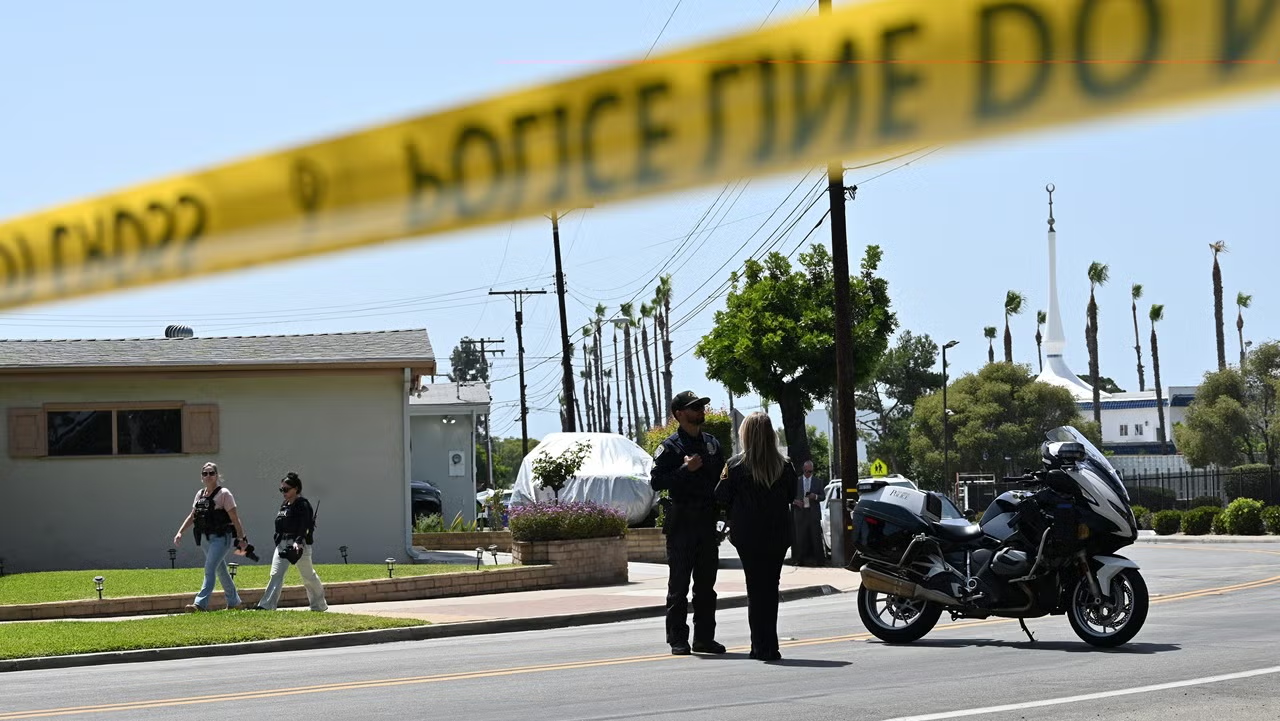
Law enforcement and emergency services respond to a shooting at the Islamic Center of San Diego (ICSD) on May 18, 2026, in San Diego, California.



Targeted violence is a premeditated and planned act of violence against a specific individual, group, or location. The attacker deliberately chooses their target, often based on a grievance or goal, and prepares and plans the attack in advance. Examples include mass shootings and terrorist attacks, such as the 2018 Tree of Life synagogue shooting and the 2025 Antioch High School shooting.
Targeted violence is distinct from violence that is random or impulsive, such as an act of road rage or a bar fight. Perpetrators typically display warning behaviors that suggest violence as a possible outcome, such as fixating on a particular target, showing interest in previous attacks and attackers, and making direct or veiled threats.
The Pathway to Violence is a general model developed by threat assessment practitioners that helps explain how and why someone moves toward committing an act of targeted violence. Each stage along this path reflects an escalation in thought and behavior, leading toward violence. The pathway consists of the following steps:
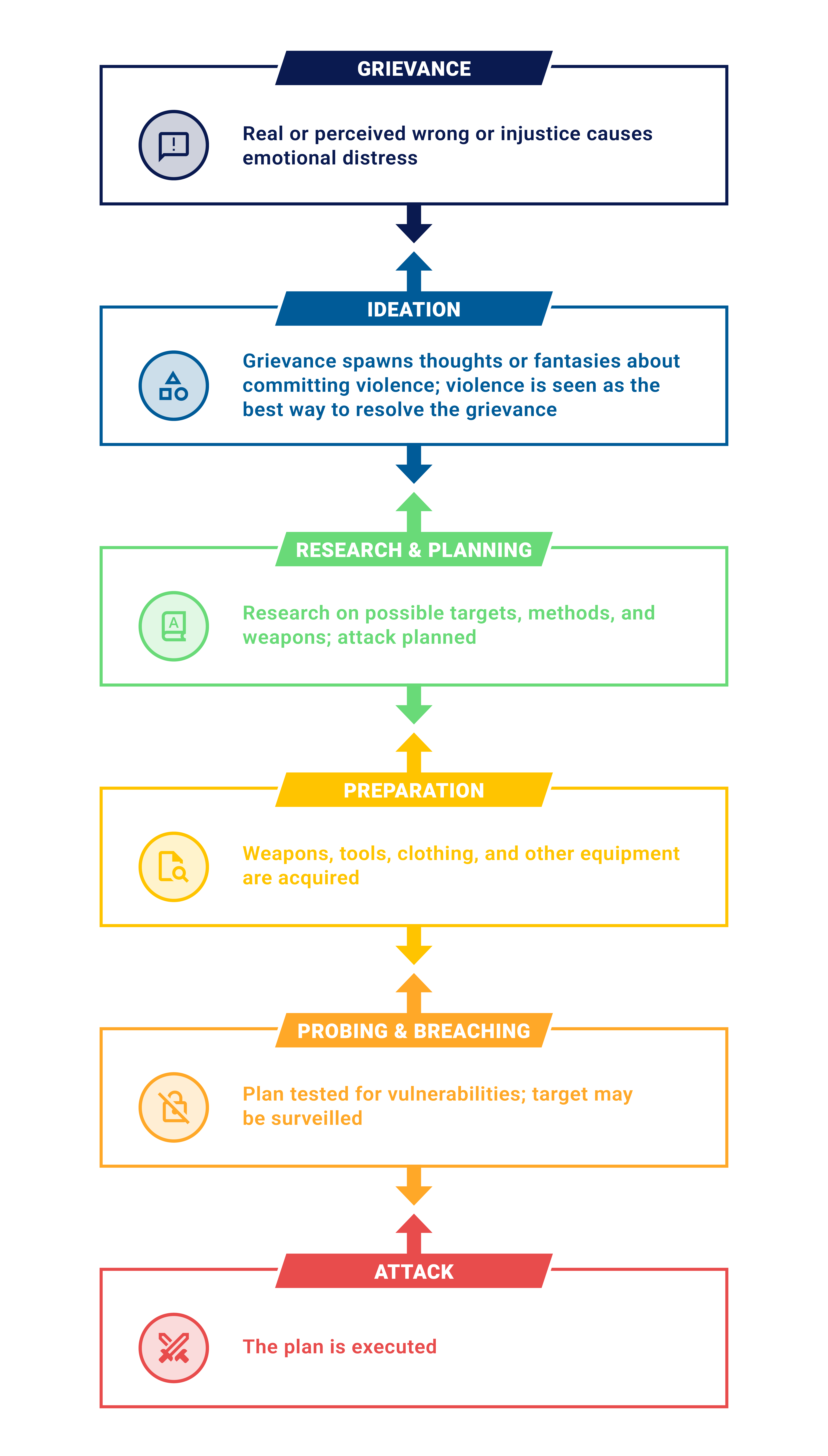
The Pathway to Violence.
The Pathway to Violence is not linear. Individuals may progress forward, move backward to earlier stages, skip stages entirely, or remain at one stage for extended periods. Some people move rapidly through the pathway, while others progress more slowly.
The timeframe varies considerably: Some individuals plan an attack over several years, while others move from grievance to action in just a few weeks or months. Individuals may also cycle through stages multiple times before ultimately carrying out an attack.