Conversations that Matter: Understanding and Discussing Antisemitism with Young People
Tools and Strategies
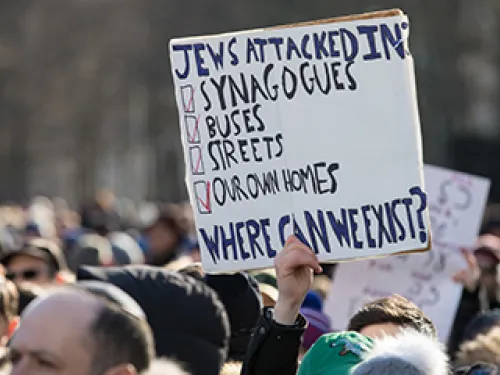
This resource assists parents, families and other trusted adults in understanding and helping the young people in their lives who are facing antisemitism—in school, online, in communities.
This discussion guide about the musical Parade will help middle and high school students and adults reflect upon and discuss the themes and artistic elements of Parade.
Echoes & Reflections
GRADE LEVEL: Middle School, High School
COMMON CORE STANDARDS: Reading, Writing, Speaking and Listening In this unit, students learn about the origins of antisemitism and how this hatred was exploited by the Nazis during the 1920s and 1930s as part of their racist ideology. Students define the terms antisemitism and stereotype, review text and video sources, and create a timeline reflecting examples of antisemitism throughout history. Students will…
Echoes & Reflections: Teaching the HolocaustGRADE LEVEL: Middle School, High School
COMMON CORE STANDARDS: Reading, Writing, Speaking and Listening, Language The lessons in this unit increase students’ understanding of Jewish people and awareness that antisemitism did not end after the Holocaust, and provide them with opportunities to learn about the persistence of antisemitism in its contemporary forms. Students investigate the ways in which old ideas about Jews and Judaism have…
GRADE LEVEL: Middle School, High School COMMON CORE STANDARDS: Reading, Writing, Speaking and Listening This unit provides an opportunity for students to explore Jewish resistance efforts during the Holocaust—focusing on the period from the establishment of the ghettos through the implementation of the “Final Solution.” An opportunity is provided for students to learn about the risks of resisting Nazi domination and the means, scope, and intensity of resistance…
November is Native American Heritage Month, which was first declared by President George H.W. Bush in 1990. The month provides an opportunity to commemorate the rich and diverse cultures, traditions and histories and acknowledge the important contributions of Native American/Indigenous people. It is also an important time to educate the general public, as well as young people in schools, about the bias, discrimination and unique challenges faced by Native American/Indigenous people…
GRADE LEVEL: High School
COMMON CORE STANDARDS: Reading, Writing, Language We see symbols every day in all aspects of our lives. Symbols are used to convey ideas, qualities, emotions, material objects/products, opinions and beliefs. Unfortunately, symbols are also used to convey hate and bias. Lately, we have seen a lot of hate symbol graffiti in public spaces and specifically the swastika, which in most circumstances is understood as an expression of antisemitism. There has reportedly…
Antisemitic Incidents: Being an Ally, Advocate and Activist
Lesson Plan
GRADE LEVEL: Middle School, High School COMMON CORE STANDARDS: Speaking and Listening, Language The surge of antisemitic incidents in the United States is alarming to many. Several reported incidents include graffiti using swastikas, bomb threats, vandalism and shootings, bomb threats targeting Jewish Community Centers (JCC) and Jewish institutions across the country. Over the past 10 years, ADL has recorded a record number of antisemitic incidents across the U.S. Since 2015,…
Martin Luther King, Jr. Day is Monday, January 16, and many educators will take the opportunity to teach about King and his enormous contributions to our society. As educators, how we approach the teaching of this holiday makes an impact on how students understand the larger context of the Civil Rights Movement and whether they make a connection between the past struggles to the current day and their own lives. Here are some thoughts about teaching the topic in a meaningful way…
The Resilience of Antisemitism: The Lies of The Protocols of The Elders of Zion
Lesson Plan
GRADE LEVEL: High School
COMMON CORE STANDARDS: Reading, Writing, Speaking and Listening, Language Since its contrivance at the turn of the twentieth century by the Russian secret police, The Protocols of the Learned Elders of Zion (or The Protocols of the Elders of Zion) has taken root in bigoted and uneducated minds around the world. The booklet’s twenty-four sections spell out the alleged confidential plans of a Jewish conclave seeking to attain world domination. They represent…
Minnijean Brown, Elizabeth Eckford, Carlotta Walls, Mayor Wagner, Thelma Mothershed, Gloria Ray, Terrance Roberts, Ernest Green, Melba Pattilo, Jefferson Thomas.
On September 23, 1957 in Little Rock, Arkansas, these nine African-American students quietly slipped into Central High School through the side door with the assistance of the city’s police, while an angry white mob numbering 1,000 swarmed the front of the school to await their arrival. Upon learning of their entry, the…
More than sixty-five years after Brown v. Board of Education, the promise of equal access to quality education remains unfulfilled. School expulsions and suspensions are among the best predictors of who will drop out of high school and African American students are three more likely to be suspended or expelled than their white peers.
In January 2014, the Department of Education and Department of Justice issued watershed guidance on school discipline with the intent to …
The Civil Rights Act of 1964 was signed into law by President Lyndon Johnson on July 2, 1964. The Act prohibited discrimination in public places, provided for the integration of schools and other public facilities and made employment discrimination illegal based on race, color, religion, sex or national origin. The document was the most sweeping civil rights legislation since Reconstruction. As we commemorate the anniversary of the Civil Rights Act, we have an opportunity to teach and learn…