Research Confirms: Teaching Antisemitism as a Cyclical Conspiracy Theory Works
Article
New research shows the Gringlas Unit effectively teaches students to recognize antisemitism as a recurring conspiracy theory, reducing belief in antisemitic tropes after just one lesson.
Who Leads the Pride: Fostering Student Leadership with Don't Feed the Lion
Article
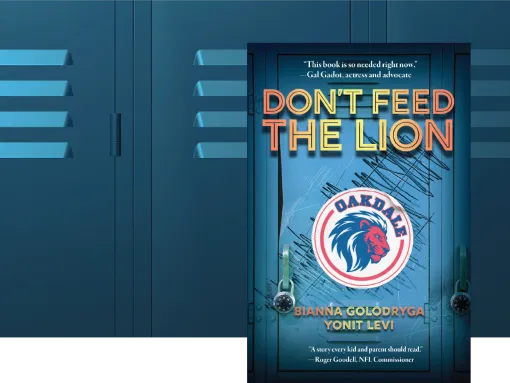
Don’t Feed the Lion: IntroductionDon’t Feed the Lion by Bianna Golodryga and Yonit Levi explores the story of antisemitism growing at Oakdale Middle School. The story begins with Theo Kaplan, a 13-year-old Chicago middle schooler and soccer captain. Theo’s world is turned upside down when his professional soccer idol, Wes Mitchell, makes an antisemitic comment that goes viral. The situation escalates when Theo discovers a swastika…
Beyond the Podium: Jewish Identity, Antisemitism and the Olympic Games
Article
Every two years, we watch athletes compete on the world stage—and what captivates us isn't just the competition. It's the stories: the struggles, the triumphs, the personal journeys that help us see ourselves and others more clearly. The Olympics offer us a unique opportunity to explore something deeper: the complexities of identity—individual and national. When we bring these conversations into our classrooms, we're teaching students to see the human stories behind the…
Tis the Season for Difficult Conversations: A Guide to Online and Offline Discourse
Article
ADL Center for Tech and Society offers a social media explainer to help guide online and offline dialogue around the war in Gaza between Israel and Hamas.
Sport is the setting of some of humanity’s greatest stories. Through the perspective of athletes, teams, fans, coaches, and others, we experience narratives filled with emotions and learn life lessons, like the fulfillment of success and the devastation of failure. Some of these stories are as short as an afternoon, like a pickup basketball game with friends, while others are lifelong journeys, such as unwavering fandom for a favorite team or the privilege of competing on the world&rsquo…
How A Texas Teen Turned Bias and Body-Shaming into Advocacy and Action
Article
Olivia Julianna (who uses only her first and middle name publicly to protect her privacy) has been an activist for several years, advocating voting rights and reproductive-health care. Like many in her generation, she found the political side of TikTok where young people post about important issues facing them. Olivia is involved with Gen-Z for Change, a nonprofit organization leveraging social media to promote civil discourse and political action on a variety of topics including…
The Horrific Mass Shooting in Buffalo: How to Talk with Young People
Article
Another mass shooting has taken place, a violent massacre in which the shooter targeted a Black community after posting a white supremacist tract online that espoused virulently antisemitic and racist beliefs.
On May 14, 2022, a gunman entered a supermarket in a largely Black neighborhood in Buffalo, New York and shot thirteen people, killing ten people and injuring at least three others. Almost all of the victims are Black. The gunman was identified by law enforcement as eighteen…
by: Libby Otto By mid-September, you’re busy with school, work and fall activities. Constitution Day, on September 17, may slip past you without a thought. So why should this year be any different?
Constitution Day is the anniversary of the day that the Founding Fathers signed the United States Constitution. As you reflect this year on how the current political climate and public policies impact millions of people, continue asking yourself: are you making a positive change to…
Martin Luther King, Jr. Day is Monday, January 16, and many educators will take the opportunity to teach about King and his enormous contributions to our society. As educators, how we approach the teaching of this holiday makes an impact on how students understand the larger context of the Civil Rights Movement and whether they make a connection between the past struggles to the current day and their own lives. Here are some thoughts about teaching the topic in a meaningful way…
International Holocaust Remembrance Day: A Backgrounder
Backgrounder
Learn about International Holocaust Remembrance Day, a date that marks the liberation of Auschwitz-Birkenau and is meant to honor the victims of Nazism.
The Civil Rights Movement of the 1950’s and 1960’s came about out of the need and desire for equality and freedom for African Americans and other people of color. Nearly one hundred years after slavery was abolished, there was widespread segregation, discrimination, disenfranchisement and racially motivated violence that permeated all personal and structural aspects of life for black people. “Jim Crow” laws at the local and state levels barred African Americans from…
Minnijean Brown, Elizabeth Eckford, Carlotta Walls, Mayor Wagner, Thelma Mothershed, Gloria Ray, Terrance Roberts, Ernest Green, Melba Pattilo, Jefferson Thomas.
On September 23, 1957 in Little Rock, Arkansas, these nine African-American students quietly slipped into Central High School through the side door with the assistance of the city’s police, while an angry white mob numbering 1,000 swarmed the front of the school to await their arrival. Upon learning of their entry, the…
More than sixty-five years after Brown v. Board of Education, the promise of equal access to quality education remains unfulfilled. School expulsions and suspensions are among the best predictors of who will drop out of high school and African American students are three more likely to be suspended or expelled than their white peers.
In January 2014, the Department of Education and Department of Justice issued watershed guidance on school discipline with the intent to …
The Civil Rights Act of 1964 was signed into law by President Lyndon Johnson on July 2, 1964. The Act prohibited discrimination in public places, provided for the integration of schools and other public facilities and made employment discrimination illegal based on race, color, religion, sex or national origin. The document was the most sweeping civil rights legislation since Reconstruction. As we commemorate the anniversary of the Civil Rights Act, we have an opportunity to teach and learn…
In 1913, the Jewish community in the United States faced rampant antisemitism and overt discrimination. Books, plays and, above all, newspapers, depicted Jews with crude stereotypes. Against this backdrop of bigotry and intolerance, an attorney from Chicago named Sigmund Livingston, put forward a bold idea—to create an organization with a mission “to stop the defamation of the Jewish people, and to secure justice and fair treatment to all…” The Anti-Defamation League…
What was Kristallnacht (kris'·tahl·nockt)?
Kristallnacht, the "Night of Broken Glass," was a wave of violent pogroms against Jews throughout Germany and Austria that took place on November 9-10, 1938. On the night of November 9th, the Gestapo (Nazi State Police) informed local police by telegram about the actions against Jews and their synagogues that would be taking place throughout Germany, instructing them not to interfere with what was happening. During these two nights,…