



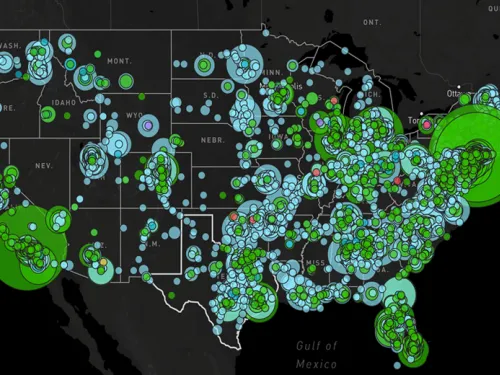

This new annual report from ADL & GLAAD documents extremist and non-extremist incidents of anti-LGBTQ+ hate in the United States.
88 Results
Back
They were ordinary people who lived extraordinary lives – or extraordinary people who put their lives on the line to protect the health and welfare of everyone.
In what has become an annual tradition, as the year comes to a close ADL pauses each December to take stock of the moments and people who shaped the last 12 months – for better, or for worse – with a Top 10 list.
For 2020, we compiled two Top 10 lists: One looking back on the moments of hurt and hate that…
For Law Enforcement
The recent tragic shooting spree in June 2015 that took nine lives at Emanuel AME Church, a predominantly African-American church in Charleston, South Carolina, starkly revealed the pain and suffering that someone motivated by hate can cause. The suspect in the shootings, Dylann Storm Roof, is a suspected white supremacist. The horrific incident—following earlier deadly shooting sprees by white supremacists in Kansas, Wisconsin, and elsewhere—makes…
For Law Enforcement Download the whole report: Bloodlust: Viral News and Calls for the Death of the President (PDF).
Even in the final months of the Obama presidency, an ADL investigation has uncovered, calls on social media for the assassination or execution of President Barack Obama are commonplace. On a regular basis, angry Americans post sentiments such as "If Obama is captured, I will gladly get the noose ready and pull the lever" to social media websites.
These calls for…
Read the full report here: Tattered Robes: The State of the Ku Klux Klan in the United States (PDF).
Despite a persistent ability to attract media attention, organized Ku Klux Klan groups are actually continuing a long-term trend of decline. They remain a collection of mostly small, disjointed groups that continually change in name and leadership. Down slightly from a year ago, there are currently just over thirty active Klan groups in the United States, most of them very small. However,…
The White Power Music Scene in the United States For Law Enforcement Read the full, comprehensive report, The Sounds of Hate: The White Power Music Scene in the United States in 2012 (PDF).
The recent tragic shooting spree at the Sikh temple in Oak Creek, Wisconsin, in which Wade Michael Page killed six people before killing himself after a shootout with police, has drawn attention to the shadowy world of white power music. Page, a committed white supremacist and member of the…

Table Talk: Family Conversations about Current EventsThe CROWN Act is a law that forbids discrimination based on hair texture and hair styles. CROWN stands for: “Create a Respectful and Open Workplace for Natural Hair.” Hair discrimination impacts Black people, especially Black women and girls in schools and workplaces who wear hair styles such as locs, braids, twists, Bantu knots, afros and natural hair. They are punished by discriminatory workplace and school dress codes and…

January 27, 2022 Using children’s literature to teach about Black history and the Black experience is a great way to open the door to discussions about these experiences and milestones. These books include important insights into Black history, culture, accomplishments, notable people, historical and current day injustice and how that injustice was and continues to be confronted and overcome. Our recommended books include…

Table Talk: Family Conversations about Current EventsJuneteenth, also known as “Juneteenth Independence Day,” “Emancipation Day,” "Jubilee Day," or “Freedom Day,” is an annual holiday that marks the end of slavery. The holiday’s name is a blending of the words “June” and "nineteenth." Juneteenth commemorates the day in history that Union General Gordon Granger arrived in Galveston, Texas and informed the enslaved…

April 21, 2021 The verdict has come down. The jury found former Minneapolis police officer Derek Chauvin guilty of second-degree and third-degree murder and second-degree manslaughter in the killing of George Floyd.
On May 25, 2020, George Floyd, a forty-six-year-old Black man living in Minnesota, was killed while being arrested by the police. Derek Chauvin, a white police officer, pinned Floyd to the ground while he was…

March 12, 2021 THE WEEK’S BIG 3
Miami Heat center Meyers Leonard was fined $50,000, suspended from the team's facilities and banned from team activities after he uttered an antisemitic slur while playing video games. Israeli society is increasingly divided, with 81 percent of Israelis stating that they believe that their society is increasingly divided, a 12 percent increase since 2017, according to a new ADL. survey. A panel of South Carolina lawmakers stripped explicit protections…

The number 33 is used by Ku Klux Klan adherents to signify the Ku Klux Klan. Since the 11th letter of the alphabet is K, three Ks signify "KKK" or the Ku Klux Klan. When using this reference, Klan members will frequently add the number 6 at the end, as in 33/6, because they think the Klan is currently in its sixth historical "era." Less commonly, some holdouts may still use the numeric code 33/5. Additional Images:

AKIA is Ku Klux Klan shorthand for "A Klansman I Am." It is related to another Klan acronym, AYAK ("Are You A Klansman?"). These are among the many acronyms developed by the Second Ku Klux Klan that emerged in 1915. Although the Second Ku Klux Klan did not survive, much of its terminology and many of its rituals did, and later Klan groups freely used them. Additional Images:

AYAK is Ku Klux Klan shorthand for "Are You A Klansman?" It is related to another Klan acronym, AKIA ("A Klansman I Am"). These are among the many acronyms developed by the Second Ku Klux Klan that emerged in 1915. Although the Second Ku Klux Klan did not survive, much of its terminology and many of its rituals did, and later Klan groups have freely used them. Additional Images:

ALTERNATE NAMES: Ku Klux Klan, MIOAKGroup Status: Active (in that there are many active Ku Klux Klan groups)
For the past century, the primary symbol related to Ku Klux Klan groups (other than Klan robes themselves) is what Klan members may call the MIOAK (an acronym for "Mystic Insignia of a Klansman"). It is more commonly referred to as the "Blood Drop" Cross. It appears as a square white cross in black outline against a circular red background. In the middle of the cross is what appears…
ALTERNATE NAMES: Ku Klux Klan, MIOAK
Read more about Blood Drop Cross

The image of the burning cross is one of the most potent hate symbols in the United States, popularized as a terror image by the Ku Klux Klan since the early 1900s. Cross-burnings (called "cross-lightings" by Ku Klux Klan groups, to make it seem as if they are not destroying a Christian cross) have long been used as a traditional symbol by Klan groups, used both in Klan rituals as well as in attempts to intimidate and terrorize victims of Klan groups. So widely associated with racial…

ALTERNATE NAMES: For God, Race and NationFGRN is a Ku Klux Klan acronym for "For God, Race and Nation," a common Klan slogan. It is one of a number of slogans, codes and rituals created by the Second Ku Klux Klan in the early 20th century. That Klan did not survive, but many of its codes and rituals were adopted by later Klan groups. In acronym form, the slogan is used primarily as a Klan identifier, typically appended at the end of on-line messages and postings. Additional Images:
ALTERNATE NAMES: For God, Race and Nation
Read more about FGRN

ITSUB is a Ku Klux Klan acronym for "In The Sacred Unfailing Being," a reference to God. It is one of many Klan acronyms created by the Second Ku Klux Klan that emerged in 1915. That Klan did not survive, but subsequent Ku Klux Klan groups continued many of its rituals and codes. Today, ITSUB has no real meaning or particular purpose and is typically used by Klan group members in on-line messages or posts solely as a way to identify themselves with the Ku Klux Klan. This has been the fate of a…

KABARK is a Ku Klux Klan acronym for "Konstantly Applied By All Regular Klansmen." It is one of many acronyms and codes developed by the Second Ku Klux Klan in the early 20th century. The Second Ku Klux Klan did not survive, but later Klan groups continued many of its codes and rituals. Today, KABARK is essentially meaningless and only used as a "sign off" in on-line messages by Klan group members, along with several other similar archaic acronyms. Additional Images:

KIGY is Ku Klux Klan shorthand for "Klansman I Greet You." It is one of many acronyms developed by the Second Ku Klux Klan that emerged in 1915. Although the Second Ku Klux Klan did not survive, much of its terminology and many of its rituals did, and later Klan groups freely used them. Additional Images: