



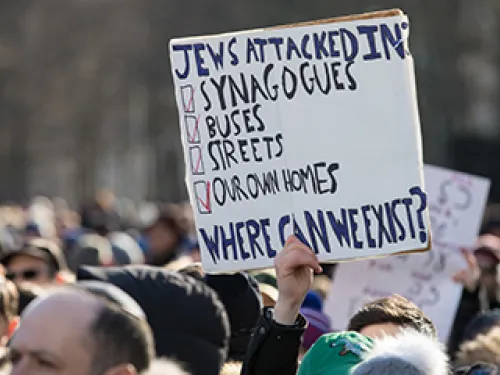




Dear President [Last Name], I am reaching out to address a pressing concern: the increasing prevalence of shadow boycotts targeting Israeli, Jewish and openly Zionist academics at [University Name] and institutions nationwide. This harmful trend, which has grown in response to the Israel-Hamas war, undermines the values of academic freedom and diversity that form the cornerstone of higher education. Shadow boycotts entail the subtle yet systematic exclusion of Israeli, Jewish or openly Zionist…
20 Results
Back
ADL is addressing antisemitism through advocacy and education to help Jewish students, teachers and allies feel safe in the classroom. Explore the toolkits now!
IntroductionThese talking points address critical issues about university endowment divestment from companies doing business in Israel. We aim to provide comprehensive insights into the economic, legal, academic, and social implications of such decisions. Background and Key Definitions1. ADL believes that many of the founding goals of the BDS movement, which if implemented, would eradicate Israel, are antisemitic. Some BDS advocates and campaigns engage in antisemitic rhetoric. Boycott,…

This parent/family discussion guide helps families engage in a discussion about the October 7, 2023 Hamas attack on Israel, its aftermath and how families can help.
Definiciones de antisemitismo, antisionismo y prejuicio antiisraelí comúnmente utilizadas y malinterpretadas.
Preguntas frecuentes sobre la libertad de expresión, su protección y las diferencias entre universidades públicas y privadas.
Cómo mantener un debate concienzudo sobre el conflicto palestino-israelí y evitar los errores más comunes que podrían invocar el antisemitismo, el sesgo o la intolerancia.
Learn tips on how to have conscientious discussions about this complex issue and how to avoid common pitfalls that could invoke antisemitism, bias or bigotry.
ADL has developed resources to help you respond to antisemitic incidents and anti-Israel bias. Explore these tools and learn more.
Definitions of antisemitism, anti-Zionism and anti-Israel bias.
Note: This letter was published in The New York Times on July 10, 2020. July 9, 2020
Letters to the Editor
The New York Times
To the Editor:
Re “I No Longer Believe in a Jewish State” (Op-Ed, July 9):
With all his soothing words about equality and blissful coexistence, Peter Beinart is calling for the elimination of the Jewish state itself. His contortions to argue that Zionism does not require an independent Jewish state are transparently false and a tactic to…
The follow letter was submitted to The Daily in response to "Netanyahu Won. The Two-State Solution Lost" (April 11) Lisa Tobin
Executive Producer, The Daily
Dear Ms. Tobin:
The Daily Podcast of April 11 was riddled with inaccuracies, omissions and premature conclusions.
Yes, for those of us who believe that Israel needs a two-state solution as much as the Palestinians, there are worrying trends, including the prime minister’s campaign statement about annexing…
The following letter was submitted to The New York Times in response to "Israel Courts Catastrophe in Gaza Protests" (April 2, 2018) Letters to the Editor
The New York Times
To the Editor:
Re "Israel Courts Catastrophe in Gaza Protests" (Editorial, April 2, 2018):
There are legitimate issues to be raised concerning Israel's policy vis-a-vis Hamas and Gaza, including the issue of access of the population to the outside world and the extent of the use of force…
What is the source of our free speech rights? Free speech rights emanate from the First Amendment to the U.S. Constitution[1] and from state constitutions. The U.S. Constitution limits the government’s ability to regulate speech based on content and it applies to all public colleges and universities. It serves as a floor, not a ceiling. State constitutions may grant more robust free speech rights than the U.S. Constitution, but never fewer. Is there a distinction between private and…
ADL reacted to an op-ed in The New York Times which "bears no resemblance to the complicated reality" between Israel and the Palestinians. Letters to the Editor
The New York Times
To the Editor:
Re “Israel’s Everlasting Occupation” (Sunday Review, June 4):
Nathan Thrall attributes to Israel an early determination to hold on to the territories. In fact, from the outset after the Six-Day War, Israel saw its winning territory as a perfect bargaining chip…
ADL responds to an article in The New York Times titled "Hamas Tempers Extreme Stances in Bid for Power” which appeared on May 2, 2017. Letters to the Editor
The New York Times
To the Editor:
The story of a new Hamas statement of principles, with all the fuss and anticipation, is much ado about nothing. On the core of Hamas’s attitudes and policies toward Israel, nothing has changed.
For Hamas, there is only one legitimate authority in the Holy Land. Israel,…
ADL letter to the public editor concerning convicted Palestinian terrorist Marwan Barghouti. Letters to the Editor
The New York Times
To the Public Editor:
We appreciate your comments about the Times failure with regard to the article by Marwan Barghouti. Unfortunately, it did not go far enough nor did the newspaper's clarification.
Yes, Mr. Barghouti was not merely a Palestinian parliamentarian. He was convicted of murder by an Israeli court.
Also important…
This letter was written in response to an article that appeared in The Nation regarding zionism and feminism. Letters to the Editor
The Nation
To the Editor:
My parents came to Israel from Morocco, a country where Jews and Muslims lived together in harmony for centuries. They instilled in me and my siblings a loving humanism that demands we treat people of different race, gender, and religion with equal respect. As an Israeli woman, I inhabit multiple identities…
Advocating to Elected Officials
Advocating to the Media
Advocating on Campus
Most Americans’ perceptions of the Middle East conflict come from the mass media. Some media – especially large-circulation daily newspapers, network television and wire services – have correspondents based in Israel and continue to devote considerable attention to the Mideast. This is not surprising considering the intensive U.S.involvement in the peace process, America’s substantial interests in the region, and the continuing strong ties between the U…