








Unsplash.com


The popular image of the mass shooter who suddenly snaps has little basis in reality. Attacks are planned, sometimes over many months, and are often preceded by observable warning signs. According to a study published in 2026 of 171 mass shootings across the U.S. between 1999 and 2024, most attackers displayed warning behaviors before their attack. In a majority of cases, these attackers explicitly communicated their plans to at least one person.
Family members, classmates, friends, or coworkers have traditionally been the first to notice warning signs in a person on a pathway to violence, simply because they interact regularly and can pick up on changes in behavior that others might miss. That circle of potential observers has widened considerably in recent years. As people spend more time on social media and other virtual spaces, strangers online are increasingly the first to encounter warning signs from someone considering violence.
Targeted violence is preventable. Research shows that between 1995 and 2020, when warning signs were reported to law enforcement in advance, mass casualty plots were stopped more than 80 percent of the time. Nearly two-thirds of these warnings came from members of the public. In February 2025, an anonymous tip to the Sandy Hook Promise tipline allowed law enforcement to stop a planned shooting at a high school in Indiana. This represents just one of hundreds of threats that have been averted because someone spoke up. Each person who reported concerning behavior acted as an upstander: someone who noticed concerning signs and reported them to someone who could help, whether a mental health professional, teacher, employer, police officer, or threat assessment team.
The public is the first line of defense against targeted violence. The difference between a foiled plot and a completed attack often comes down to whether one person decides to speak up.
Common warning signs include:
No single warning sign necessarily means a person is planning an attack, but the presence of several at once may be cause for concern. Signs that someone has moved from thinking about violence to actively preparing (such as acquiring weapons alongside talk of wanting to kill others) likely warrant immediate reporting. Explicit statements of intent to harm oneself or others should also be taken seriously and reported appropriately.
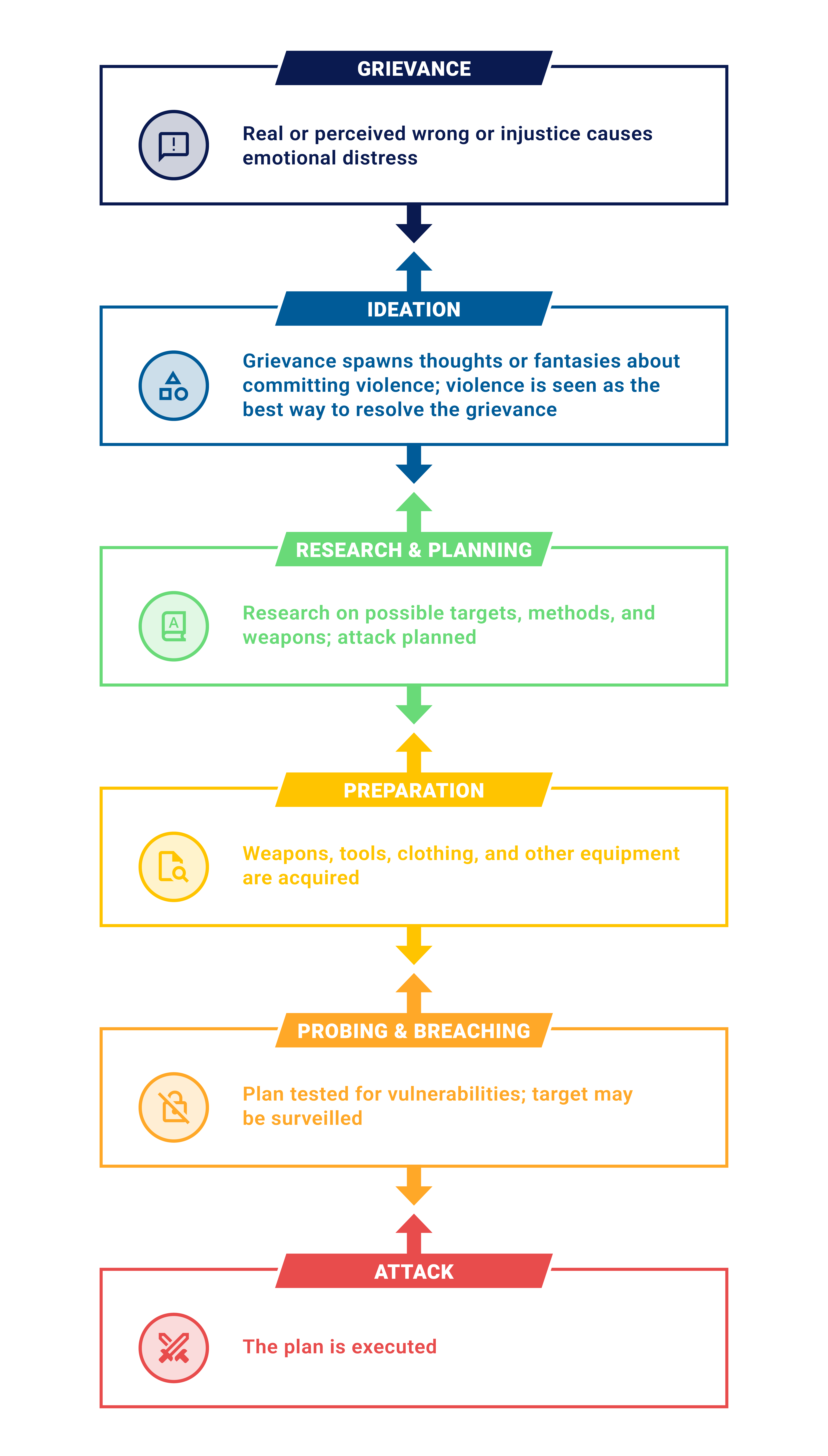
The Pathway to Violence.
Multiple resources are available for reporting concerning behavior:
Reporting is key to prevention. If you see something concerning, speak up. You don’t need to be certain that someone poses a threat. Threat assessment teams are trained to evaluate credible concerns and whether someone poses a real threat. The cost of speaking up is small. The cost of silence can be devastating.