




(Spencer Platt/Getty Images)
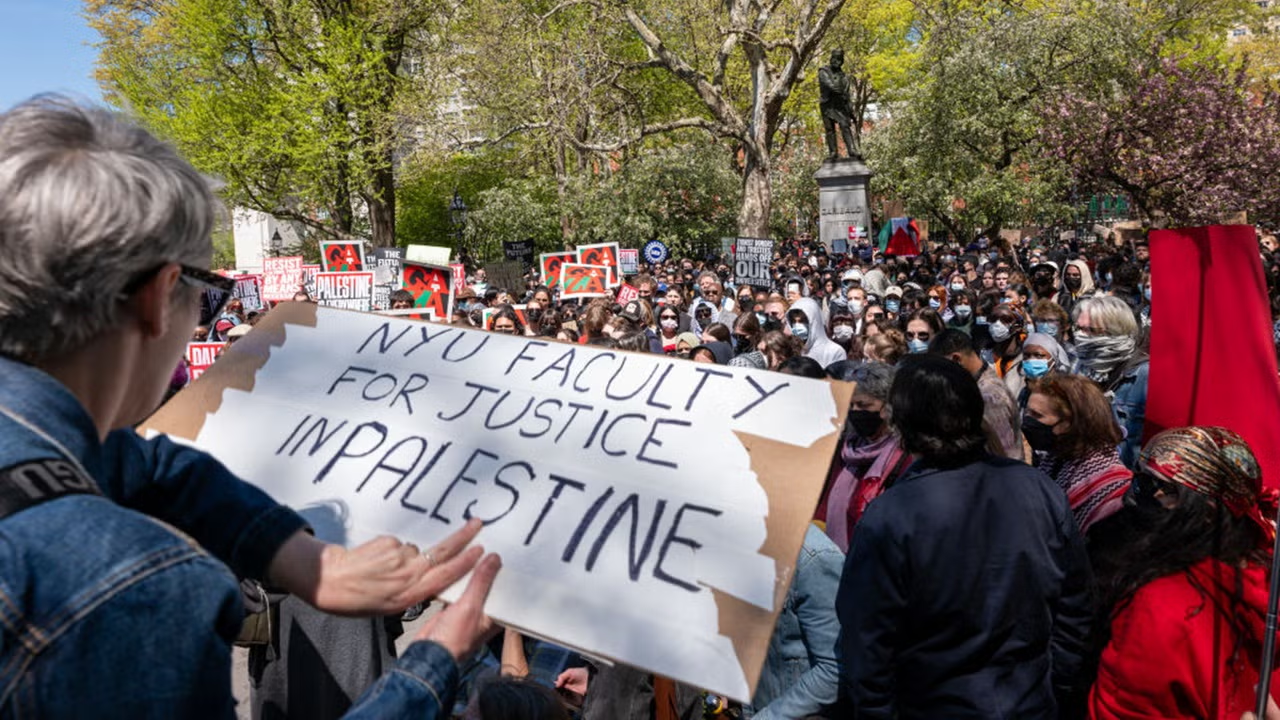
New York University (NYU) students and faculty participate in a protest against the war in Gaza at Washington Square Park on April 23, 2024, in New York City.


Across U.S. university and college campuses, an organized segment of faculty groups, unions, and networks has emerged as a significant force driving belligerent anti-Israel rhetoric and activity. In some cases, this activity has also crossed into antisemitism.
This report focuses on networks of professors and staff members of all ranks and statuses who actively participate in or lead anti-Israel and anti-Zionist organizing on and around campus.
Since the 2024 wave of encampments, in which some faculty participated, certain faculty networks have collaborated with anti-Israel and anti-Zionist student groups to provide institutional cover for student activists and normalize extreme hostility towards Israel as legitimate academic discourse, while creating hostile environments for Jewish students, staff and faculty. This has resulted in disciplinary cases against faculty, some of which are still being resolved.
The impact of this campus atmosphere is measurable, though the available data only begins to capture its full extent. In a 2025 ADL/AEN survey of 209 Jewish-identifying faculty, nearly three-quarters reported observing anti-Jewish activity originating from other faculty, staff, or administrators. Respondents described feeling “continuously traumatized by the actions, even in online posts, of the main faculty, who deny antisemitism on campus (unless directly affected) and minimize what others may be experiencing,” being told by a non-Jewish faculty member that they “had no idea what antisemitism was,” and being ostracized or excluded. “Faculty are not talking to me because they know I'm a Zionist,” said one respondent.
These faculty and staff networks seek to influence university policy, curricula, institutional ties, and public discourse. Their members organize and actively participate in anti-Israel protests and activities, some of which have crossed into antisemitism through the use of classic antisemitic tropes, the targeting of Jewish organizations and individuals, and open hostility toward Jewish students and colleagues. Some of these protests have led to clashes with law enforcement, arrests, and extensive damage to campus property.
These same networks challenge institutional relationships with Israel, advance the broader Boycott, Divestment and Sanctions (BDS) movement, and seek to disrupt university events. Some behavior in lecture halls also occasionally creates difficult environments for students and colleagues.
The influence of these networks extends to Jewish campus life more broadly. Faculty campaigns to sever ties with Jewish organizations such as Hillel, protests of Jewish events, and public support for students engaged in problematic campus activity, including encampments, have contributed to an overall environment in which Jewish and Israeli students, staff, and faculty face exclusion, intimidation, and at times, explicit hostility impacting safety.
The scale of faculty leadership, participation, and intervention during the spring 2024 encampments was without precedent. Faculty play a pivotal role in shaping how students engage with identity, conflict, and debate. The decision by some to participate in the encampments and intervene directly on behalf of encampment protesters became a flashpoint for students and faculty across the country. Some faculty and teaching assistants also cancelled classes in “solidarity” with student protesters, and held teach-ins or classes within the encampments. Others made class attendance optional.
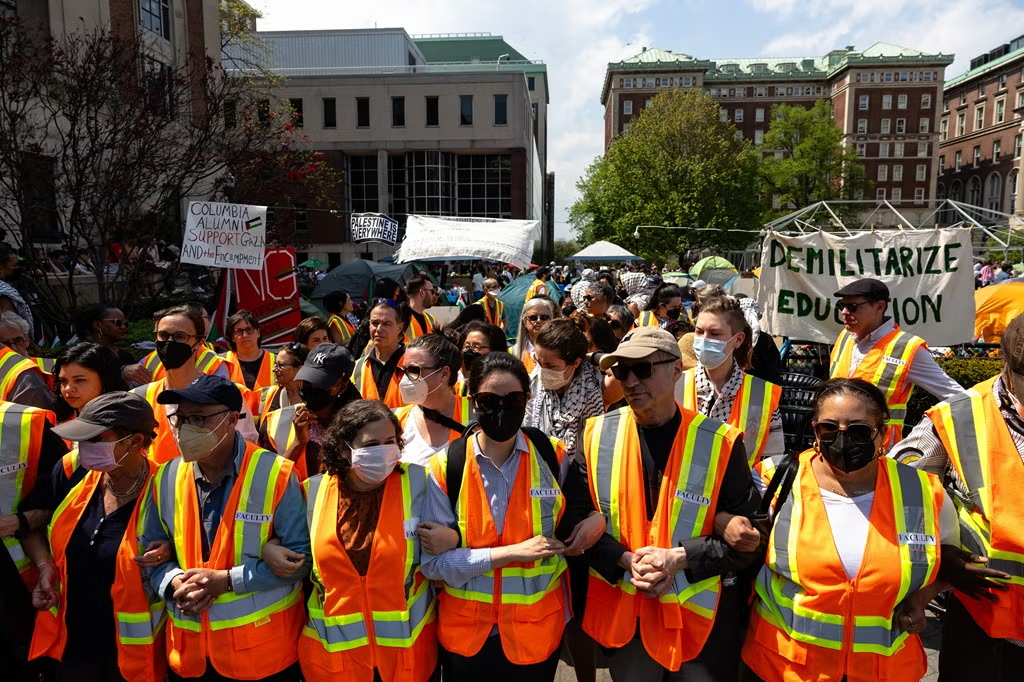
In some cases, faculty acted to impede law enforcement when universities moved to dismantle the encampments. At New York University and Columbia University, faculty formed a physical "protective wall" around student encampments to prevent officers from clearing public areas. At Northwestern University, a group of faculty members locked arms to block university police from reaching student tents.
(Michael M. Santiago/Getty Images)
Columbia faculty members protect students in the "Gaza Solidarity Encampment" on the West Lawn of Columbia University on April 29, 2024, in New York City.
At the University of Illinois, Associate Professor Maryam Kashani, of the Gender and Women's Studies and Asian American Studies departments, was direct about the strategic value of faculty presence: "I think there's a certain legitimacy that comes with the letters before our names."
In other cases, faculty did not just protect encampments but actively built and promoted them. At California Polytechnic University, Humboldt, faculty participated in and helped sustain a campus encampment. At San Jose State University, Professor Sang Hea Kil, faculty advisor for the campus SJP chapter, described spending a week helping establish the encampment at San Francisco State University and then encouraging San Jose State students to replicate it.
The encampments prompted many colleges and universities to revise their time, place, and manner policies for protests and activities, and some schools are only now resolving disciplinary cases against faculty and students who participated.
The antisemitic elements in some faculty-organized encampments were explicit. During a May 2024 encampment organized by Faculty and Staff for Justice in Palestine (FSJP) at Southern Illinois University Carbondale, protesters chanted, "There is only one solution; Intifada, revolution," a slogan widely understood as a call for violence against Israel and the Jewish community.
Faculty unions and governing bodies have also been using their institutional platforms to advance BDS resolutions, push for amnesty for students who violated campus conduct policies, and obstruct the adoption of formal antisemitism definitions. These bodies carry authority over disciplinary standards, hiring, publishing, and conference participation. Their positions can legitimize antisemitism and hinder academic freedom within their departments.
Recent examples of this environment:
The following details some of the major faculty networks, organizations, and unions that are driving some of these efforts on campus. While each operates independently, their combined reach across U.S. campuses is significant and still growing.
Faculty and Staff for Justice in Palestine (FSJP) is a growing network of more than 130 affiliated university faculty and staff groups, principally operating in the United States with some chapters in Canada. The network formed in February 2024 after several academic groups banded together to organize, partly in response to a call by the U.S. Campaign for the Academic and Cultural Boycott of Israel (USACBI).
Through their authority, tenure protections, and access to administrative channels, FSJP chapters actively support local Students for Justice in Palestine (SJP) chapters and anti-Israel campus unions, amplifying their influence and working to protect them from disciplinary consequences by university administrations.
FSJP chapters endorse BDS efforts, particularly against Israeli academic and cultural institutions, and promote activities supporting the "cause of Palestinian liberation." For example, a Pratt Institute FSJP solidarity letter calls for a full ”academic and cultural boycott of Israel." Rutgers FSJP posted a statement in March 2024 endorsing the Rutgers University Student Assembly (RUSA) Spring 2024 divestment referendum and alleging that "Israeli universities, including TAU, are complicit in this campaign of 'cultural genocide.'"
FSJP promotes the belief that Israel is a settler-colonial, racist, and apartheid state, and that Israel and Zionism must be understood as part of "interlocking systems of oppression underpinned by global white supremacy and racial capitalism."
The group’s organizing is strategic. Dana Morrison of the FSJP chapter at West Chester University in West Chester, Pennsylvania, noted in a November 2025 interview that faculty on her campus are careful to develop faculty-oriented divestment campaigns instead of starting campus-wide efforts, so students can learn to organize themselves. At the University of Massachusetts Amherst (UMass Amherst) in Amherst, Massachusetts, FSJP members said the chapter focuses on supporting student divestment campaigns and carving out spaces for anti-Israel advocacy in the face of the "repression of the free exchange of ideas." Cedric de Leon, a university faculty and FSJP member, noted in a January 2026 interview that the campus chapter had "organized a lot of direct action," which he described as "petition campaigns, sit-ins, and of course our encampment."
In some cases, various chapters have also deployed overtly antisemitic rhetoric. For example, in May 2025, the FSJP chapters at the University of Pennsylvania, Drexel University, and Bryn Mawr-Haverford College (Bico) were among the co-organizers of a protest where protesters displayed the flag of the Popular Front for the Liberation of Palestine (PFLP), a U.S.-designated terror organization, along with signs reading "Long Live the Intifada" and "Victory to the Resistance" a phrase commonly used to euphemistically indicate support for U.S.-designated terrorist groups, including Hamas and others.
In August 2025, FSJP Bryn Mawr-Haverford College (Bico) posted a cartoon to its Instagram story of a character with a Jewish Star of David on his chest first attempting to hide or downplay news about the war in Gaza. The next panel shows the character appearing to deny or care about the news once they “realise [sic] there are no consequences."
The reach of FSJP chapters is broad and consequential. In the 2025 ADL/AEN survey, 44% of respondents were aware of a chapter on their campus, with the overwhelming majority reporting those chapters organized protests (79.4%), hosted anti-Israel programming (77.2%), and endorsed divestment campaigns (84.8%). When faculty, staff, and administrators legitimize this activity, there is a risk of emboldening antisemitic attitudes among students.
Founded in 1915, AAUP’s stated mission is to advance academic freedom, shared governance and the economic security of faculty and academic professionals. It counts over 500 chapters at accredited colleges and universities nationwide.
In practice, a number of AAUP's publications and positions have minimized antisemitism on campus and adopted rhetoric hostile to Israel. In one publication, the organization characterized the establishment of the State of Israel in 1948 as "the contemporary world's most egregious instance of settler colonialism" and "ethnic cleansing," language that goes beyond any criticism of Israeli policy.
AAUP has also actively pushed back against key tools used to identify and address campus antisemitism. In a November 2025 report titled "Discriminating Against Dissent,” the organization framed the International Holocaust Remembrance Alliance (IHRA) definition as problematic, arguing that many Title VI complaints relying on IHRA examples improperly frame anti-Zionism as "necessarily antisemitic” and recast "speech supporting Palestinian armed resistance as antisemitic harassment." The report downplays these complaints as politically motivated and argues that the IHRA definition turns what the AAUP characterizes as political criticism into hate speech, impacting academic freedom. It offers no alternative framework to the IHRA and no actionable tools to address the genuine safety concerns of Jewish students while focusing almost exclusively on protecting anti-Zionist speech.
In 2025, a coalition of major Jewish organizations sent a letter to AAUP noting that the organization "now appears to have become yet another anti-Zionist labor union."
The California Faculty Association (CFA) is a union representing over 29,000 professors, lecturers, librarians, counselors and coaches across the California State University (CSU) system.
In late 2025, mainstream Jewish organizations accused CFA of antisemitism when the organization asked in a candidate questionnaire whether respondents have "endorsements or take contributions from groups and sectors like AIPAC/JPAC, the oil industry, the tobacco industry, police associations, etc." CFA said the faculty union won’t support candidates who accept money from groups that "harm working people." It later apologized.
The CFA also denounced California Assembly Bill 715 as a "threat to free speech and academic freedom" and has faced criticism for antisemitism within its ranks. AB 715, signed into law in October 2025, strengthens protections for Jewish and Israeli students against antisemitism and other forms of discrimination in California's K-12 public schools. It does so by imposing clearer obligations on districts, educators, and instructional providers, and creates the role of an Antisemitism Prevention Coordinator to educate teachers and school leaders about antisemitism. In September 2025, Melina Abdullah, CFA’s Political Action & Legislation Committee chair, streamed a class where she advocated for students to urge the governor to veto AB 715. Describing bill co-authors Rick Zbur and Dawn Addis as "two Zionist state legislators," she also claimed that "AIPAC has bought and paid for almost every single member of Congress," invoking the antisemitic trope of Jewish money controlling U.S. politics.
The CFA has also explicitly made anti-Israel rhetoric a major priority for union business, which too creates a hostile environment for Jewish and Israeli members of educational communities. At its Fall 2025 Assembly, a CFA leader declared: "Palestine is a labor issue… Faculty are workers, and communities are our core and our center."
Months earlier, in April 2025, the CFA adopted a resolution calling on California State University to end study-abroad programs and partnerships with Israeli universities, a core pillar of the BDS movement.
The Coalition for Action in Higher Education (CAHE) is an organizing collective formed in 2023 that describes its vision for higher education as "truly anticolonial, antifascist, antiracist, anticapitalist, feminist and free." Its membership includes campus faculty, staff and organizations such as AAUP and Jewish Voice for Peace (JVP), an anti-Israel and anti-Zionist activist group that advocates for the eradication of Zionism and the boycott of Israel. While CAHE frames its mission around access and academic freedom, much of its organizing centers on Palestinian solidarity.
CAHE organized Days of Action in 2024, 2025, and 2026, where supporters held rallies, teach-ins, and event tabling. The 2026 Day of Action claimed to be about free education in every sense, tuition-free and free to dissent, but most sessions were focused on Palestine or academic freedom issues related to the conflict. A press release for the 2025 Day of Action claimed that a major goal of the day’s events was "to link the struggle for free speech around Palestine to the financial, political, and ideological assaults on higher and public education."
There is significant overlap with CAHE and AAUP, with many coalition organizers drawn from AAUP networks. AAUP was a major organizer of activities for CAHE’s 2024, 2025, and 2026 Day of Action events.
At the 2026 CAHE Day of Action webinar announcing the launch of a new initiative titled "Conscientious Objection Pledge to End Complicity in Genocide & Apartheid," Professor Barry Trachtenberg of Wake Forest University in Winston-Salem, North Carolina, said that institutions "cannot cooperate with Israeli universities, research centers, libraries, grants, and language academies while also claiming to oppose apartheid and genocide."
He also described the period after the Spring 2024 encampments as an opportunity to work "hand-in-hand with student groups to be laying foundations that can be more sustainable beyond those brief moments of intense activism."
Launched in December 2024, Sanctuary Campus Network (SCN) is a "coalition of students, faculty, and staff organizing to protect and support those most vulnerable against state repression and violence under the current administration." Though primarily focused on protecting marginalized students, particularly immigrants, SCN links much of its work to Palestine solidarity organizing.
SCN has organized with and supported SJP chapters, encouraged work with faculty senates, invited Jewish Voice for Peace (JVP), an anti-Israel and anti-Zionist activist group that advocates for the eradication of Zionism and the boycott of Israel, to speak at meetings, and recommended JVP's toolkit as a campus organizing resource. In early planning meetings, SCN meeting participants drew inspiration from FSJP’s organizing model. Some SCN members are also active with FSJP.
SCN was identified as critical to organizing within academic unions by CAHE leader and AAUP member Professor Bill Mullen of Purdue University. This recognition, alongside SCN’s organizational ties to FSJP and JVP and its integration into faculty senates, makes it a network worth noting as the movement continues to evolve and expand its infrastructure.
There is significant overlap between faculty networks, professional academic associations, unions and student groups, an interconnection that intensified following the Hamas-led October 7, 2023, terror attacks.
Mullen, the AAUP member and CAHE leader, also leads a caucus within the American Studies Association (ASA), the Caucus on Academic and Community, that he has described as a deliberate vehicle for influence that actively recruits students and faculty into its activities: "We especially recruited new members into the caucus whose politics on Palestine were going to align with our own. Via the caucus, we wanted to remake the ASA in an anti-Zionist direction."
The overlap is visible at the individual level as well. Professor Corinna Mullin, an adjunct professor let go after her participation in an encampment, described in a February 2026 video how she had simultaneously been actively organizing within and outside CUNY, serving as a faculty advisor to SJP, and holding a position as a union delegate.
(Andrew Harnik/Getty Images)
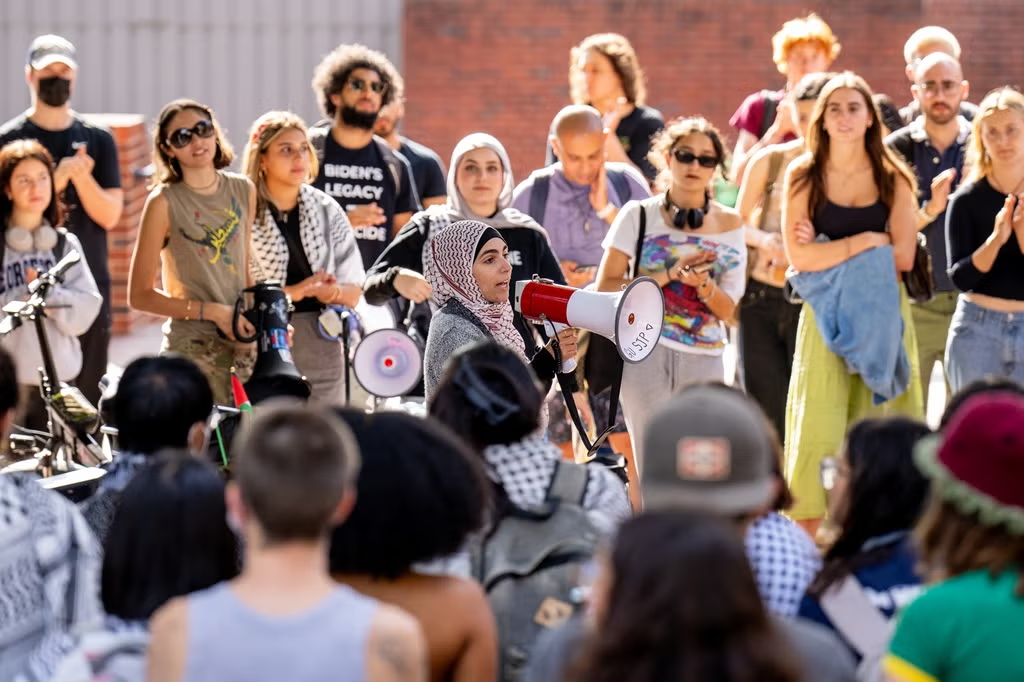
A woman speaks as Georgetown students hold an on-campus protest at Georgetown University on September 4, 2024, in Washington, D.C.
On some campuses, the difference between student, faculty, and community organizing is minimal, as campus and off-campus groups merged. At North Carolina State University, the campus's Dissenters group merged with off-campus organizations. Anthropology Professor Chelsey Dyer, faculty advisor of the school's Dissenters chapter, speaking in a November 2025 interview, said this fusion allows professors to show up as peers rather than authority figures, shifting the power dynamic. At the University of Texas at Austin, Professor Karma Chávez, an AAUP and FSJP volunteer, described a similar pattern in a July 2025 interview, noting that students found "unexpected security in local progressive churches," which served as organizing "headquarters” when campus protests became "risky."
This merging in some locations of on- and off-campus infrastructure suggests this movement is working to deepen its roots in the broader community and retain organizers past graduation.
The post-October 7 campus protest movement is sustained by an interconnected network of faculty activists, professional associations, unions, student organizations, and community groups that increasingly operate across organizational and geographic boundaries.
These relationships enable the sharing of resources, organizing expertise and strategic frameworks, helping activism persist beyond individual protest cycles and campus administrations. Faculty networks in particular serve as connective tissue linking campus-based activism to broader professional, labor and community infrastructures.
For universities, policymakers, alumni and donors seeking to understand this landscape, visible demonstrations are only part of the picture. The networks that organize, support and sustain them have real consequences for Jewish and Israeli students, staff and faculty, who continue to navigate campuses where hostility toward them has been normalized, legitimized and, in some cases, actively encouraged. They demand equal scrutiny.