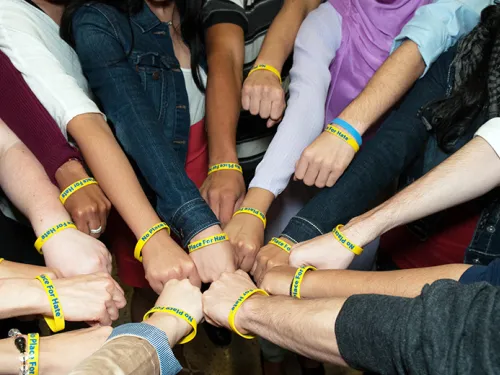






These suggested No Place for Hate® activities are differentiated for elementary, middle and high school students. The activities below can be used as a follow-up to watching the webinar, “Do More with No Place for Hate:” which aired on 10/23/25. To make this a NPFH activity towards designation, watch the video, engage students in a discussion using the discussion questions and do one of the additional activities included below. About the WebinarJoin author Dana Kramaroff for a…
275 Results
Back
To what degree do an author’s objectionable comments, unrelated to their books, matter when being a consumer of those books? J.K. Rowling’s bestselling seven-volume Harry Potter books are cherished by children and adults alike. Rowling has sold more than 500 million copies and the books have inspired movies, theme parks, toys, collectibles, merch and more. According to a U.S. survey, 31% of people have read at least one of Rowling’s books, 18% of people have read all of…
The #DropTheADL is not a good-faith critique of ADL’s work. Use this guidance to understand the campaign and push back.

They were ordinary people who lived extraordinary lives – or extraordinary people who put their lives on the line to protect the health and welfare of everyone.
In what has become an annual tradition, as the year comes to a close ADL pauses each December to take stock of the moments and people who shaped the last 12 months – for better, or for worse – with a Top 10 list.
For 2020, we compiled two Top 10 lists: One looking back on the moments of hurt and hate that…

By
Mark Kumleben and Samuel Woolley
Propaganda Research Team
Center for Media Engagement
University of Texas at Austin
Maggie Engler
Global Disinformation Index Much of online speech today occurs on social media platforms like Facebook where a few companies have attained an outsized influence on what is permitted discussion on the internet. The rules and enforcement of the rules around speech on social platforms have far-reaching societal implications -- they can determine…
The following report is an analysis of computational propaganda, the Jewish American community, and the 2018 elections. As part of the wider paper series focused on “humanizing the effects of computational propaganda” this empirical work details the ways in which the Jewish socio-religious population in the U.S. is being disproportionately targeted with disinformation and abuse during this crucial political moment.

Misogyny is a dangerous and underestimated component of extremism, and it shares alarming common ground with white supremacist ideology.

Educators can teach young people what antisemitism is, where it comes from and what it looks like today, so they can recognize and report it.
ADL Title VI Settlement with Colorado District Leads to Sweeping Reforms
New York, NY, September 9, 2026 ... Following almost three years of growing antisemitism in K-12 schools, which have included bullying and, in many cases, ostracization, Jewish students across North America are returning to potentially tense classroom environments. To help students, parents, and communities better advocate for themselves, Jewish Federations of North America, the Anti-Defamation League (ADL), American Jewish Committee (AJC), Conference of Presidents of Major…

It’s critical that parents, caregivers and educators learn more about social media and how to support young people in their understanding of its power and limitations.

ADL's research and data on antisemitism provides a bridge between history, current events, and students' lived experiences. Explore the Global 100.

Don’t Feed the Lion: IntroductionDon’t Feed the Lion by Bianna Golodryga and Yonit Levi explores the story of antisemitism growing at Oakdale Middle School. The story begins with Theo Kaplan, a 13-year-old Chicago middle schooler and soccer captain. Theo’s world is turned upside down when his professional soccer idol, Wes Mitchell, makes an antisemitic comment that goes viral. The situation escalates when Theo discovers a swastika…
Innovative educator tool uses AI to assist educators teaching about Holocaust, Jewish themes New York, NY, February 26, 2026 – Today, ADL (the Anti-Defamation League) launched ADL Ora: an AI Assistant to provide educators in K-12 schools with at-your-fingertips access to accurate and pedagogically sound information for teaching students about Jewish identity, antisemitism, and the Holocaust. A trusted source, this closed AI agent offers dynamic capabilities, providing…

Every two years, we watch athletes compete on the world stage—and what captivates us isn't just the competition. It's the stories: the struggles, the triumphs, the personal journeys that help us see ourselves and others more clearly. The Olympics offer us a unique opportunity to explore something deeper: the complexities of identity—individual and national. When we bring these conversations into our classrooms, we're teaching students to see the human stories behind the…

Help young people use AI critically. Learn how bias and misinformation show up in AI tools, plus conversation starters and activities for families and educators.
Online toolkit empowers parents and educators to identify biased and inaccurate materials on antisemitism, the Holocaust, and Jewish history New York, NY, January 14, 2026 – Today, the Anti-Defamation League (ADL) launched an online toolkit to help parents and educators evaluate whether content on antisemitism, the Holocaust, Jewish identity, and history is accurate and unbiased. In an age of evolving technology, educators are drawing from a variety of sources to create curricula…

Educators should select narratives for their classroom with thought and care—ensuring that history and fact are presented accurately and with as much balance as possible.

Publicly available maps can be inaccurate or misleading; when used as teaching aids, such biased maps can create a distorted sense of events. For this reason, educators should take care when choosing whether and how to use publicly available maps for instructional purposes, especially when covering complex and ongoing topics.

In recent years, the education landscape has changed dramatically. With the rise of AI platforms like ChatGPT and resource sharing hubs like Teachers Pay Teachers, there are many organizations and resources that claim to offer quality material—often at no cost. The rise of these platforms coincides with a change in trends for educators. According to a report from Education Week, the average teacher uses five supplemental resources and two core curricula sources. While the intention…