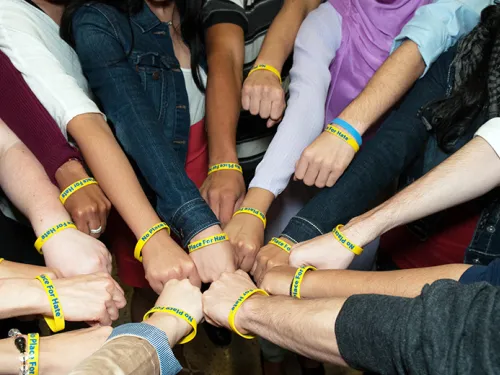









Safe, Seen and Included: Parent and Family Toolkit
Introduction
The purpose of this toolkit is to share guidance, tools and resources to help parents, caregivers and families of Jewish students introduce themselves and their children to school leadership in a proactive, positive and approachable way. These tools will help parents/families work together with schools to help Jewish students feel safe, seen and included in school. Working together in partnership, this toolkit will help school staff, students and families foster safety, inclusivity and a sense of belonging for Jewish students.
This toolkit provides many resources for parents and caregivers to proactively engage school officials in conversations around learning, understanding and their students’ experiences in the school setting. In addition to this, do not underestimate the power of critical conversations you have with your children about their experiences in school and the ways you can empower them to become their own advocates.
Unfortunately, there may be times where an incident escalates beyond the focus of the guidance below. If you believe you are in imminent danger, please contact law enforcement.
Know Your Rights
All young people have the right to attend school free of bias, discrimination, harassment and bullying.1
According to federal civil rights laws and policies, students are entitled to protections against discrimination and equal access to education, regardless of race, color, national origin, sex, disability, or other protected characteristics. These laws prohibit discrimination based on race, color, or national origin in programs or activities that receive federal financial assistance.
Title VI of the Civil Rights Act of 1964 protects all students, including Jewish students, from discrimination and harassment based on their actual or perceived race, color, or national origin, which has been interpreted to include shared ancestry or ethnic characteristics. Title VI states that: “No person in the United States shall, on the ground of race, color, or national origin, be excluded from participation in, be denied the benefits of, or be subjected to discrimination under any program or activity receiving federal financial assistance.” The Department of Education’s decision to include Jewish students under the protection of Title VI was reinforced in December 2019, when President Trump issued an Executive Order stating: “it shall be the policy of the executive branch to enforce Title VI against prohibited forms of discrimination rooted in anti-Semitism as vigorously as against all other forms of discrimination prohibited by Title VI.” These protections are important to be aware of as you think about the expectations all parents/caregivers should have of their child’s school.
1. A note for Independent School parents/caregivers: information can be found at the bottom of this section that specifically pertains to independent/private schools.
The Rise of Antisemitism in K-12 Schools
In recent years, we have seen escalating rates of antisemitism in the U.S. generally and K-12 schools specifically.
This antisemitism shows up in a variety of ways: Jewish youth being targeted by bullying, intimidation, taunts and bias; antisemitic incidents in schools like vandalism, swastikas and other anti-Jewish graffiti; physical and verbal attacks; and antisemitic rhetoric that sometimes emerges when Israel is in the news and discussed in class. In some schools, Jewish holidays are not acknowledged or shared when talking about commemorations and observances. In addition, Jewish voices, stories and narratives are often missing in literature, social studies and other subject areas--which can contribute to Jewish communities feeling alienated and excluded. This guide will help you acknowledge these realities in a proactive way to establish a positive partnership with your school and work towards combatting antisemitism.
Section I: Proactive Conversations
Antisemitism is on the rise, and young people encounter it in schools, extracurricular activities, and online spaces. It's crucial to foster a home environment where young people feel comfortable discussing these experiences without immediately jumping into problem-solving or lodging complaints. By listening actively and helping them process their feelings, you empower them to share incidents and seek help when needed. Use the guidance below to create an environment that welcomes open communication.
Start by creating a safe environment for conversation:
- Consider beginning the conversation by reading an article, watching a video, or reading a book together on Jewish identity, antisemitism, etc.
- As it is appropriate, share a definition of antisemitism to ensure that everyone enters the conversation with common language. While ADL uses this definition of antisemitism and Echoes & Reflections this definition, use one that is age appropriate for the child(ren) participating in the conversation.
- Find out what young people already know. Ask what else they want to know, be honest about the limits to your knowledge and research together to learn more.
- When discussing the topic, ask young people open ended questions that deepen the conversation. Be mindful not to judge their responses and listen thoughtfully.
- You can rephrase or reflect what the young person says to confirm that you understood them. “What I heard you say is...” (Adapted from ADL’s Antisemitism Today)
Provide Age-Appropriate Education About Antisemitism
- Help children understand that antisemitism did not begin or end with the Holocaust—it's a complex and enduring ideology
- Use educational resources that are designed for families.
- Discuss current events and data in ways that are appropriate for your child.
- Read articles, watch videos, etc. as appropriate to further the conversation.
- Ask what your child(ren) may have seen or heard about antisemitism online or in school. Discuss how hearing or seeing this made them feel, and how they want to respond.
It’s very important to create a sense of trust in these conversations, and to take cues from your child(ren)--it is also important to communicate that there will be certain situations that will require you as a parent or caregiver to reach out to a school, regardless of the wishes of your child(ren). And, as much as possible, it’s important to validate and listen to the young person sharing.
Helpful ways to respond in these conversations as a parent or caregiver are:
- Use questions and speak in “I statements” to better understand your child(ren)’s experiences. Some examples of this are:
- “Thank you for sharing that with me,” “Tell me more,” “I see, then what happened?” or “That sounds hard/tricky–is there something that I can do to support you right now?”
- While it can be challenging to not react to everything your child(ren) says verbally, nodding while listening and staying quiet are helpful.
- Making sure you understand what is being said and reflecting back feelings is also helpful. You can say something like “Let me see if I understand” and then reflect back what you believe that you heard.
- Specifically for tweens and teens, ask, “Do you prefer that I just listen or that I share my thoughts and ideas?” (From “Conversations that Matter”)
As adults, parents or caregivers, you have the opportunity to model for young people the communication and behaviors you want them to exhibit. Show your child(ren) how you, as an adult, process, validate and cope with complex emotions. You do not need to have the answers all the time, but you can show your child how you adapt and address complicated topics like antisemitism and you can do research into topics together.
Creating these spaces for open dialogue with your family will allow young people to come to you when incidents take place to ask for help in addressing them. (Further guidance on responding to incidents can be found in Section V: What to Do When Something’s Gone Wrong).
As much as possible, try to have a positive and collaborative approach to addressing and interacting with school personnel. As best as possible, enter into the conversation from a place of curiosity about what took place, assume there was no ill intent from the school and focus on ways that you are able to collaborate and support the school or school district in ensuring Jewish students, like all students in the community, feel safe and welcomed.
To begin the relationship in a positive framing—consider reaching out to leadership within the school before the year even begins to introduce yourself, your child, and any information that is relevant for them to have. Templates to help facilitate this communication can be found in Section VII: Letter Templates.
Should an incident or more pressing concern arise, flag your concerns both respectfully and clearly. More guidance on addressing incidents with schools can be found in Section V: What to Do When Something’s Gone Wrong, but when navigating conversations with educators, focus on explaining the negative impact on your child and advocating for proactive measures to be taken to protect your child and prevent such incidents from happening again. Due to privacy laws, schools will not be able to share information about punitive measures taken with students or educators so keep the focus on your child and active steps that can be taken there.
Section II: Supporting Children to Self-Advocate
It is also important to empower young people to learn self-advocacy skills at all ages. As always, listen to your child(ren), help them to achieve the end-result that they want, and validate their emotions throughout the conversation. The goal with all of this is for young people to feel empowered, confident and supported in their Jewish identity.
Developing self-advocacy skills is an important life skill that can be fostered from a young age. In elementary school, children are beginning to develop their sense of identity, notice difference, and navigate inter-personal relationships. It is for this reason that elementary school-aged children can use their voices to address incidents of antisemitism with support from the adults in their lives.
Create opportunities for conversations about Jewish identity and joy. (More information can be found in Section I: Proactive Conversations.)
- Develop and model communication skills.
- Model and practice expressing emotions in more complex ways than “mad, glad, and sad.”
- Expanding vocabulary about feelings (and modeling this by expressing your own emotions) helps younger children better express and process their own emotions.
- Build off of this expansion of vocabulary and start to discuss with your child(ren) the difference between thoughts, feelings and facts.
- Encourage questions, foster curiosity, and validate children's feelings.
- If appropriate, help your child(ren) think about how they would respond to an antisemitic incident using scenarios or picture books. This will allow the young person to consider and practice responding to an incident in a safe space.
Identify resources
- While children in elementary school have voices and thoughts that should be nurtured and encouraged, it is also important to help them to identify the adult resources that are in place to help them.
- Ask your child(ren) to identify a safe adult at school, who they can go to for support if an incident were to happen. Ask your child(ren) to identify a safe adult outside of school, who they can go to for support if an incident were to happen.
- Make sure to emphasize that if something happens that makes them uncomfortable, they do not need to address it alone and that there are many adults who will help them navigate the situation.
Emphasize support
- Throughout this process and in developing these safe spaces for conversations, always emphasize that you as a parent/caregiver are always there to support your child(ren) if an incident were to happen.
- It is also important to note for them that not all advocacy leads to the desired result, and that is okay. We can learn and grow, even when the outcome isn’t what we wanted.
Putting this into practice
- Scenario: You receive an email from your child’s school that swastikas were drawn around the building overnight. The email states that the graffiti is being removed and investigated.
- How do you have a conversation with your child about this?
- Start by understanding what your child knows about the incident.: What have you heard about? How does this make you feel? (Try to listen and validate more than speak). Is there anything else you want to discuss about this?
- End the conversation with a child-level action that you can take together. Maybe this is writing an email to the principal together about helping to clean up the graffiti, maybe it’s sharing a book with the school librarian to add to the library, or maybe it’s going together to ask the classroom teacher about bringing in challah to celebrate Jewish joy one Friday, to name a few.
- How do you have a conversation with your child about this?
As young people grow and develop in their identities, so too does their ability to navigate complex conversations and ideas. As children mature, they often want to take action when they witness a form of bias, like antisemitism, and parents should encourage this step into self-advocacy. Helping to provide spaces for conversation and guidance will empower older children to address antisemitism within their communities.
Establish roles or rituals to celebrate, strengthen and support Jewish identity formation. (More information can be found in Section I: Proactive Conversations).
- Encourage your child to explore and strengthen their own Jewish identity.
Know Your Resources
- Research with your child(ren) the code of conduct at their school, reporting protocols that are in place, and district-level policies.
- (Further guidance on responding to incidents can be found in Section V: What To Do When Something's Gone Wrong).
- Consider: are there groups in your area that would offer safe spaces for a Jewish young person to share their experiences?
- (Further guidance on responding to incidents can be found in Section V: What To Do When Something's Gone Wrong).
- Help your child(ren) identify adults (both inside of and outside of school), who can offer support and help them should an incident take place.
- Emphasize that, while you want your child to use their own voice in navigating an incident, you are always a support for them and will always offer assistance and guidance.
Develop Your Advocacy Voice
- In regular conversations with your child(ren), create spaces for them to practice articulating concerns clearly, respectfully and concisely.
- This is something that you as a parent/caregiver can model regularly for your child(ren), but also something that you can practice using books, news articles, and videos.
- Provide young people with phrases that can help navigate the conversation like: “I know you meant well, but this hurt me.” or “I know this is not what you intended to say, but here’s what I heard.” or “This comment hurt me, and here’s why.”
- Develop skills to have conversations about sensitive and emotional topics.
- Be open and honest with your child(ren): adults also struggle with this skillset, and that not every conversation on a contentious topic will go exactly how you want it to. Emphasize that these are conversations you can practice in safe spaces like with family and close friends.
Listen above all else
- Listen to your child more than you speak. Allow them to share their thoughts and feelings without interjecting and avoid evaluative language in responding.
- Validate their feelings and emotions and provide guidance and support as is appropriate.
- Ask what their intended end-result is and how you can support them in achieving it. Make sure that you emphasize that a situation may not resolve exactly as intended, but that does not mean it is a failure or anyone did anything wrong.
Scenario:
- At the dinner table, your child shares that someone at their lunch table was making supposed jokes about how Jews belong on trains in Europe and how Hitler hadn’t finished the job.
- How do you have a conversation with your child about this?
- Start by thanking them--“Thank you for sharing that with me.” Follow this with questions that will provide further information: “Tell me more,” “I see, then what happened?” or “That sounds hard/tricky–is there something that I can do to support you right now?”
- Listen to your child and find out what steps they want to see taken. Consider using a phrase like: “Do you prefer that I just listen or that I share my thoughts and ideas?”
- Work together on an age-appropriate response: reporting the incident to the principal, having a conversation with friends who were at the lunch table about the impact of these words (and prepping for this conversation together) or choosing to sit with a different group of people at lunch moving forward, to name a few.
- How do you have a conversation with your child about this?
Section III: Inclusive Curriculum
In fostering welcoming and inclusive school communities for all students, many schools and school districts are trying to be intentional about celebrating the different cultures, ethnicities and religions that comprise their student and faculty bodies. Parents and family members have the opportunity to advocate for an inclusive curriculum that includes the celebration of Jewish students and Jewish culture, outside of Holocaust education. Judaism, like any culture, ethnicity, religion, etc., should not be limited to its most traumatic moment.
- Start by researching how your child(ren)’s school or school district is already celebrating and including diverse cultures, ethnicities and religions. This can be things like celebrating various heritage or observance months, learning through advisory or community circle time, books featured in the school library, etc.
- Having this information is a way to positively frame the conversation with the school. You have the opportunity to highlight what they are doing well and then share ideas for areas where they can improve.
- Advocate that schools share information about Jewish holidays like Rosh Hashanah, Yom Kippur, etc.
- Advocate that schools observe Jewish-American Heritage Month in May. Some resources on ways schools can celebrate and uplift Jewish voices and contributions to the U.S. can be found here.
- Anticipate certain responses:
- If asked about why including Jewish voices in the curriculum is important, emphasize how much representation matters for students. Seeing themselves reflected in the classroom—from books to names in word problems to seeing holidays respected and explained—makes every child feel a sense of belonging and safety within their school community.
- Jewish people are part of their school community and deserve to be included in curriculum like any other group.
- Schools have incredibly limited time and do need to focus on aligning lessons to curricular standards and exams. While this is true, there are easy ways to diversify information presented to students without taking away important instructional time.
- Suggest books that celebrate Jewish identity outside of the Holocaust. Books are a great way for students of all ages to learn about different people, times, cultures, etc. Some suggestions: Picture and Chapter Books to Celebrate Jewish American Heritage Month.
- As students are already reading and engaging with books throughout their entire school career, diversifying the texts would allow teachers to continue to meet learning standards.
- Suggest the school use Jewish-American Heritage Month to educate the school community about Jewish people and their role in the United States. This can be done through advisory, morning announcements, community emails, and more,. and does not need to impact instructional time.
- Suggest books that celebrate Jewish identity outside of the Holocaust. Books are a great way for students of all ages to learn about different people, times, cultures, etc. Some suggestions: Picture and Chapter Books to Celebrate Jewish American Heritage Month.
- Teachers have limited capacity, so if you are able, offer your willingness to assist. Whether it’s book or resource suggestions, or time to volunteer—empathy and gratitude go a long way with educators and administrators.
- If asked about why including Jewish voices in the curriculum is important, emphasize how much representation matters for students. Seeing themselves reflected in the classroom—from books to names in word problems to seeing holidays respected and explained—makes every child feel a sense of belonging and safety within their school community.
Approaching school or district leadership from a partnership perspective will help establish a collaborative environment and build rapport.
Section IV: Holidays and Scheduling Conflicts
Just as not every Jewish family observes the holidays in the same way, not every school and school district has the same calendar. Make sure that you check your school or district’s calendar first—see what holidays are acknowledged on the calendar and what holidays they close for. In order to foster a positive and proactive relationship with school leadership, consider informing your child’s school about Jewish holidays during which Jewish students and faculty may be absent or require accommodations. Templates to help facilitate this communication can be found in Section VII: Letter Templates. If you are comfortable, consider adding in information for administrators about what those holidays mean to you and your family as Jews and how you personally observe them as a family. Depending on your personal and family observances, you may want to inform the school or district about:
- Rosh Hashanah (Jewish New Year)
- Yom Kippur (Day of Atonement)
- Sukkot (Feast of Booths)
- Shemini Atzeret and Simchat Torah (Eighth Day of Assembly/Rejoicing in the Torah)
- Purim (Celebration of Jewish people’s rescue in ancient Persia)
- Passover (Celebration of Jewish people’s exodus from Egyptian enslavement)
- Shavuot (Feast of Weeks)
Use ADL’s Calendar of Observances as a resource to learn more and for specific dates. Use this communication with administration as an opportunity to develop positive and proactive relationships with administrators, to advocate for your Jewish child(ren) and to share about Jewish joy and culture.
Section V: What to Do When Something’s Gone Wrong
While the goal of this guide is to establish proactive and positive relationships to prevent antisemitic incidents from happening in the first place, that is not always realistic. If incidents of antisemitism do take place, it is important for families to be prepared to address them strongly and effectively.
So...what do you do if an antisemitic incident takes place in your child’s school?
- Always start by having a conversation with your child, more information can be found in Section I: Proactive Conversations.
- Document details of the conversation, with your child’s consent, in case they are relevant later.
- Resources to prepare for this conversation: Empowering Young People in the Aftermath of Hate and Championing Change: How Parents and Families Can Address Antisemitism in Schools.
- If more intervention and school-involvement is needed, begin reaching out to the school to address the incident. Start small by reaching out to the teacher closest to the incident.
- Consider sharing ADL’s resource A Guide for Responding to School-Based Bias Incidents
- Research any reporting protocols that the school or school district have in place and report the incident as is appropriate.
- If you are looking for additional guidance in responding to an incident or to report an incident for tracking purposes, you are always welcome to complete ADL’s Incident Response form.
All young people have the right to attend school free of bias, discrimination, harassment and bullying. A note for Independent School parents/caregivers: information can be found at the bottom of this section that specifically pertains to independent/private schools.
Bullying is “repeated actions or threats of action directed toward a person by one or more people who have (or are perceived to have) more power or status than their target in order to cause fear, distress or harm.” Bullying can be physical, verbal, psychological or any combination of these three. Bullying behaviors can include name-calling, obscene gesturing, malicious teasing, rumors, slander, social exclusion, damaging a person’s belongings, threats and physical violence. Bullying can happen in person, in digital spaces, or both. Identity-based bullying refers to any form of bullying related to the characteristics considered unique to a person’s identity, such as their race, religion, sexual orientation or physical appearance. This includes bullying based on Jewish identity or antisemitic bullying.
Most state laws, policies, and regulations require districts and schools to implement a bullying policy and procedures to investigate and respond to bullying when it occurs. You can find more information on the federal government’s Stop Bullying page, which includes a U.S. map with detailed information on the anti-bullying laws and policies of specific states and territories.
A note on Independent/Private Schools
Because the Constitution’s prohibition against curtailing free speech only applies to government entities and officials, private schools (grades K-12) are typically not directly bound by the First Amendment. (There are exceptions, like in the state of California, where a statute applies the First Amendment to private high schools as well, or Rhode Island, where a law protects private school student journalists and their work at all educational levels). Government funding or other governmental ties may also impact the effect of the First Amendment on private schools. Because the First Amendment typically does not apply, private schools have much more leeway to limit speech. Students should review their school’s student handbook including any policies about speech and student conduct. These materials should provide guidance about how freedom of expression will be treated in K-12 schools.
Section VI: Advocacy Basics
The Fundamentals of Effective Advocacy
Successful advocacy depends on understanding your audience, communicating clearly, and crafting a compelling narrative.
In a school setting, your audience is likely your child’s teacher, or the school administrator, depending on the incident you want to address. When an antisemitic incident occurs, first, talk with your child's teacher if the incident was classroom-based or if the teacher is directly involved. Teachers often have the most immediate ability to address classroom dynamics and can provide valuable insight into what happened. If the incident occurred outside the classroom, or if your conversation with the teacher doesn't resolve the situation satisfactorily, escalate to a school administrator or counselor. These individuals have broader authority to implement school-wide solutions and can coordinate responses across multiple classrooms or grade levels.
If the issue remains unresolved after speaking with school administrators, consider escalating to the superintendent level. This step should be reserved for situations where lower-level interventions have been unsuccessful or when the incident represents a serious violation of school policy. Throughout this process, document your conversations and any actions taken by school staff, as this information will be valuable if further escalation becomes necessary.
Try to anticipate the perspective of the person with whom you are speaking before engaging, and approach the conversation with respect and a problem-solving attitude, rather than a combative one. Preparation is critical for communicating effectively and advocating to a successful result. It can be helpful to create talking points for yourself before having this kind of conversation. Practice delivering your message until you feel comfortable. Anticipate the teacher’s or administrator’s response, and be prepared for it.
Clearly articulate the issue you are addressing, and its impact on your child/family and the entire school community. Do your best to remain focused on the facts and potential solutions, rather than on emotions. While your feelings are valid and important, grounding your advocacy in concrete information leads to more productive conversations and actionable solutions.
More information on advocacy can be found in ADL's How to Advocate for Your Students at their K-12 School.
Section VII: Letter Templates
Opening a line of communication with a school is incredibly important—whether it is reaching out to your child’s teacher or teachers and/or administrators before the school year begins, sharing about Jewish holidays in the fall, or reaching out after an incident happens. Often these letters can feel challenging to write in a way that is clear, respectful and concise. Download any of the templates below as a starting off point for communicating with schools throughout the year.
Letter Template: Sample for Introductions
Letter Template: Sample for Jewish Holiday Accommodations
Section VIII: Additional Resources
- 6 Tips for Supporting Jewish Students in the Classroom
- 6 Ways to Be an Ally
- A Guide for Responding to School-Based Bias Incidents
- Antisemitism Today
- Calendar of Observances
- Championing Change: How Parents and Families Can Address Antisemitism in Schools
- Conversations that Matter: Understanding and Discussing Antisemitism with Young People
- Crisis, Controversy and Activism: Tips and Guidance for K-12 Schools
- Empowering Young People in the Aftermath of Hate
How to Advocate for Your Students at their K-12 School