





(Source: Screenshot)
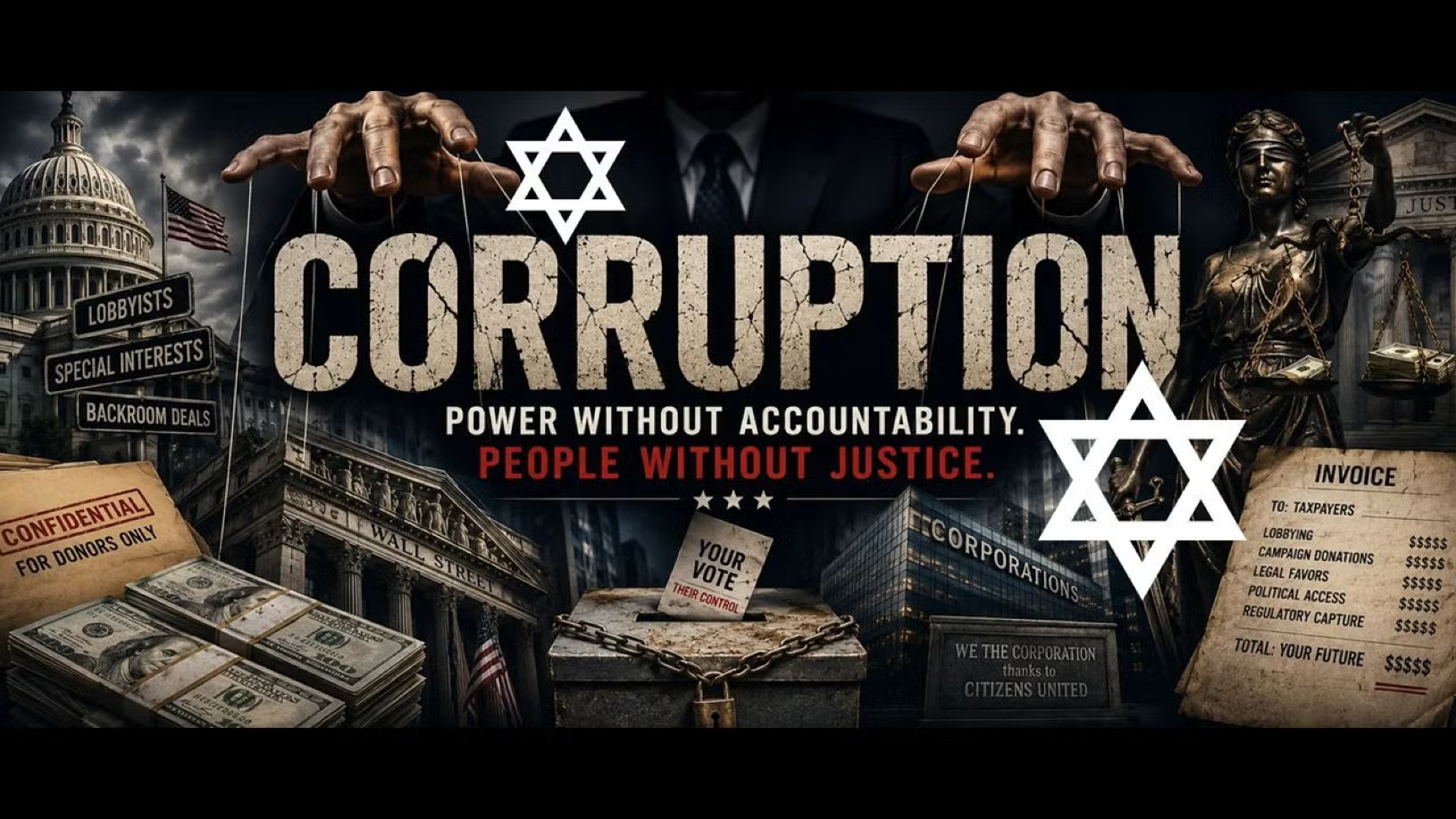
Antisemitic imagery published on the campaign website of 2026 Washington congressional candidate David Blomstrom.



Disclaimer: As a 501c3 nonprofit organization, ADL takes no position on behalf of or in opposition to any candidate for elected office.
Antisemitic conspiracy theories and dehumanizing rhetoric about Jews have been a prominent feature of the 2026 election cycle. Political commentators, antisemitic influencers, and even some candidates have amplified classic and contemporary antisemitic tropes and conspiracy theories.
One of the prevailing antisemitic tropes has been the longstanding allegation that Jews seek to manipulate elections and government officials to serve an explicitly Jewish agenda at the expense of non-Jews.
Claims that Jewish donors favor the interests of Israel over the United States, that Jews or Israel are controlling the U.S. government, and that Jewish elected officials hold dual loyalty to Israel (to the detriment of their constituents) frequently intersected with antisemitic, conspiratorial responses to the release of the Epstein files and the 2026 Iran War, and were leveled by bad actors across the ideological spectrum.
These antisemitic themes transcend party lines and highlight the concerning, increased normalization of antisemitism in the public sphere.
Dehumanizing Antisemitic Language Used to Convey Violent Threats and Targeted Harassment
During this election cycle, several prominent Jewish candidates have been targeted, including with threats of violence, due to their Jewish identity. Jewish candidates have also faced harassment because of real or assumed connections to Israel, including accusations that they are genocidal or place the interests of Israel above the U.S.
These incidents demonstrate a concerning escalation in physical confrontations and violent tactics used against Jewish politicians at a time when Jews nationwide face an unprecedentedly high threat landscape.
Pennsylvania Governor Josh Shapiro, who is seeking reelection in Pennsylvania’s 2026 gubernatorial race, was targeted with antisemitic, violent threats allegedly made by Delaware County resident Richard John Franklin on July 7.
Law enforcement charged Franklin with terroristic threats, ethnic intimidation, and other charges after he allegedly referred to Shapiro as “that Jew” multiple times and stated that he would “like to burn down his [expletive] mansion with him in it.” This alleged language mirrors the April 2025 arson attack targeting Shapiro and his family while they slept inside the governor’s residence on the first night of Passover.
U.S. Rep. Greg Landsman, a Jewish Democrat running for reelection in Ohio’s 1st Congressional District, reportedly received a voicemail from someone who stated, “I don't like Jewish people, and the congressman should just go die.”
U.S. Rep. Dan Goldman, a Jewish Democrat seeking reelection in New York’s 10th Congressional District, was retroactively banned from Poetica Coffee in Brooklyn after he made a purchase there days before the June primary election. The coffee shop posted a photograph from the store’s security camera on June 21 showing Goldman at the register, writing in the caption: “We see that you stopped by our shop today for a coffee. Do you see how it doesn’t taste like genocide juice? We don’t serve racists, fascists, homophobes, genocide enablers, or anyone in between. Too bad we didn’t recognize you right away, or we would have turned you away. We issued you a refund—we don’t need your money (it’s probably coming from AIPAC anyways).”
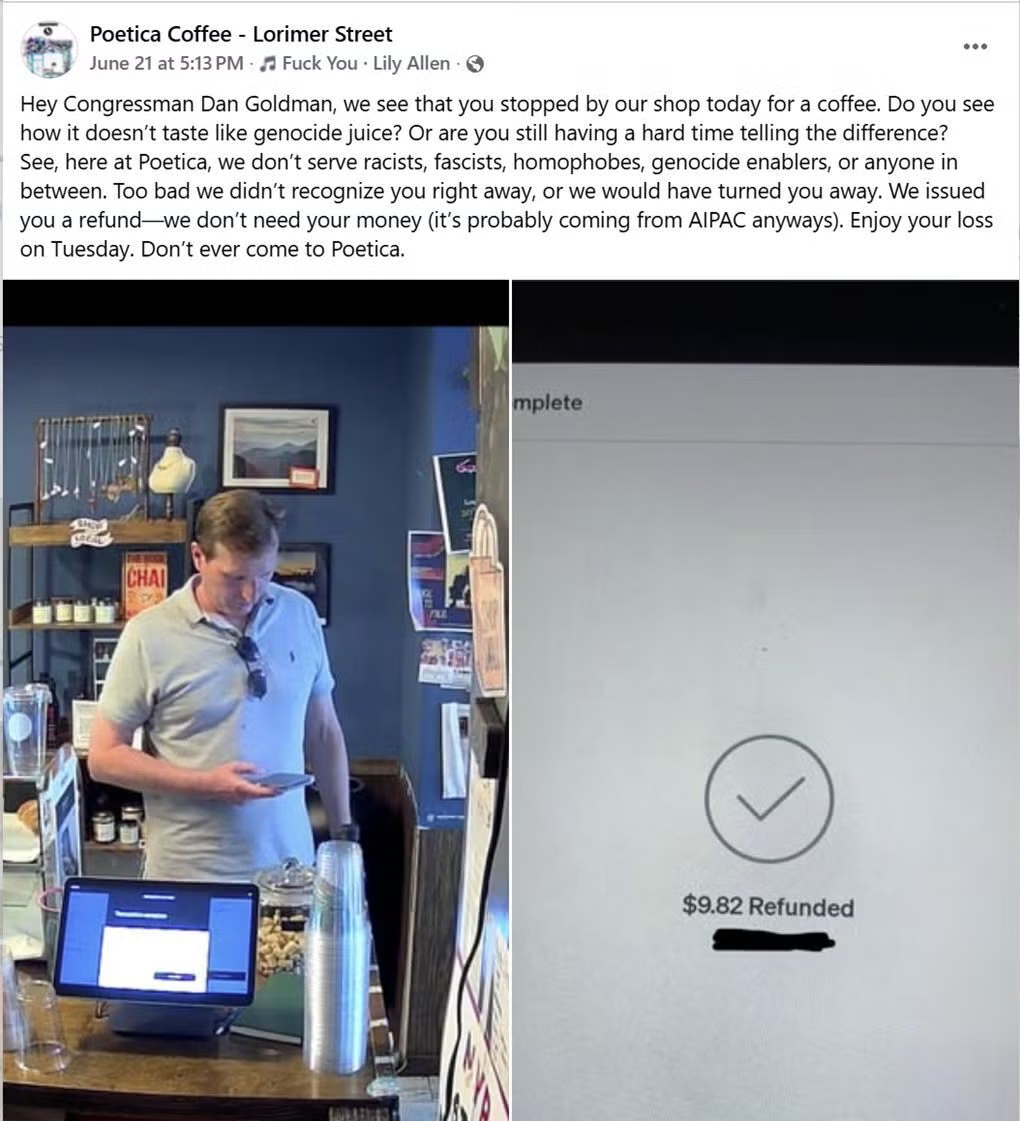
(Source: Screenshot/Facebook)
Poetica Coffee’s social media post targeting Rep. Dan Goldman.
California State Sen. Scott Wiener, a Jewish Democrat running for the U.S. House seat in the state’s 11th Congressional District, was harassed and physically intimidated in two separate incidents in San Francisco in late June. Several individuals aggressively approached and verbally accosted Wiener with antisemitic comments at the annual San Francisco Trans March. The harassers shouted that Wiener “stopped being queer the moment [he] started supporting Israel” and accused him of having “Israeli handlers.” Wiener was forced to leave the march, which he has attended every year since 2004.
At a World Cup watch party at a local bar earlier that week, an individual allegedly cornered Wiener and began “scream[ing] abuse” at him and his staffers before the bar ejected the individual responsible. Wiener noted that the individual was the same person who had “stalked” him on a plane in late 2023 and harassed him about what they called his “tainted bloodline.”
The incidents and rhetoric used against Goldman and Wiener, in particular, demonstrate how the increasingly popular anti-normalization approach used by some anti-Zionist activists can be incorporated into targeted harassment. This approach calls for the complete rejection of any association or even cooperation with any individuals or organizations who recognize Israel’s legitimacy as a state. Wiener, for example, recognizes Israel’s right to exist, but has openly criticized the Israeli government’s actions in Gaza and even stated that he would vote against U.S. support for Israel’s military and Iron Dome defense system. Nonetheless, activists still targeted him with harassment.
This anti-normalization strategy functionally results in the rejection of the vast majority of the Jewish community who, regardless of whether they may be critical of specific Israeli policies or have strong differences of opinion regarding Israeli government or military actions, nonetheless recognize its right to exist as a state. This anti-normalization mindset has been used by some anti-Israel activists to justify excluding Jewish individuals from certain public and private spaces, particularly in recent years.
"The Area Code Is Tel Aviv:" Kentucky's Primary Unleashed Antisemitic Conspiracy Theories Nationwide
The Republican primary race for Kentucky’s 4th Congressional District, which incumbent Rep. Thomas Massie lost on May 19, became an opportunity for individuals across the country to promote conspiratorial claims about Jews or pro-Israel forces supposedly buying the election. This race underscored how antisemitic rhetoric has become normalized and how a single local race can trigger the spread of such narratives that quickly reverberate nationally.
Massie — who has a previous history of engaging in antisemitic, conspiratorial rhetoric — accused the Republican Jewish Coalition of using his opponent, Ed Gallrein, as a “puppet.” Massie implied that Jews were controlling the race, stating at a campaign rally days before the primary that “they gave me the number to call to concede. The area code is Tel Aviv, though.” He repeated a similar message in his concession speech, commenting, “I would have come out sooner, but I had to call my opponent and concede, and it took a while to find Ed Gallrein in Tel Aviv.”
Before the election, Massie supporter William Paul — a former congressional staffer and the son of Republican U.S. Sen. Rand Paul of Kentucky — accosted Republican U.S. Rep. Mike Lawler of New York with antisemitic comments about Massie’s race. Incorrectly assuming that Lawler was Jewish, Paul reportedly told Lawler that, if Massie lost the primary, it would be because of “you Jews” who are “anti-American” and favor Israel over the U.S.
During the campaign, the Massie-aligned Hold the Line PAC funded a television attack ad against Gallrein that demonstrated the convergence of antisemitic and anti-LGBTQ+ hate by claiming that he was “bought and paid for by the LGBTQ mafia” and depicting Jewish hedge fund manager Paul Singer, who supported Gallrein’s campaign, with a large, rainbow-colored Star of David in the background.
Such hateful rhetoric was not confined to the Kentucky race. Tucker Carlson, one of the most prolific amplifiers of antisemitic and conspiracy theory-laden content online, similarly targeted Singer and other Jewish political donors, including Miriam Adelson and John Paulson. During the May 20 episode of The Tucker Carlson Show, Carlson criticized these individuals, claiming that “their loyalty is not to the United States. It’s to a foreign country.” A post that same day on the Tucker Carlson Network (TCN) website blamed “deep-pocketed Israel First groups” for Massie’s defeat and claimed that Israel “has the tightest of grips on our politics…We are an occupied nation.”
During the May 20 episode of Piers Morgan Uncensored, Morgan platformed two guests, Buckley Carlson and Glenn Greenwald, who made similar statements. Greenwald, a journalist known to peddle conspiracy theories about Israeli influence over U.S. affairs, alleged that people who “have either primary loyalty or at least equal loyalty to a foreign country are overriding what polling shows.” Buckley Carlson, the brother of Tucker Carlson and a Republican strategist, stated sarcastically, “people in Kentucky now, who can’t find jobs, young people who can’t find jobs, it’s great: they can just go into the military and fight Israel’s wars for Miriam Adelson, Paul Singer, and all the rest.”
The conspiratorial responses to Massie’s loss did not appear only among conservative or right-wing voices, but also across political and ideological divides. Emad Sabbah, a longtime board member of the Georgia chapter of the Council on American-Islamic Relations (CAIR) — a non-profit organization that seeks to position itself as the country’s leading American Muslim civil rights organization and whose leaders are known to traffic in openly antisemitic rhetoric — shared multiple antisemitic, conspiratorial images about the race on his social media that were created using Generative Artificial Intelligence (GAI). The posts included a GAI depiction of Massie being cheered on by the masses while a small group of shadowy puppeteers represented those who “bought the election” and “sold out America,” with captions that included, “AMERICA HAS BEEN DEFEATED BY ZIONISTS.”
Claims of Jewish Disloyalty and Manipulation
While Kentucky’s 4th Congressional primary race offered a particularly illustrative example of antisemitic accusations about Jewish donors allegedly buying elections, federal and state races nationwide also provoked similar claims about supposed dual loyalty and manipulation.
Former U.S. Rep. Marjorie Taylor Greene, a Republican from Georgia who left office in January 2026 but continues to share frequent political commentary online, has repeatedly claimed in recent months that Israel controls the U.S. government. Greene wrote in two separate X posts in July: “Israel controls our politicians and our government” and “[President] Trump is controlled by Miriam Adelson and Israel.”
Meanwhile, former Democratic member of the U.S. House of Representatives and 2008 Green Party Presidential candidate Cynthia McKinney, who continues to be a prominent far-left political voice known for peddling antisemitic and anti-Zionist conspiracy theories, shared familiar antisemitic tropes in her published platform for her 2026 campaign to represent Georgia’s 14th Congressional District. “For decades,” she wrote, “a powerful Zionist lobby has infiltrated every level of our government, from Congress to the executive branch.”
Before losing her bid for the U.S. House of Representatives in Texas’s 35th District, Maureen Galindo repeatedly shared classic antisemitic conspiracy theories, including denouncing the “Jews who own Hollywood” and implying that Jews “worship Satan” and represent “the Synagogue of Satan.” Galindo wrote in late December 2025 that “we need Congress members that put America before Israel,” and similarly commented in January 2026 that the U.S. Department of Homeland Security is “based out of tel aviv.” Galindo was the top vote-getter in the March 3 Democratic Party primary and advanced to the runoff election, which she lost on May 26 with approximately 41 percent of the vote.
During a campaign rally for a slate of candidates backed by the New York City chapter of the Democratic Socialists of America (DSA) in Brooklyn in June, NYC Mayor Zohran Mamdani invoked antisemitic themes when he referred to the American Israel Public Affairs Committee (AIPAC) as “monsters” and claimed that “they move millions in dark money to accomplish a single goal, to preserve their power so that they can turn us against one another instead of our leaders turning towards the moral change we all know to be necessary.” Later that month, at an election night party for the victorious NYC-DSA candidates, attendees chanted, “From the river to the sea, Palestine will be free,” a slogan that calls for dismantling the Jewish state and the removal of Jews from their ancestral homeland.
Antisemitic commentary has marred state-level races, too. Campaign mailers paid for by the Protecting Our Democracy PAC that were sent to voters ahead of the Democratic primary race for Pennsylvania State Senate in District 16 demonstrated this trope. The mailer criticized candidate Bradley Merkl-Gump — who later lost the primary election in May — as a “Special Interest Puppet,” writing, “you don’t have to settle for the hand-picked candidate of the corporate, Israel-first Democratic party boss and insiders.” This message was paired with a photograph of Merkl-Gump alongside U.S. Sen. John Fetterman, a vocal supporter of Israel, and Pennsylvania State Sen. Steve Santarsiero, who is Jewish, with an Israeli flag superimposed over his image.
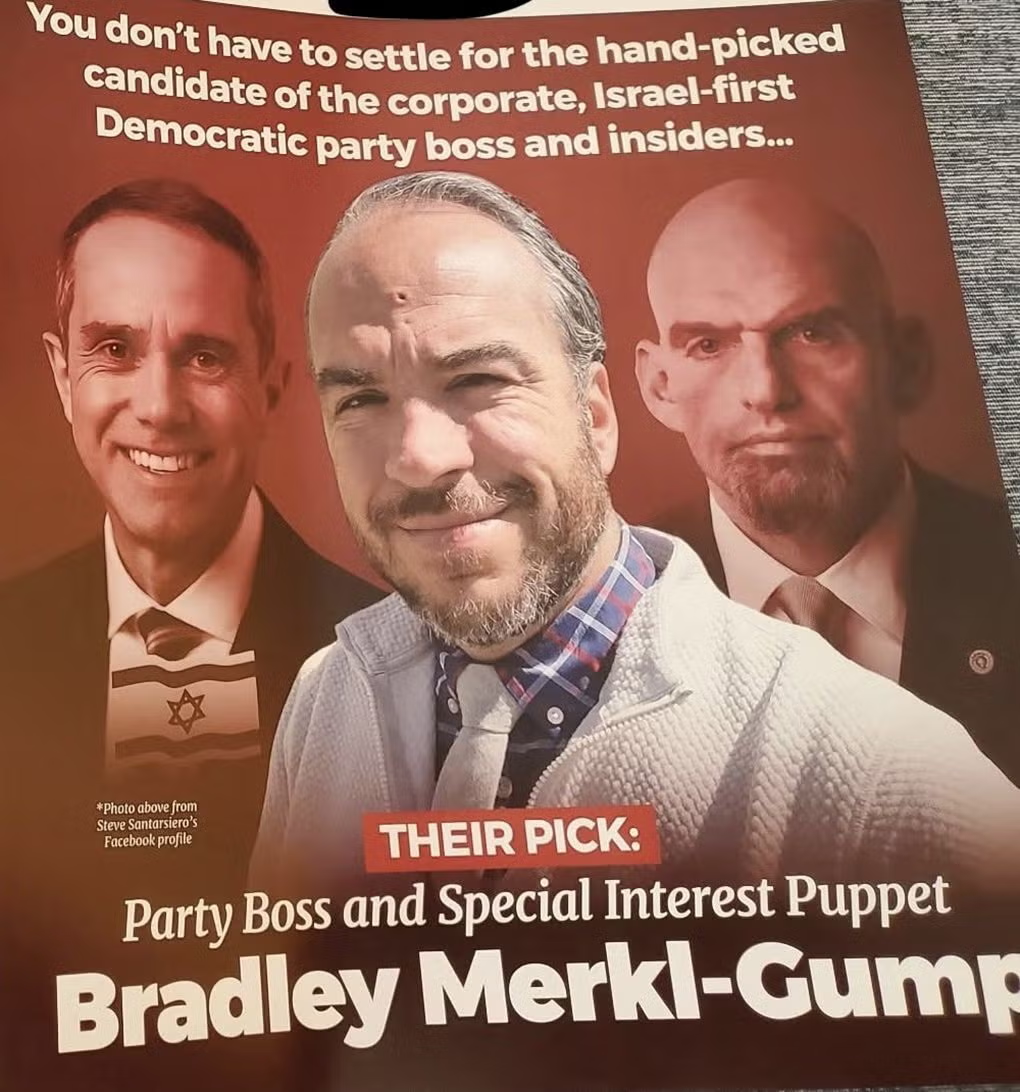
(Source: Screenshot/Facebook)
A campaign mailer featuring antisemitic dual loyalty rhetoric was sent to voters ahead of Pennsylvania’s 2026 State Senate primary election.
Various antisemitic dog whistles and codewords have also been incorporated into election-related rhetoric. Antisemites often make accusations that certain candidates and elected officials are loyal to or controlled by Israel by using phrases like “wall kisser,” “kiss the wall,” and “touch the wall.” This thinly veiled language is meant to imply that individuals signify their supposed subservience to Jews or Israel by visiting the Western Wall in Jerusalem, a holy site in Judaism. Candidates themselves have helped normalize this rhetoric in some cases by asserting their refusal to “kiss the wall.”
James Fishback, who lost in the Republican gubernatorial primary in Florida, used this coded language during a February campaign event at the University of Central Florida, telling student supporters that he would not visit Israel. “If you’re gonna visit another country, you should be helping people, creating jobs, facilitating trade. Not kissing a stupid wall,” he said. During a podcast interview later that same month, Fishback reiterated: “I'm not kissing the wall under any circumstances.”
Fishback’s use of antisemitic coded language on the campaign trail also includes the term “goyslop,” which originated among antisemites to promote the conspiracy theory that Jewish people deliberately poison non-Jews with cheap food to keep them unhealthy and docile. The term’s use has since expanded to also refer to content — such as media, art, or political messaging — that the speaker considers low-quality, manipulative, or propagandistic.
In California’s gubernatorial race, independent candidate Don J. Grundmann used the terms “goyim,” a word used to refer to non-Jews that is often weaponized by antisemites, and “ZOG,” a reference to the phrase “Zionist Occupied Government” that is commonly used by white supremacists and other antisemites. He shared a litany of antisemitic, conspiratorial beliefs in a candidate statement that was published in the state’s official voter information guide and mailed to voters ahead of the primary election. Grundmann claimed in his statement that “Israel rules our conquered Republic,” adding that “we are ‘goyim’ (less than human animals/cattle) that they will enslave” and promoting the phrase “DestroyTheZOG.”
Grundmann’s statement elevated numerous additional longstanding antisemitic tropes, including accusations that Israel was behind the 9/11 terrorist attacks and that Israel deliberately attacked the U.S.S. Liberty. Grundmann also promoted a list of antisemitic websites, including a site operated by the Goyim Defense League (GDL). Grundmann, who ran with no party preference, received approximately 1,900 votes in the June 2 primary election.
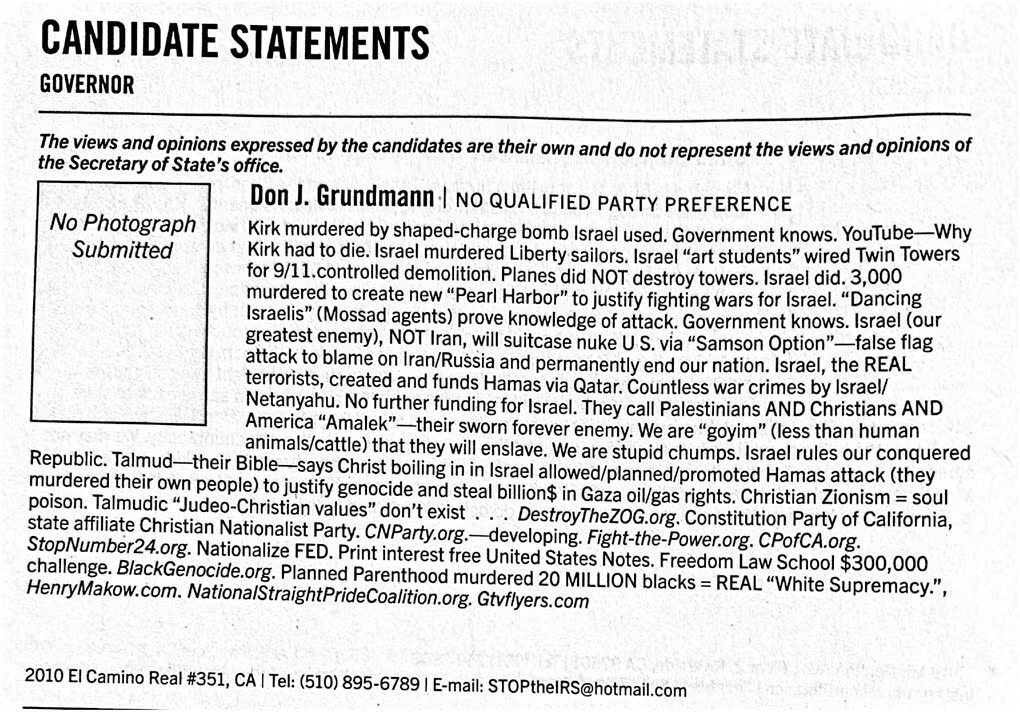
(Source: Voter Information Guide, California Office of the Secretary of State)
California Gubernatorial Candidate Don J. Grundmann’s antisemitic candidate statement published in the state’s voter information guide.
In Washington, 7th Congressional District Independent candidate and self-described “Proud Holocaust Denier” David Blomstrom, who finished in a distant fourth place in the state’s nonpartisan primary in August, ran on a platform that called to end what he deemed the “Jewarchy.” He signaled his antisemitic beliefs in the state and county voter guides published by the Washington Secretary of State and King County Elections offices, respectively, including writing in the state voter guide: “From the river to the sea, let's globalize the Intifada!” On his campaign website, he referred to the “Jewish problem” and openly proclaimed, “I regard the Jews as a global menace that should have been dealt with long ago.”
At least 10 candidates across multiple parties for congressional and statewide races participated in the America First United (AFUnited) conference in Ohio in May, which billed itself as “the first bipartisan event uniting America First candidates and influencers opposed to AIPAC, endless wars and the Epstein cover-up.” The event, which featured remarks from candidates alongside various antisemitic influencers and other speakers, promoted malignant conspiracy theories about Israel and explicit hatred for Jews, from scapegoating Jews to demonizing the Jewish religion, to attacking so-called “Jewish supremacy.”
Multiple speakers thanked white supremacist Groyper leader Nick Fuentes and referred to him as the creator of the movement, though he was not in attendance and did not publicly endorse the conference. The event was partly led by Anti-Zionist America PAC (AZAPAC) founder Michael Rectenwald, a far-right antisemitic influencer who was the runner-up for the Libertarian Party presidential nomination in 2024. Under Rectenwald’s leadership, AZAPAC’s messaging recycles classic antisemitic talking points under the guise of anti-Israel sentiment.
The conference included a virtual address by Dan Bilzerian, a prominent influencer with more than 48 million followers on social media who often engages in antisemitic rhetoric, and who ran in the 2026 Republican primary for Florida’s 6th Congressional District. Bilzerian’s remarks scapegoated Jews, demonized Judaism, and attacked what he alleged was “the real root cause of the problem, which is Jewish supremacy.”
Bilzerian’s speech echoed beliefs he repeatedly shared during and before his congressional campaign. One of the key pillars of his published campaign platform called to “End Jewish Supremacy,” claiming that “this country is being run into the ground by Jewish Special Interests.” Before running for office, he had similarly stated in a 2024 interview with Piers Morgan: “I believe that Jewish supremacy is the greatest threat to America and I think it's the greatest threat to the world today.”
Bilzerian has shared a wide range of additional antisemitic tropes and conspiracy theories, from allegations about Jewish control of the media, to disputing the number of Jews killed in the Holocaust, to falsely representing Jewish religious texts, and more. He has also repeatedly demonized Israel and Israelis using antisemitic, violent language, including claiming that Israel is a “fucking parasite” that orchestrated or had prior knowledge of the 9/11 attacks, the U.S.S. Liberty attack, and President John F. Kennedy’s assassination.
“You Guys Aren’t Human:” Weaponizing Anti-Zionist Language and Calls to Persecute Zionists
The word Zionist — someone who believes in the Jewish people’s right to self-determination — is increasingly used as a slur leveled at Jewish and Israeli people and their allies, particularly since October 7, 2023. This disparaging language is often paired with dehumanizing rhetoric or calls for harm and can be used to attempt to obscure antisemitic actions and rhetoric.
The vast majority of Jews around the world feel a connection to Israel. The word “Zionist” is sometimes used as a stand-in for “Jew,” and attempts to target “Zionists” are, in practice, most often simply targeting Jews. Several cases from the 2026 election cycle reflect this dynamic.
Multiple campaign placards for Arizona State Rep. Alma Hernandez, a Jewish Democrat who is running for Arizona State Senate District 20, were defaced with the words “ZIONIST BITCH” in early July. Hernandez’s opponent in the race, former Tucson city council member Rocque Perez, attempted to garner support for his campaign by reportedly sharing messages urging supporters to help him “unseat a Zionist” and an “Israel-First Dem tied to big money.” Hernandez defeated Perez in the July 21 primary.
Alicia Lapp, whose bid for California governor ended with a loss in the Republican primary in June, posted a video on social media in May in which she stated: “America, it’s time we deport every single Zionist and every single illegal. And to the people who are Zionist in this country, you are a traitor and should be in prison, but I’ll take deportation instead.”
She doubled down in the post’s caption, accusing Zionists of “betray[ing]” America and stating, “history shows exactly why so many nations have been forced to expel you, and it is time for America to do the same…We will no longer tolerate the compromise of our national security by those who place foreign interests above our own.”
Lapp’s comments employed the familiar rhetorical tactic in which antisemites claim that Jews have been expelled from numerous countries throughout history and therefore must be a malicious and harmful people who should also be expelled from countries where they currently live.
A Jewish elected official who is running for reelection to the U.S. House reportedly received numerous antisemitic, harassing voicemails where callers moved freely between explicit slurs and calls to leave the U.S., including messages telling him to “go back to Israel” and that “you and your family ‘ought to be stripped of citizenship and deported to Israel, because that's where you belong.” Callers have also used disparaging language, referring to the candidate as a “Jewish sack of sh*t” and a “Jew boy,” and telling him, “you guys aren't human,” “antisemitism is on the rise because you guys think you own the f*cking world,” “you guys are going to be shot dead every f*cking day,” “a real holocaust will take effect.”
Texas congressional candidate Maureen Galindo called for the jailing of Zionists in a May Instagram post, writing that she would “turn Karnes ICE Detention Center into a prison for American Zionists and former ICE officers for human trafficking. (It will also be a castration processing center for pedophiles which will probably be most of the Zionists).”
Influencers, Candidates, and the Normalization of Antisemitism as Political Strategy
Influencers known to promote antisemitism are not just commenting on the 2026 midterms, but directly engaging in the races by campaigning for candidates or hosting candidates on their platforms. Candidates in some races are actively seeking out these opportunities to appear on antisemitic influencers’ shows.
This engagement enables candidates to reach sizeable audiences and helps normalize fringe or extremist individuals and their beliefs by giving them a role in mainstream political discourse. Candidates’ embrace of antisemitic influencers or individuals who are known to promote antisemitic rhetoric via campaign rallies and media appearances demonstrates how antisemitism is seen by some not as a hindrance, but a valuable tool to appeal to certain voters.
Hasan Piker, a prominent Twitch streamer and political commentator who has more than 11.3 million followers across social media platforms and a history of rhetoric that sanitizes violence and denigrates Jewish people, has campaigned with or hosted several Democratic Socialists of America (DSA)-backed candidates on his livestream show during the 2026 election cycle.
Guy Christensen, an extreme anti-Zionist social media influencer with millions of followers who defended the antisemitic murder of two individuals outside the Capital Jewish Museum in Washington, D.C. in May 2025, has also contributed to on-the-ground campaign activities and online amplification of candidates.
Multiple candidates in the 2026 election cycle have sought out interviews with antisemitic and extreme anti-Israel social media influencer Erik Warsaw (also known as Arjusz Roszkowski), who routinely engages in Holocaust denial, promotes antisemitic tropes, and has engaged in antisemitic activities on the ground in Jewish neighborhoods.
Candidates have also appeared on podcasts hosted by figures such as Ella Maulding, a white supremacist influencer who has reportedly called Nick Fuentes “the greatest civil rights leader in history,” posted antisemitic attacks on the Talmud, and claimed that Jews are behind pedophilia, pornography, and immigration; Sneako, a prominent manosphere influencer who has repeatedly espoused antisemitic conspiracy theories and denied key facts of the Holocaust; and Myron Gaines (aka Amrou Fudl), an antisemitic influencer who hosts the “Fresh and Fit” podcast.
The disturbing normalization of antisemitism seen in the relationship between influencers and candidates can carry into not just future election cycles, but strategies and behaviors that could be increasingly put into action by elected leaders while in office. Increased antisemitism from public figures could also influence their supporters and constituents to take on antisemitic beliefs or lend legitimacy to views that were previously understood to be extreme or fringe beliefs.